
Patient Experience Network
PEN Lived Experience of Long Covid Resources
The Patient Experience Network (PEN) were delighted to announce a day of drop-in sessions sharing ‘Lived Experience of Long-COVID’ hosted online on Tuesday 25th July alongside NHS England.
Throughout the day there were 3 x 1.5 hour online drop-in sessions. All resources, presentations and recordings from those sessions are available here.
Session 1
-
- Journal article: ‘I don't know what to do or where to go’. Experiences of accessing healthcare support from the perspectives of people living with Long Covid and healthcare professionals: A qualitative study in Bradford, UK. Health Expectations.
- Journal article: ‘I am just a shadow of who I used to be’—Exploring existential loss of identity among people living with chronic conditions of Long COVID. Sociology of Health & Illness. A guide to Long Covid and mental health
- A guide to Long Covid and mental health
- Policy brief: identifying mental health support gaps for people living with Long COVID
- CONVALECENCE project website
- Study Website
- Study Protocol
- Journal article: Towards evidence-based and inclusive models of peer support for long covid Soc Sc & Medicine
- Study protocol: Long Covid Multidisciplinary consortium Optimising Treatments and services across the NHS (LOCOMOTION): protocol for a mixed-methods study in the UK. BMJ Open.
- Long Covid active case finding: a co-produced community-based pilot within the STIMULATE-ICP study. PLOS ONE
- Defining usual care and examining inequalities in Long Covid support: protocol for a mixed-methods study. PLOS ONE
- STIMULATE website – Long Covid Inequalities
- Long COVID stigma may encourage people to hide the condition
- Long Covid stigma: Estimating burden and validating scale in a UK-based sample | PLOS ONE
- My cruel teacher – Long Covid | Nisreen Alwan | TEDxSouthamptonUniversity
Session 2
Session 3
PENNA Case Studies - Long Covid
-
Long COVID Rehabilitation - a collaborative approach to development of service delivery
Oxford Health NHS Foundation Trust

Contact: Emma Tucker - emma.tucker@oxfordhealth.nhs.uk
Organisation
Oxford Health NHS Foundation Trust is a community service serving the Oxfordshire population. The Post COVID service is a collaborative service with the local secondary care Trust, Oxford University Hospitals NHS Foundation Trust, and other third party organisations. The Post COVID service to date employs a total of 22 staff and has assessed and supported a total of 1500 patients diagnosed with Post COVID-19 condition.
General Summary
The primary aim was to develop and evaluate a new collaborative service, designed to meet the needs of patients with a complex and evolving syndrome, termed Long COVID. Initial guidance centred around the establishment of Post COVID assessment clinics, with NHSE funding provided. Locally in Oxfordshire the passion from leadership and previous expertise of rehabilitation, recognised that rehabilitation pathways needed to be essential in approach to the management of individuals with continuing symptoms and a collaborative pathway between the secondary and community care services was established. Continual reflection, listening to both clinicians and patients was fundamental in the development and delivery of the service, enabling both a team and pathway that put patients at the centre of all elements of delivery of care.
The major learning points gained for our team and development of this service that when boundaries of organisations, mode of delivery of care, passion and seamless working from leadership and ability to trial treatment approaches were utilised, a multi-disciplinary approach to managing long term conditions can truly be established that puts the patient at the heart of all conversations, pathway developments and is truly listened to.
Rationale
Post COVID Syndrome (Long COVID) was initially defined as the continuation of symptoms related to a COVID-like-illness after 12 weeks post onset (NICE Guidelines December 2020). It has evolved to now being recognised as Post COVID-19 condition and reflects the fluctuating and relapsing nature of the symptoms (WHO Delphi consensus October 2021). Most recent ONS prevalence data (June 2022) estimates that 3.1% of the UK population self-reports long COVID, with 72% of these reporting symptoms lasting more than 12 weeks, with a significant impact on daily functioning, employment, and quality of life.
Typically, those diagnosed with Post COVID-19 condition require support and guidance to manage their symptoms. National funding was provided in January 2021 to establish Post COVID Assessment Clinics. It was recognised early on that it was necessary to be able to offer ongoing rehabilitation as part of this pathway.
Planning
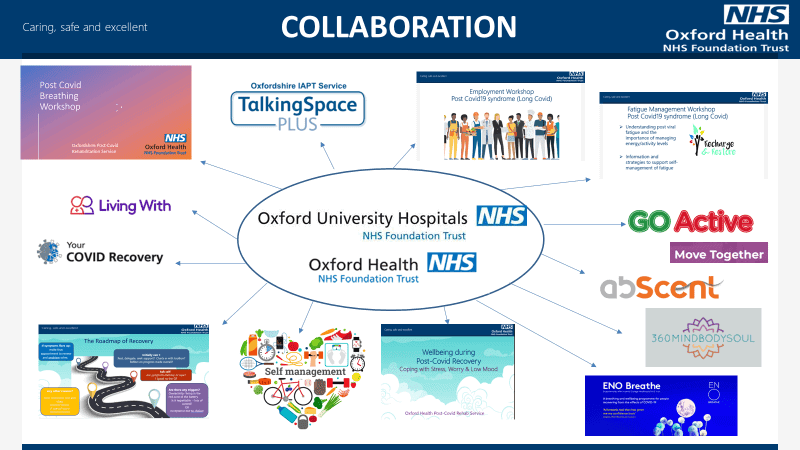
A collaboration of services and stakeholders evolved, facilitating the development of a service that was both large enough to meet the growing demands, but also fluid enough to grow and adapt to new research findings, listening and learning from clinical experience and most importantly responding to the patient voice.
In response to growing referral rates and waiting times virtual workshops were established to offer patients education and self-management strategies in breathlessness and fatigue, led by Respiratory and Fatigue Specialists. By August this had increased to also offering specific sessions supporting return to work and education around legal aspects and management tools to enable a successful return to work. In November we piloted our first ‘Overcoming Obstacles and Maintaining Progress’ course. This was developed and run collaboratively by Post COVID specialists with a CBT therapist, aimed at patients that struggle to utilise the self-management strategies effectively, and more recently included a Well-being workshop to introduce skills to aid management of psychological health affected by experiencing long COVID.
Digital applications were researched, and the team implemented the use of Living With COVID recovery. This app meets the needs of both clinicians and patients, offering a symptom tracking ability for patients, a communication platform, data collection and an easy to access resource library,
The team has developed strong links with external agencies including ENO Breathe, yoga communities and local Move Together initiatives.
Fortnightly MDT meetings were established to discuss and plan care for complex patients – with members from Rehabilitation Medicine, psychological therapies, respiratory and fatigue specialists.
Impact
The Post COVID rehabilitation service has provided a personalised, multi-professional and needs met approach to over 1000 patients in the 18 months. To achieve this, mode of delivery, expertise of clinician and expectations of patients are all variables that have adapted and continue to evolve to meet this need. In this delivery of rehabilitation, we have worked with local initiatives and charities, funded external companies to support and research concepts, and will continue to transform to meet both local and national requirements.
Patient feedback was recognised as being of great value within the service and has been reflected while evolving methods of service delivery. In Oxfordshire the I Want Great Care system is used to collate feedback. This was reviewed monthly, and changes and responses were made in a timely manner as reasonably possible.
Between January 2021 and June 2022 the service received 156 detailed narratives to assist in the service development. It was rated 4.84 out of 5 stars in this time period with 98.7% of patients reporting a positive experience.
Most common themes when asked ‘what would you like to see improved?’ included:
- reduced waiting times,
- ability to see medical professional,
- joined up working,
- education to GP’s and wider teams regarding long COVID presentations.
The collaborative team of multidisciplinary professionals delivered webinars to GP’s, Acute Trust Medical teams and Community Care colleagues to educate about the nature and presentation of this syndrome. The establishment of virtual workshops enabled patients to be seen and managed in a more timely manner, within a shared and mutual environment with other individuals in similar scenarios, enabling patients to understand ‘they were not alone’.
Positive feedback received was beneficial for the well-being of our clinicians in the absence of established validated outcome measures in this population, demonstrating the quality of the care that we continue to deliver, with pressure to meet waiting list and patient demands. A summary of common words patients used to describe their experiences with the Oxfordshire Post COVID Rehabilitation Service is attached as additional supporting material.
Standing Out
This initiative was different. We needed to respond quickly and evolve almost daily to the changing scenarios and feedback received. The service pathways and team were able to act without the boundaries of reporting KPI’s and fixed service pathways – ensuring that the most appropriate and clinically effective care was delivered.
By rapidly evolving and moving with expectation and demand we have been able to establish a successful and respected multi-professional service that provides a model of service delivery to demonstrate how other conditions could be, and potentially should be, managed in the future.
The most recent NICE Guidance publication (December 2021), updated March 2022 titled: Managing the long-term effects of COVID-19, recommends a multidisciplinary approach to guide rehabilitation, including physical, psychological, and psychiatric aspects of management. In Oxfordshire we set out to achieve this and have been successfully delivering for 12 months. Our aim is to continue to deliver this whilst, maintaining clinician well-being, patient satisfaction and contributing to evidence based care.
The establishment of a collaborative and multi-disciplinary service from already established and overstretched services, demonstrates the ability to ensure that the needs of the patients are put first. Patient voice, feedback has shaped and evolved the service to ensure that it continues to meet the growing need and demand of this population. The service model and ability to listen and change, should be considered as pathways of excellence, ensuring that we manage all long term conditions in this manner.
Key Learning Points
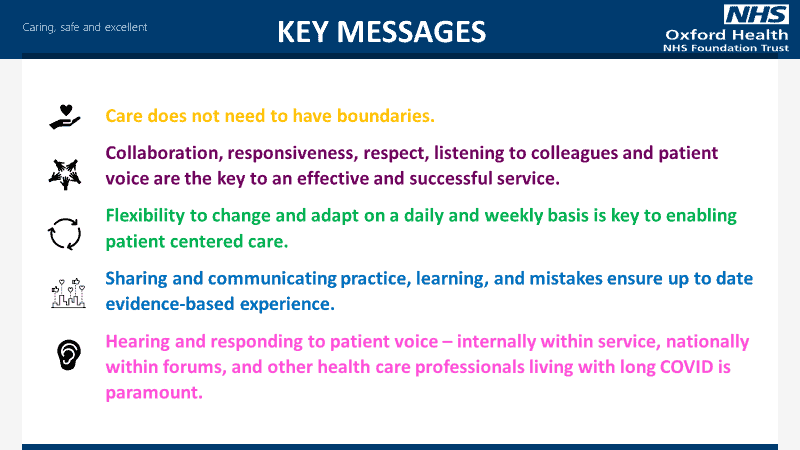
Over the past 18 months many professions, and certainly our team, have learnt that care does not have boundaries. A collaborative, responsive and respectful approach, listening to each other and most importantly the patient voice, has enabled the development of an effective and successful service.
Collaboration between acute and community Trusts, services and specialties is key to creating a service that puts the patient at its core.
Changing and adapting on a weekly basis based on clinician and patient feedback is a priority in the absence of structured protocols and guidance.
Sharing practice through the use of online forums, webinars and use of social media is paramount to ensuring that patients receive the most up to date and evidence-based experience.
Hearing and responding to the patient voice, from both a patient within the service experiencing long COVID, to health care professionals living with Long COVID has enhanced and developed research. Many Oxfordshire patients are involved in local and national PPV groups, ensuring that service development continues to remain integrated and holistic.
-
Co-producing a Long Covid assessment and support service for Kent and Medway
NHS Kent and Medway

Contact: Clare Delap - clare.delap@nhs.net
Organisation
This entry relates to the work carried out by NHS Kent and Medway Clinical Commissioning Group and partners to involve people and families in developing services for people with Long Covid in Kent and Medway. The Clinical Commissioning Group was the NHS organisation that planned healthcare services to meet the needs of the 1.9 million people living in Kent and Medway. We had an annual budget of around £3.5 billion in 2022/23 to provide the best possible care for the whole county.
On 1st July 2022 the Clinical Commissioning Group became the Integrated Care Board – NHS Kent and Medway.
Working with our health and care partners to recover from the challenges of the pandemic remains a focus for NHS Kent and Medway, including:
- reducing the number of people waiting for hospital treatment
- increasing capacity is diagnostic and treatment services
- supporting general practice manage very high demand
As an Integrated Care Board, NHS Kent and Medway will continue ensure that Long Covid services are provided for our population.
General Summary
More than 900 people with Long Covid have been involved in co-producing a new service for Kent and Medway. At the start we knew very little about this condition. By putting people with lived experience at the centre of the design process we were able to put resources into what mattered to them. Patients now oversee delivery and determine next steps.
The Post Covid Assessment Service achieved the aim of developing a multidisciplinary assessment – seeing more than 1,800 patients in its first year. Working with a patient reference group we have developed plans for an enhanced service: more local face-to-face appointments, case management, more mental health support and peer support groups. Each service development is planned through a dedicated delivery network comprising partners from across health and social care and voluntary and community sector organisations, as well as patients, making sure the services are realistic and sustainable.
People involved feel listened to and valued and tell us taking part has been important for their own health and wellbeing. Long Covid co-production provides a blueprint for how we will work with people in future in our new integrated care system.
Rationale
Some people who get Covid-19 experience long-term symptoms including pain, fatigue, shortness of breath, confusion, and memory problems (commonly called brain fog) – this is known as Long Covid and it can be life changing.
In 2020, knowing very little about this new condition, we sought to work with people with Long Covid and their families, as well as healthcare professionals caring for them, to drive the plans for a new service. Involvement was urgently needed because we were receiving comments about the lack of support for people, and because we knew bringing people together with health care professionals would make a much better service.
There was little evidence about the scale of the condition. In early 2021 national figures showed as many as 1-in-10 patients were finding the recovery from Covid-19 prolonged and difficult.
The latest predictive models – from January 2022 – estimated 10 to 13% of cases of Covid would result in long Covid equating to 11,000 to 14,000 patients in Kent and Medway.
Our initial aim was to listen to people’s experiences and to feed these into the development of an assessment service
Planning
Teams from the Clinical Commissioning Group (CCG) worked with Healthwatch, clinical leads and patient experience teams at local hospitals to involve people in planning and delivering Long Covid services.
Stage one co-production, March 2021 – May 2021: Learning together about Long Covid
To hear from a range of residents with Long Covid as well as their carers we reached across Kent and Medway through:
- a call out for evidence through social media, local press and bulletins and GP, hospital and council websites
- Healthwatch discussion groups
- an online survey – advertised widely through social media
- three well-attended patient experience workshops –including question and answer sessions with clinicians
- focus groups and interviews run by community groups targeting people from black and minority ethnic backgrounds.
512 people told us Long Covid was having a devastating impact on their lives. For many this was the first time someone believed them about the scale of symptoms. People urgently needed expert assessment and support and they also called for an information campaign.
Stage two co-production, June 2021 – April 2022: People driving delivery
The multidisciplinary Post Covid Assessment Service (PCAS) was established in May 2021 by a local GP Federation meeting a key requirement from people with Long Covid. PCAS was the largest service of its kind in England.
We wanted to involve people directly in overseeing the new service and further planning so we:
- recruited a patient reference group, which met regularly with commissioners and clinicians
- drafted a work plan based on the recommendations made by patients and families
- established the Long Covid Delivery Network – led by the Covid clinical lead including representatives from hospitals, GPs and voluntary and community sector partners
- involved patients in the delivery network meetings
- Sent out regular updates through public bulletins and websites
- made a film with people with Long Covid about their experiences.
Stage three co-production, April 2022 and onwards: From assessment to rehabilitation support
Based on the recommendations from patients and families, the delivery network started to plan for an ‘enhanced rehabilitation and support service’. To keep people at the centre we:
- conducted workshops with the patient reference group to design requirements for an enhanced service
- carried out a further extensive survey across Kent and Medway reaching into communities
- started to involve people in the procurement of a new service – people with lived experience assessing proposals from potential providers.
We have heard from more than 400 people so far about what should be in the new service specification.
Impact
The services created for people with Long Covid have been driven by their experiences and priorities. Direct impact includes:
The Post Covid Assessment Service
Since April 2021 PCAS has received 2,009 referrals. 1,148 patients have been discussed as part of the multidisciplinary team process, 355 patients have been discharged and 1,292 have had onward contact with referred services.
The Patient Reference Group told us there needed to be more contact with patients due to the fluctuating nature of the condition and to help manage multiple referrals. Funding was provided so that PCAS case managers could be recruited to check in regularly with patients and help with referrals.
Education
People wanted the clinical workforce and employers to understand and recognise the condition. We ran GP and hospital staff training events, putting patient and family experience directly in front of clinicians. Reference group members also made a widely circulated film with one major local employer using it for staff training. Over 90% of all GP practices in Kent and Medway have made a referral to PCAS – demonstrating the success of the awareness-raising.
Patient- led peer support
People told us that speaking to others with similar experiences was essential to their progress. The CCG worked with voluntary and community sector organisations providing ‘social prescribing’– they have set up the first groups, others will follow.
Pathways of care
A fully developed end -to-end pathway for people with long covid in Kent and Medway was signed off by the CCG’s Clinical Cabinet Board in January 2022. Designed by the Long Covid delivery network it follows directly the priorities of patients and sets out the services which will be provided for patients. The ‘enhanced services’ which are currently being established will be assessed by patients to make sure they follow this pathway.
The Future – Co-production is firmly established as part of planning and implementing Long Covid services in Kent and Medway. The patient reference group continues to meet with leaders and with clinicians, further outreach work through surveys and workshops has just taken place and we continue to work across all our communities.
The Long Covid Delivery Network ensures buy-in from across the health and care system and that plans meet national guidance and best practice.
We expect to have local providers of an enhanced Long Covid rehabilitation and support service in place by the end of 2022. The focus for this service follows the priorities people have told us about including a local face to face assessment, more emphasis on rehabilitation, ongoing case management, more mental health support.
NHS Kent and Medway wants to work in this way across all services. An ambitious Engagement Strategy commits the new integrated care system to a gold standard of co-production – rolling out the Long Covid model across the county.
We can demonstrate that people with lived experience can be constructively involved in developing a service – even for a new and unknown condition during the difficult circumstances of a pandemic.
Living with Long Covid: https://vimeo.com/660435267/44e8f5ef44
Being Involved with Long Covid Co-production: https://vimeo.com/726117729
Standing Out
Long Covid co-production is an ambitious step forward, moving from one-off limited engagement to sustained outreach and involvement. People’s lived experience were embedded at each stage from understanding a new condition together, through to delivering a model of care – at each point we fed back to people.
A strong cross-organisation delivery network and senior level ownership from the CCG ensured we could act on what people told us in a realistic way. The patient representatives on the delivery group provided a key focus point – colleagues concentrated entirely on delivering what was important for people and their families.
Co-production ensured a work plan and a framework which is sustainable and co-owned. Those involved report feeling listened to and valued and the process has helped them personally:
“Having the ability to talk to other patients, doctors and other health professionals has been a lifeline… We are all learning about this new illness and… we all learning from each other. Our point of view is being taken seriously and action takes place from that.”
(Darren, patient representative)
“It has been an emotional experience … but it has also been an enormously rewarding part of my career and bought me back to a core value of the NHS: To create services that respond to patients experience rather than what we the ‘professionals’ think people need.”
(Abigail, senior CCG manager)
Key Learning Points
- People who experience a health condition understand it best
- Involve people early and plan for ongoing engagement – it grows in value
- Be creative in how you reach out to people – offer a variety of approaches to make sure engagement is based on the experiences of as many communities as possible
- Make sure you have senior buy-in and a strong delivery and decision-making structure
- Regularly touch base with people– how is the process working for them, what do they want changed?
- Be honest and treat people like adults – explain why you cannot do everything straight away
- Ensure there are outcomes based on the patient experience.