
Patient Experience Network
PEN Case Studies
-
A coproduction partnership to improve the sexual health of people of African and Caribbean heritage
Common Ambition Bristol

Contact: Bristol Health Partners - hello@bristolhealthpartners.org.uk
Organisation
Common Ambition Bristol (CAB) is a programme initially funded by The Health Foundation, in partnership with:
Brigstowe (lead partner): Bristol-based HIV support charity with strong track record of involving people living with HIV in design and delivery of services.
African Voices Forum: network of community organisations from different cultures and faiths aiming to amplify voices and empower people to take part in policies and initiatives that concern them.
Unity (NHS): Bristol’s integrated sexual health service; includes STI and HIV testing and treatment.
University of Bristol: responsible for formative and summative evaluations plus iterative measurement and feedback to improve programme delivery.
Bristol City Council Public Health: has city-wide sexual health commissioning and wider public health role facilitating community and institutional engagement, ensuring ‘whole systems’ approach to delivery.
Bristol Health Partners: strategic collaboration between universities, providers, commissioners, councils and people with lived experience, which provides a mechanism for change in our health and care community.
General Summary
CAB is working in equal partnership with African and Caribbean Heritage Communities (ACHC) and sexual health professionals to co-produce new ways of increasing HIV awareness and testing and tackling HIV stigma.
New thinking: CAB has invested in a holistic ‘co-production plus’ approach, and applied this to a challenging, highly stigmatised area of health amongst an underserved community. This approach goes beyond the core principles of co-production: putting lived experience in the driving seat and championing community involvement across the system.
Leadership: Senior leaders from partner organisations play an active role alongside community members, inputting to advisory and project meetings, providing oversight and support, enabling system change to ensure that decisions can be implemented quickly. Partners come together to provide leadership and direction.
Outcomes & Sustainability: CAB is co-producing adoption and spread strategies to share learning across the system. CAB is working closely with commissioners to ensure that knowledge generated is included in the service specification developed for the local sexual health service recommissioning process. Partners are networking out to embed new knowledge and ways of working.
Involvement & Inclusion: CAB takes pride in embedded community involvement. Community members lead the delivery of the project: from outreach to setting up two dedicated clinics. The project co-ordinator, outreach workers and community researchers are all from ACHC. CAB is committed to empowering the community and using learning to address inequalities faced by those who use sexual health services and beyond.
Transferability & dissemination.CAB is ensuring that learning from the programme is disseminated locally and nationally. Team members are meeting and discussing with, and presenting and publishing to, diverse stakeholders from academia, health and care, local authorities, community groups.
Rationale
HIV inequities persist among UK African and Caribbean heritage communities (ACHC) in the UK, leading to disproportionately high rates of HIV, late diagnosis and limited access to HIV testing and pre-exposure prophylaxis (PrEP). The Common Ambition Bristol project aimed to tackle these inequities, by co-producing and co-delivering interventions with the ACHC to reduce HIV stigma and increase HIV testing and access to PrEP. The four CAB interventions involved multimedia resources; targeted health promotion; community outreach; and accessible testing.
African and Caribbean heritage communities (ACHC) are disproportionately affected by HIV in the UK. In 2021, 37% of new HIV diagnoses among heterosexuals in the UK were from ACHC, despite ACHC making up only 4% of the population. In 2021 the proportion diagnosed late was highest among people of Black African ethnicity (55%) with negative consequences for health. The government set a goal of ending new HIV transmissions by 2030. Their 2021 HIV Action Plan emphases addressing ACHC HIV inequities and recommends i) culturally sensitive education programs, ii) reducing HIV stigma, iii) culturally sensitive community testing and iv) supporting community led initiatives.
Planning
CAB is based on co-production. A Project Delivery Group (PDG) of community members is working with sexual health professionals to help decrease HIV stigma and increase testing. The PDG is designing and delivering interventions, including community outreach, targeted health promotion and ACHC-specific sexual health testing clinics. Community researchers are evaluating how effective these interventions are.
The interventions are guided by research about how to change behaviour. They aim to lower HIV stigma and increase HIV testing and people using PrEP.
- – Multimedia resources – CAB film, printed materials, radio adverts, and website that includes information on sexual health, HIV, HIV myth busting and testing options
- – Targeted health promotion – CAB community-based events, combining education and a social space where HIV was openly discussed.
- – Community outreach – CAB outreach team weekly sessions attending more than 30 ACH business, providing testing social role models, distributing instant HIV self-tests, CAB condoms and promoting the CAB website and clinic.
- – Community accessible testing – dedicated CAB drop-in ACH community sexual health clinic, and changes to existing NHS sexual health services.
Impact
The EIDO leaflet is used by trusts throughout the UK, thus sharing learning outside of the organisation. There have been no further local complaints received relating to this issue since interventions have been implemented. Additionally the most recent patient survey (2017) indicated that 100% of patients were either completely satisfied or satisfied to some extent with the consent process for this procedure. The team have also introduced ongoing monitoring of patient awareness of how to withdraw consent through annual patient survey.
Patient Satisfaction Survey Results
On average around 100 patients are surveyed per year, about their experiences at the endoscopy unit. Patient comments:
“The leaflet explained the procedure in a manner which was easy to understand” – Annual Survey 2017.“I found I understood all of the information given out. Very satisfied with everything given”
Annual Survey 2017.“Full information provided by Consultant and information leaflet about the procedure” Annual Survey 2017.
“It wasn’t explained to me, but the leaflet said you could put you hand up to stop the procedure”
Annual Survey 2017“Withdrawal of consent was discussed prior to procedure in the treatment centre – private room”
Annual Survey 2016“The information was in the leaflet, I cannot remember being told verbally, but I’m not quite sure”
Annual Survey 2016Relevance to Others
HIV and sexual health are still taboo subjects in many marginalised communities, not only ACHC. These communities are not homogenous but have varied intersectionalities. Each area of the community CAB works with has its own needs and challenges, but all deserve equity, and good service provision.
CAB is powered by the community, with the elevation of the community at its heart. As the programme has progressed, it has impacted on many lives. CAB has improved knowledge, increased wellbeing, improved health, empowered communities and impacted inequalities.
These impacts normalise this way of working in future. The programme tackled life-changing areas, both within a specialised and heavily stigmatised medical field, and navigating the complexities and intersectionalities of race, discrimination, inequalities, inequities and social deprivation. The work is nuanced, creative, essential, and important.
CAB is keen to recognise the input of community members, who are using their connections, knowledge and time to ensure that the work resonates with and is accessible throughout the community.
The programme team is committed to continuing dissemination of this learning by developing a robust adoption and spread strategy: taking every opportunity to share learning, transferable across health condition areas, and to different geographic areas working with ACHC.
Standing Out
CAB’s community members are not just members of their respective communities, but a valued and indispensable part of CAB. Their involvement has been vital to the success of CAB, enabling a sustainable, authentic and valued programme of work that resonates with the community.
Community member involvement has proved a valuable two-way learning process. Being part of the programme is enhancing their skill set, knowledge, and ability to influence. In turn, researchers and health professionals have been exposed to, and embraced working in different and culturally sensitive ways.
One of the reasons for the project was the lower rates of HIV testing amongst ACHC. Through ideas from our paid Community Members, we have increased attendance at our drop-in testing clinics which are now regularly full, with extra people being given a postal testing kit. This huge success has been achieved through the dedication and commitment of all the partner organisations and individuals involved in CAB.
Key Learning Points
Representation matters: Representation, in every sense, is crucial in any programme that works with marginalised communities. It has an impact on partner organisations, which must consider their level of representation internally and externally if they are to become part of the solution not the problem.
Co-production must be meaningful: CAB is based on genuine co-production, which involves active participation of individuals and communities in designing, developing, and implementing interventions, services, or initiatives through equal and reciprocal relationships.
The team has conducted interviews and observations and has learning to share based on over 4 years of meaningful co-production. This includes issues around shared decision-making, power-sharing, roles, responsibilities, communication and capacity-building. Community members must be paid to facilitate and value their involvement.
Trust and relationships take time to build: Time is required to build trust and relationships, particularly when working with groups experiencing systemic discrimination.
Leaders must buy-in to change: Senior leadership involvement is crucial to enable system change and resource allocation and respond to the voices of those involved.
-
The Carers Lounge
Bedford Hospitals NHS Foundation Trust
Organisation
Carers in Bedfordshire (CiB) is a registered charity founded in 2004, to help unpaid family carers and former carers cope with the mental and physical stress arising from their role, through assistance such as information, advice, support, advocacy, training and practical help. CiB is a network member of the Carers Trust, and affiliated to Carers UK. CiB have approximately 41 members of staff and 80 volunteers, 32 of which are carers. Bedford Hospital NHS Trust is a 360 bed high performing acute district general hospital serving a population of approximately 270,000 across Bedfordshire and surrounding areas (a 900,000 catchment for vascular services) and an annual turnover of approximately �168.5 million. The Hospital has annual activity levels of:
- 68,000 A&E attendances
- 3,800 planned inpatient admissions
- 23,000 day case admissions
- 21,000 non elective admissions;
- 213,000 outpatient attendances
- 2,900 births
General Summary
Often hospital is where people find themselves in the caring role for the first time, unsure where to turn. The Carers Lounge is an innovative partnership between Bedford Hospital, CiB, Bedford Borough Council (BBC) and Bedfordshire CCG, established to give carers visiting the hospital a safe, confidential, non-judgmental space where they can find support, information and advice. Support for the carer continues after the patient has been discharged. The Lounge Coordinator leads a team of support workers and volunteers, specialising in areas of support, including benefits, support for carers of children with additional needs, and for carers of individuals living with dementia. The coordinator keeps records of contact made with carers, which are reported to all stakeholders along with case studies. First fiscal year (2012 to 2103) the Lounge had contact with 427 carers, rising year on year to 2073 carers in 2014 – 2015, demonstrating a substantial impact. These have also been shared with others looking at starting similar projects.
Rationale
In 2010, the Government published a strategy to improve health and social care support for the UK’s 6.5 million carers. Priority areas were identified which form the key principles of the 2014 Care Act;-
- Supporting early self-identification and involvement in local and individual care planning
- Enabling carers to fulfil their educational and employment potential;
- Personalised support for carers;
- Support carers to remain healthy.
Carers need the knowledge and skills to care safely in a way that promotes wellbeing for the care recipient. The CEO of CiB’s business plan for the Carers Lounge at Bedford Hospital was also informed by the Moffat Project pilot in Scotland (2009-10) which placed carer support workers into hospitals and social work departments. The program aimed to get support for carers at an early stage, to advise carers of their rights and offer them a carer’s assessment, reduce the pressure on carer’s health, and involve carers in discharge planning.
Almost 3,000 new carers were identified and more than 3,500 health and social care professionals were trained in carer awareness. The directors of Bedford Hospital and the CEO of CiB recognized the importance of learning from this pilot and the need for a sustainable long term plan. They engaged Bedfordshire CCG and BBC as funding parties in the initiative and the hospital agreed to provide an area where carers could find information, advice and support. The Carers Lounge was born.
Planning
The shared aim was to ensure all carers coming into contact with Bedford Hospital were identified, directed to appropriate services, advised, and made aware of their rights. The partnership plan was to provide a base within Bedford Hospital with skilled staff to support carers. The business plan had a vision to deliver:-
- Identification of new carers
- Access to professional advice from the range of hospital services
- A quiet area for carers
- Referral and support for carers assessments
- Practical advice
- Welfare check on carers staying overnight
- Linking to end of life services, dementia, orthopaedics supportingcarers� involvement in discharge planning with a strong re enablementfocus
- Benefits checks
- Support for young carers
- Support for parent/carers of children admitted to the hospital
- And parent /carers of adults
Christina Offord was employed as the Carers Lounge Coordinator to deliver this initiative. She consulted with carers and attended carers groups. Feedback suggested the Lounge should have opening times to cover visiting hours and times out-patients departments operate. It should be accessible to carers in daytime employment, without the need of a referral or appointment. Carers said the service should be reliable, sustainable and robust and cater for their often overlooked needs.
Impact
Since the Lounge opened in 2012, 5653 carers have been contacted, 4252 who were carers unknown to any other health or social care service, and may otherwise have remained unidentified. Carers were informed of their right to a Carers Assessment and offered benefits advice. Carers feedback informed a Carers Charter and Carers Information Pack which were launched in the hospital to provide carers with knowledge of what is available and their rights.
- The average age of carer using the Lounge has been over 65
- Common conditions were stroke, mental illness, heart disease, COPD and dementia.
- 62% were women and 38% were men. Carers contacted through the Lounge are recorded and each return visit is counted.
We record if the carer has received benefits advice or been referred for a carers assessment. Statistics are shared with hospital directors and funders, to evidence the value and importance of the Carers Lounge. Example in additional information. Qualitative feedback is collected through carers self-reporting and case studies to ensure soft outcomes are collected.
Standing Out
The plan is for
- Bedford Lounge to become firmly embedded into the internal structure of the hospital, as much as the x ray department.
- For Lounges to become part of the internal structure of more hospitals. Nearby hospitals are following our initiative, and CiB opened a Lounge in the Luton and Dunstable Hospital in September 2015.
- Lounges have also been opened in Stoke Mandeville, Milton Keynes and Lister Hospital. Kettering and Watford Hospital have also now followed.
- Bedford Hospital is looking to increase the space the Carers Lounge operates from. This includes a second room that can be used as a private area for services such as benefits advice and counselling.
- Other plans include supporting the carer more through discharge, and continuing that support in the community to help reduce hospital readmissions. One study found that problems associated with the carer contributed to readmission in 62% of cases.
- Carers of people readmitted were more likely than other carers to:
- – be experiencing ill-health, fatigue and interrupted sleep;
- – be conducting at least one intimate task;
- – Generally feel frustrated.
- Our vision is to make an impact on readmissions locally.
The Carers Lounge initiative is one of the first of its kind, achieved through an innovative partnership between statutory services, the voluntary sector, and the local community, with proven results in identifying unpaid carers and keeping them informed and safe. Carers save the government 139 billion pounds a year. Initiatives like the Carers Lounge help give carers recognition, within communities and with professional staff. If we help support carers then we help to reduce pressures on hospitals and re admissions. The Carers Lounge is unique and different from other projects, with key success factors –
- – it came from a shared vision
- – determination to make it a reality
- – having the Lounge firmly embedded, physically and working in partnership with the
Key Learning Points
Key learning for lounge projects are
- – The need for persistent promotion and raising awareness
- – Staff within the Lounge need to be resilient, reliable and robust
- – The need to build trust within the hospital to maintain momentum
- – To be able to offer a consistent service.
- – Other parties interested in doing something similar, should consult and value carers and take their views into account. The carers are at the heart of the success of the Lounge, they helped to shape the Lounge following consultation at carers support groups. Carers asked for the Lounge to be easily accessible.
- – The Carers Lounge is managed as a drop in. Carers do not need an appointment or to be referred. Hospital staff use the services at the Lounge either for themselves or to direct carers to.
- – The use of reliable volunteers to visit the clinics and wards and promote the services offered at the Lounge directly to carers has been an invaluable way to raise awareness, in addition to the posters, leaflets and giving talks to staff.
- – We have also continually improved the Lounge space to create a welcoming area that combines comfort and professionalism. Information on the Carers Lounge is shared on Bedford Hospital’s and CiB’s website, along with other publications such as the Carers Information Booklet.
-
The Story Shop - Bringing Mental Health Stories to Life
Nottinghamshire Healthcare NHS Foundation Trust

Organisation
Nottinghamshire Healthcare is a major provider of mental health, intellectual disability and community healthcare services for the people of Nottinghamshire. We provide services across the county for people with mental health needs, with needs relating to drug or alcohol dependency, mental and physical health services for people with intellectual disabilities and community physical healthcare. We also provide secure mental health services. We see about 190,000 people every year. Our 8,800 staff carry out a wide range of roles, working together to provide integrated and coordinated care and support to those using our services.
General Summary
Nottinghamshire Healthcare’s Story Shop programme brings the stories of people suffering with mental ill health, and their carers, to life in a way that challenges stigma and promotes understanding and acceptance. Our service user volunteers generously commit both their time and their personal stories, our staff dedicate real skill and sensitivity to facilitate the conversations and our Board and Executive Leadership Team back the programme, all recognising it’s power and importance. It innovates in the way that it enables safe, honest and intimate conversations that encourage inquisition. Evaluation has shown overwhelming praise for the initiative, and we believe that it serves as a model which could be used to challenge a wide range of prejudice and stigma and to invite professionals into the field of mental health.
As the major provider of mental health services in our region, it’s important that we help to tackle the stigma that surrounds mental ill-health. We believe that by challenging stigma, we can encourage the people to talk about mental health as they would any other health concern, and that this will result in earlier treatment, less isolation, better understanding and more focus on recovery. We were aware of the Human Library, which aims to challenge prejudice through social contact by positioning people as books and allowing others to speak with them and ask questions. Social contact is known to be one of the most powerful means through which stigma can be tackled (http://bit.ly/1TgsdwV). We translated this idea to nurture conversations between our service users and young professionals, staff and the public. Our intention was to sensitively facilitate the kind of contact that would encourage people’s inquisition and support our service users to share their stories safely. From this The Story Shop was developed and created. All of the terminology and protocols that we use were developed in partnership with service users and carers and have contributed to its success, but also the sense of ownership that those taking part feel.
We began with medical students. They are an important audience because they are the primary contact for someone struggling with mental health issues and we are aware that there is only a very small proportion of medical training that covers mental health. We wanted to ensure they had a good rounded understanding of mental health and the many issues that come with it. Our Stories talk with students prior to them choosing their career pathway i.e. GP, with the hope that the students will then look at mental health in a totally different way and begin to understand the wide range of complications they cause in everyday life, and will appreciate the recovery journey taken.
We incorporate the carer perspective to ensure that students understand and consider the whole picture. We know that nationally there is a shortage of psychiatrists and the Migration Advisory Committee (MAC) added Core Psychiatry Training to the shortage occupation list in 6 April 2015 and we aim to show that treating, supporting and helping people with mental health issues is interesting, rewarding and hugely worthwhile.
Planning
Daniel Tsoi Consultant Psychiatrist and Clinical Teaching Fellow & Associate Clinical Subdean at University of Nottingham approached The Story Shop Team in 2013 with a view to working together. We now deliver one Story Shop session to each cohort of 4th year medical student during their mental health training (four a year). This work continues and a request from the Medical School to double the number of sessions that we run is currently being discussed.
Daniel Tsoi said The Story Shop is very useful and it really helps students to see the other side of mental health. Students can often become focussed on the pathology and the Story Shop gives them a totally different perspective and see the recovery that is possible. It is important that that they also get chance to speak to carers and their role in mental health, and how this isn’t just about the medical but how vital the social aspect is to people’s recovery.
The Trust Board has always supported The Story Shop, from the very beginning it was signature strength of the Trust’s anti-stigma campaign and since then has been more widely embedded as part of the Trust-wide Involvement & Experience Strategy. In partnership, we decided right at the start that we were a team working together service users / carers and staff.
A Story Shop Steering Group was formed and decisions made on how we:
Engage with a Story – We have regular talks with our volunteers about the Story Shop explaining the process, from this we identify a possible story teller.
Write a Story – We ask the volunteer to write their story in their own words, with a start, a middle and an end. We meet with this person several times talking through what they have written (and usually what they haven’t) and between us we develop a story starting from the beginning of their mental health journey to where they are at present. We usually have the very long story, we condense this into bullet points to help volunteers when telling their story.
Train a Story – We spend time talking through the expectations of being a story explaining that the experience is interactive and you are not only telling your story but that you must listen to questions asked and feel confident to answer honestly. We ensure you ready to tell your story, talk through what to expect and how you may feel and what to look out for. Ultimately our Stories are in charge and at any time they can stop a session should they wish to. We ask all our Stories to read and sign a Story Shop Contract this is an agreement explaining how we will keep them safe and what is expected, also contact details for an emergency.
Support a Story – Before a session all the stories and the member of staff meet up and talk for half an hour about how we are all feeling; this is where the staff member will recognise if a story is feeling vulnerable/emotional. Time will be spent with this individual ensuring that they are happy to go ahead with their story, we go through the signals we use when in a session so that the story is relaxed and emotionally prepared. During the session the staff member makes sure all Stories are facing them so that at all times the stories face and body language is visible, the staff member continually walks around listening and watching ensuring that all the stories are coping and feel comfortable and aren’t struggling in any way.
Keep safe signals whilst Story Shop in session – All Stories have bottled water and a pen on their individual table. During training we explain that at any time should they feel uncomfortable/under strain that they lift their pen and wiggle with it, the listeners are not aware that this is a signal but the member of staff is and will immediately go to the stories assistance. The staff member is extremely vigilant during each session and will notice any small change in a stories body language (this is extremely draining experience). A decision is then made if the Story wishes to carry on or take time out in another room where they can talk through how they are feeling.
Follow up aftercare of all Stories – At the end of day we all meet up again for a cuppa and talk through how we all felt the session went, how interactive were the young medical students, what did we all get out of it. It is at this point the member of staff will identify if anyone needs TLC. We will then talk with this person and ensure that they have someone they can talk to through the night should they need just to talk. The staff member will contact the Story over the next few days ensuring that they are emotionally feeling ok and will continue until they are happy that our Story is back on form.
Staff visit the venue before a session – Liaise with partnership staff ensuring they have an understanding of our values/rules and expectations. We always ensure the room is large enough for all our Stories to sit at a desk facing the organiser of the session. We expect a separate room for our stories to go if they become upset or unwell. We have access to toilets and kitchen facilities for refreshments.
All through the planning and delivering of the Story Shop, Service Uses / Carers and Staff work together!!!! At any time the staff member running the Story Shop or Story Shop Meetings has concerns about a Stories mental health it will be for them to decide if the Story should be used or be encouraged to take a break. As part of the training to be a Story, we discuss that both the Stories themselves have permission to stop at any time and we also give permission to those staff running the event that they can ask a Story to stop at any time; this is in the context of looking after an individual’s wellbeing . The Stories are the most important part of the whole process and without them we would just have an empty shop! De-briefing is always offered after an event, and because of the way that volunteers develop through the Involvement Centre, staff see volunteers that have taken part in a Story Shop regularly afterwards.
Impact
We measure the impact of Story Shop on our Stories by talking with them during an event and when we get together with new volunteers to inspire them to become Stories. We recognise it is a very powerful tool and that although sometimes our Stories are exhausted from this experience they are also exhilarated and get an enormous sense of wellbeing and pride.
The Story Shop works two fold, it educates and reduces stigma for those listening to the Stories but also for those Storytellers taking part it supports their own personal Recovery.
‘Gives my condition a voice; it helps me with my own personal recovery’
‘When I am talking about my story I can see how far I have come, what I have achieved in my recovery and how proud I should feel’
‘As a carer I feel it reduces stigma, opens up opportunities for carers to put their point over to the students who are our future medical professionals. It makes them think about the role of the carer and the importance of listening and understanding their needs. It educates, one comment from a student was ‘I never really thought about talking to carer’ which says an awful lot.
To measure impact on the students The Story Shop Steering Group developed a questionnaire for each student to fill in on completion of each session. A set of questions with answers 1 to 5 are asked; students circling their answer, we then put this information on to a spreadsheet which results in simple pie charts showing by percentage how the Story Shop has impacted on them. In 2015 86% of medical students agreed or strongly agreed that it helped them appreciate the concept of recovery in mental health. 96% agreed or strongly agreed it helped them to understand different dimensions of mental health and 91% agreed or strongly agreed that it helped them recognise how stigma impacts on mental health. We also ask for comments which continually evidence the power of the spoken word and the effect of students listening/talking to Stories.
It’s the clearest and widest picture of mental health I’ve experience so far. Hearing from patients and carers who have extensive life experience of mental health gives more information and perspective than any other teaching method I’ve had so far.�
4th year medical student – Honestly, I am truly inspired by the people I have met. What they have all been through and where they are now, words cannot describe how touched I am. These people inspire me to be a better person, brought tears to my eyes. I thank-you all.
In August 2013 Stephen Kendall, DMS, MBA did a study on The Story Shop with a focus on the work being done with medical students titled; Can mental health stigma be reduced by interactions with the targets of the stigma? In this paper he concluded that although these students started off with a lower threshold of stigma compared to the general population their prejudices and stigmatising thoughts did reduce further after their interaction with Stories in The Story Shop. As far as we are aware we are the NHS Trust that run a long term project like this. Many organisations have picked up on the work of the Human Library, but we specialise in mental health in a way that the broader human Library cannot. Other Trusts do run one off events of a similar nature, but we have developed this and now maintain the project. We had strong links with the Human Library from 2009 to 2012 and we were responsibly for over a quarter of their loans nationally. Since we have developed The Story Shop it is unlikely that any other organisation can claim to have had face to face interaction with over 4500 people in any similar scheme.
Key Learning Points
- All ‘Stories’ have read and understand their Contract/Agreement which they have signed to enable them to partake in a Story Shop.
- Ensure all staff have an understanding of their role and what is expected of them on the day that they know and understand each individuals story and the person telling it.
- Monitor and watch carefully throughout each session, how each Story is and be able to stop any conversation should the Story become distressed, the welfare of the Story is paramount.
- Stories are regularly updated, life goes on and stories are ever changing. Try and have a start, middle and end to each story.
-
Improving our Colorectal Cancer Pathway Patient Experience
Nottingham University Hospitals NHS Trust
Contact: James Blackwell - james.blackwell@nhs.net
Organisation
Nottingham University Hospital Trust – With 15,000 staff, we are one of the biggest employers in the city with a central role in supporting the health and wellbeing of our local population. We play a leading role in research, education and innovation. We have a national and international reputation for many of our specialist services, including cancer services and we are the tertiary referral centre for colorectal cancer in the region. We operate upon approximately 250 patients with colorectal cancer per year, with many more patients having contact with our department via diagnostic, treatment or surveillance pathways.
General Summary
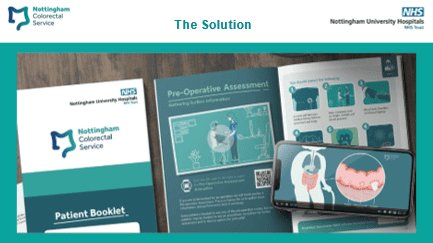
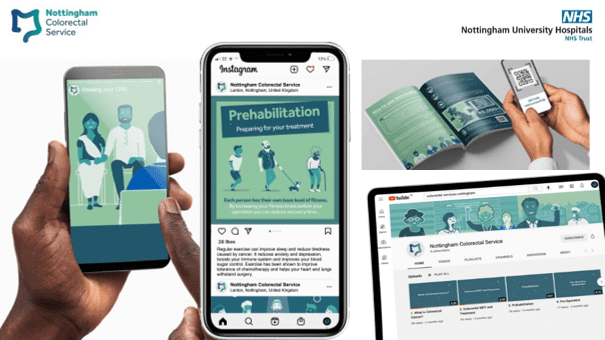
We have created bespoke, innovative and high-quality digital content (animations + social media) to guide and support patients through their colorectal cancer treatment journeys. Triggered by QR codes embedded in bespoke cancer patient pathway literature, this digital content condenses the huge quantity of patient literature previously given down to engaging, easy to share digital media.
Clear objectives and multi-level leadership have benefited this project. The governance group meets regularly and receives feedback from clinical champions within stakeholder working groups.
We report a 23% increased positive response rate (agree/strongly agree) to patient experience surveys. Our resources are in full clinical use and can all be updated in response to patient feedback and changes to clinical practice.
The design process centred around patient feedback and cancer survivor testimonials from the outset. We consulted multiple clinical stakeholders, working groups, addressed key elements of the pathway and connected discrete elements of the multi-disciplinary team. Since roll-out we have established continuous patient experience feedback.
Digital outputs from this project are fully transferable across the UK colorectal cancer population and indeed across other cancer groups. We have presented this project locally and are exploring dissemination via the colorectal expert clinical advisory group (ECAG) and Cancer Alliance.
Rationale
A pathway wide audit of our colorectal cancer service (externally commissioned via Johnson & Johnson) highlighted areas of excellence but also areas for improvement. The overall patient experience was highlighted as needing improvement. Concerningly, there were fundamental questions within the National Cancer Patient Experience survey where we fell below not only the national average but also standards we would want our patients or family to experience during contact with our service. For example Question 10: Patient completely understood the explanation of what was wrong, we scored 69% vs National average 79% and Question 12: Patient felt that treatment options were completely explained, we scored 78% vs National average 85%. We identified ten key questions requiring improvement having scored significantly below the national average. Our group felt that we should aspire to achieve 100% positive response rate to these questions.
We also saw opportunity to develop truly personalised stratified care, particularly during the period before treatment starts. In medicine this term is known as prehabilitation (like rehabilitation but before treatment). We wanted to develop an individualised risk assessment, targeting modifiable chronic health parameters, with measurable outcomes to target surgical risk factors.
We wanted to empower our patients to engage with their healthcare journeys. This requires clear communication, education about new diagnoses/how chronic disease increases their individual risk from surgery (and how we can support patients to modify this risk), whilst ensuring they feel fully informed and supported throughout. We wanted to improve the patients’ perception of continuity despite the huge number clinical/non-clinical staff involved in a patients’ care.
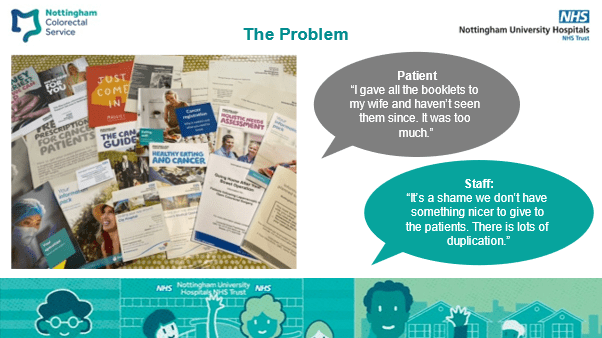
We are confident that our service delivers gold standard clinical care and it is important that this is reflected in the patient experience for both personal and professional pride across our workforce. Before this project patients received upward of >26 booklets upon receiving their cancer diagnosis. Many reported feeling overwhelmed by this and that the pages of written text were too much to digest.
We aimed to address the issues raised above by distilling current patient information into a single patient booklet, complimented by a series of informative/engaging animated videos. These resources guide the patient through their treatment journey from diagnosis to discharge and beyond. This addresses healthcare inequalities in those patients who have difficulties understanding written concepts and conveys large amounts of information in a visual format which is easily digested away from clinical environments.
Planning
A pathway wide audit of our colorectal cancer service (externally commissioned via Johnson & Johnson) highlighted areas of excellence but also areas for improvement. The overall patient experience was highlighted as needing improvement. Concerningly, there were fundamental questions within the National Cancer Patient Experience survey where we fell below not only the national average but also standards we would want our patients or family to experience during contact with our service. For example Question 10: Patient completely understood the explanation of what was wrong, we scored 69% vs National average 79% and Question 12: Patient felt that treatment options were completely explained, we scored 78% vs National average 85%. We identified ten key questions requiring improvement having scored significantly below the national average. Our group felt that we should aspire to achieve 100% positive response rate to these questions.
We also saw opportunity to develop truly personalised stratified care, particularly during the period before treatment starts. In medicine this term is known as prehabilitation (like rehabilitation but before treatment). We wanted to develop an individualised risk assessment, targeting modifiable chronic health parameters, with measurable outcomes to target surgical risk factors.
We wanted to empower our patients to engage with their healthcare journeys. This requires clear communication, education about new diagnoses/how chronic disease increases their individual risk from surgery (and how we can support patients to modify this risk), whilst ensuring they feel fully informed and supported throughout. We wanted to improve the patients’ perception of continuity despite the huge number clinical/non-clinical staff involved in a patients’ care.
We are confident that our service delivers gold standard clinical care and it is important that this is reflected in the patient experience for both personal and professional pride across our workforce. Before this project patients received upward of >26 booklets upon receiving their cancer diagnosis. Many reported feeling overwhelmed by this and that the pages of written text were too much to digest.
We aimed to address the issues raised above by distilling current patient information into a single patient booklet, complimented by a series of informative/engaging animated videos. These resources guide the patient through their treatment journey from diagnosis to discharge and beyond. This addresses healthcare inequalities in those patients who have difficulties understanding written concepts and conveys large amounts of information in a visual format which is easily digested away from clinical environments.
Public: We sough expert patient opinion from the colorectal expert clinical advisory groups (ECAG) patient liaison chair. This provided excellent insight into both his personal experience and lessons learnt on a regional level.
Delivery: We provided multiple staff education sessions frontline staff involved with the patient journey. We had a soft launch and three month pilot phase from February 2022. Cancer nurse specialists select appropriate patients to undergo the individualised risk assessment and they then receive the patient booklet.
Impact
An unexpected impact of this project has been upon staff groups not directly involved in clinical care (i.e. administrative support staff). They report greater understanding of the patient pathway and clinical terms used in patient correspondence. Staff report being proud to present patients with the booklet and believe it is a realistic representation of the care delivered.
Results (please see supporting evidence document):
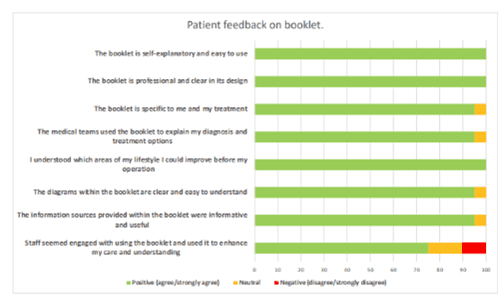
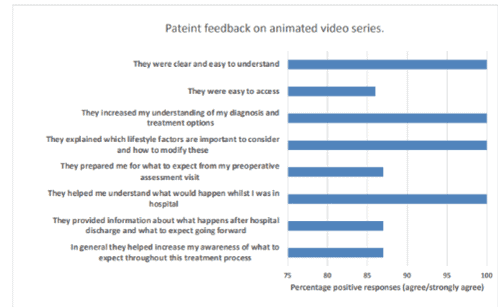
Forty-three patients have received the booklet to date (22 patients having completed treatment and follow-up). We report a 23% increase in positive response rate (agree/strongly agree) to the ten key questions, which would have correlated to a mean of 17% higher than national average.
Patient quote: “After hearing ‘cancer’ I glazed over. The booklet and videos helped me understand what was happening to me and helped me cope with the whole experience.”
Patient quote after using booklet: “I did find it really useful that I could input into it as well as the clinical stuff. Doing the activity diary, saying I needed to be as fit as possible for the operation gave me the green light to get back running and boosting my fitness level up so I could be ready for the operation.”
Staff quote: “Patients have been able to show family members, ‘this is my diagnosis and this is my treatment plan going forward’. This have helped everyone’s understanding”.
Standing Out
This pathway wide intervention was designed to improve the continuity of care for patients and staff. Many projects impact discrete elements of the patient journey, we aimed for an over-arching intervention which connected many smaller elements, creating a seamless patient journey to enhance patients’ continuity of care.
Striving to deliver individualised stratified care with the patient at the centre. We believe that we have displayed intention and delivery of this key recommendation of the NHS Long Term Plan.
Thorough consultation process which included canvassing opinion, agreeing the common goal and designing interventions/solutions that worked for all. The sheer number of stakeholders makes this project stand out from others.
The overall professionalism and design quality of our resources has received high praise as this is not always experienced with the NHS. Clear objectives with the patient experience at the centre has allowed us to make impactful resources which are engaging and informative to patients. Bridging the gap between clinical knowledge and patient facing information is key to patients understanding their conditions and treatment options.
Key Learning Points
Patients told us what information they wanted – always involve patients from the outset, listen and give them what they want!
Patients retain a limited amount of information once they are given a cancer diagnosis. Information we provide often looks poor, is outdated or undigestible. We had to look critically at the information we were giving out to make positive improvements.
Ensuring patient understanding and expectations are set at point of diagnosis and then met throughout their treatment journey is key to maintain high patient experience levels.
Engage a large group of stakeholders – this allowed us to look at pathway wide issues, many of which were aspects of care traditionally separately delivered (i.e. preoperative assessment and post operative care).
Engaging all staff, with a common vision and goal, remembering that every patient contact counts maximised the patient experience impact of this project.
-
The PaCT Workshop: Embedding Lived Experience in Nursing Education
Winner - Strengthening the Foundation - PEN 2025
Contact: Bimpe Kuti-Matekenya - b.kuti@greatermanchester.ac.uk
Organisation
The University of Greater Manchester is a growing higher education institution located in the North West of England (Main Campus based in Bolton), dedicated to excellence in teaching, research, and community impact. With a diverse academic community and over 900 staff members, the university supports a wide range of undergraduate and postgraduate programmes across health and social care disciplines. These include Nursing, Midwifery, Operating Department Practitioner, Paramedic Science, Physiotherapy, Sports Rehabilitation, Sports Medicine, Public Health, Social Work, Allied Health Professions, Dental Technology, Health and Social Care, and Medical Education.
The university plays a key role in preparing the future health and care workforce through innovative, interprofessional learning, active involvement of people with lived experience, and strong partnerships with NHS, local authorities, and the voluntary sector.
General Summary
The Patient as Coach Team (PaCT) initiative represents a transformative step forward in nurse education. Led by service users and carers, PaCT reimagines how student nurses learn about, connect with, and practise person-centred, compassionate care. By placing lived experience at the heart of its design, the initiative offers a powerful model of learning that supports the development of emotional intelligence, ethical awareness, and the values that underpin professional nursing practice.
In an era where healthcare systems are under increasing pressure to maintain dignity, empathy, and humanity in care delivery, PaCT stands out as a pioneering and innovative educational response. It is firmly rooted in the 6Cs of Nursing—
1. Compassion and Empathy
2. Dignity and Confidentiality
3. Trust and Honesty
4. Collaboration and Communication
5. Courage and Commitment
6. Competence and Expressing Emotion
It offers students an opportunity to engage in co-produced education shaped by people with direct experience of care. Rather than being passive recipients of care, service users and carers become educators in their own right, and are influencing the next generation of practitioners.
The PaCT initiative offers a bold and sustainable way to bridge the gap between theory and real-world practice. It humanises the learning experience, embeds lived experience as a vital source of knowledge, and helps to shape a workforce that is not only clinically competent but also grounded in empathy, dignity, and ethical care.
Recognising the value of PaCT is a recognition of what the future of nurse education must look like: one where compassion is not only taught, but genuinely understood, deeply felt, and consistently practised.
Rationale
The PaCT (Patient as Coach Team) initiative was developed in response to a growing recognition within nurse education that technical proficiency alone is not sufficient for delivering high-quality, person-centred care. There was a clear need to create structured, sustained opportunities for student nurses to meaningfully engage with the lived experiences of those receiving care, that is beyond simulated scenarios or abstract case studies.
Emerging from a desire to embed values-based practice at the heart of nurse training, PaCT was designed to humanise the learning process and challenge students to critically consider the real-world impact of their communication, attitudes, and behaviours. The initiative arose from shared efforts to co-produce education with service users and carers, ensuring their voices not only inform curriculum content but actively shape professional identity formation.
Planning
The development and delivery of the PaCT (Patient as Coach Team) initiative was rooted in co-production, bringing together academic staff, service users, carers, and clinical education partners to collaboratively design and implement a meaningful learning experience for student nurses.
Planning Phase-PaCT was initiated by Lead for service user and carer involvement and academic staff within the School of Nursing and Midwifery, to embed lived experience more centrally within the curriculum. A planning group was formed, comprising Programme and Module Leads, service users and carers with experience of health and care services, NHS Practice Education Facilitators. This group co-designed the thematic framework based on the 6Cs of Nursing and created workshop formats that prioritised psychological safety, accessibility, and relevance. Crucially, service users and carers were involved from the outset as equal partners, not just as contributors but as co-educators and designers.
Delivery Phase-Each session is delivered in small groups to promote open dialogue, reflection, and a safe learning space. Sessions are facilitated by trained service user and carer educators, supported by academic staff who provide logistical coordination, safeguarding, and reflective guidance.
- Service users and carers lead Stage 1 workshops, sharing personal narratives linked to the six core themes and encouraging open dialogue with students.
- Students engage in active listening, questioning, and reflection during the sessions, followed by Stage 2, where they complete a structured Reflective Learning Worksheet aligned to the themes discussed.
- Academic staff arrange the sessions, ensure alignment with curriculum learning outcomes, and support facilitators before, during, and after the workshops.
- Feedback loops are integrated into each cycle—students, facilitators, and staff provide input that informs future session refinement and planning.
The whole process is underpinned by a commitment to valuing lived experience as expertise, with service users and carers compensated for their time, contributions and offered opportunities for training and development. This collaborative model has created a culture of mutual respect and continuous improvement, enabling the PaCT initiative to thrive as a sustainable and impactful part of nurse education.
Impact
The impact of PaCT was formally evaluated and published in Kuti and Houghton (2019), which explored student nurse perspectives on service user involvement in teaching. The study used a qualitative methodology, including focus groups and reflective narrative analysis, to assess the impact of the PaCT sessions. The article below details the measure, data fathered and results of evaluation of the PaCT session.
Kuti, B. and Houghton, T. (2019) Service user involvement in teaching and learning: student nurse perspectives. Journal of Research in Nursing.23(3-4) pp. 183 – 194
Key findings from the evaluation highlighted:
- Increased awareness among students of the real-world impact of their behaviour and communication on patients and families.
- Improved confidence in navigating complex situations and responding to service users with greater sensitivity and care.
- A stronger sense of accountability and professional values, with students reporting that the sessions challenged their assumptions and influenced their practice placements.
- Evidence of long-term impact, with students integrating learning from PaCT into their ongoing reflections captured within their Personal Development Portfolios.
The Future
The continued success and sustainability of the PaCT (Patient as Coach Team) initiative is underpinned by its strong institutional integration, co-production ethos, and commitment to continuous improvement. PaCT is firmly embedded across all three years of the adult nursing degree programme, ensuring its longevity as a core component of students’ educational journey. Its alignment with professional standards and values (such as the 6Cs of Nursing and NMC expectations) further reinforces its relevance and necessity in pre-registration nurse education.
A key feature of the initiative’s sustainability is the ongoing feedback mechanism built into its delivery. After each session, students, service user facilitators, and academic staff contribute to structured feedback forms and reflective discussions. This real-time input drives iterative refinements to workshop content, delivery methods, and support structures—ensuring the model remains responsive to changing needs and experiences.
To support future growth, we are actively recruiting more diverse service user and carer volunteers from the local community through our public and community engagement work, to further build facilitator capacity and confidence. We are also exploring interdisciplinary expansion, adapting the PaCT model for wider application across midwifery, social work, allied health, and medical education programmes—several of which are already piloting values-based, co-produced sessions inspired by the PaCT framework.
The initiative continues to benefit from institutional backing, with academic leads, curriculum planners, and quality assurance teams recognising its value. We have been highly commended by the NMC, during programme validation about the PaCT initiative. Its reputation as a model of excellence in co-produced education positions it well for future investment, partnership, and dissemination across the wider health and social care education sector.
Ultimately, the enduring strength of PaCT lies in its ability to evolve while staying true to its founding principle: that those with lived experience are not just voices in the room—they are educators who shape the professionals of tomorrow.
Standing Out
What makes the PaCT (Patient as Coach Team) initiative stand out is its deeply embedded, co-produced design that elevates the role of service users and carers from contributors to educators and facilitators. Unlike traditional approaches that feature lived experience as occasional input, PaCT is longitudinal, embedded across all three years of the adult nursing programme, and directly aligned with professional values and regulatory expectations.
Its success lies in several key elements:
- Authentic Co-Production: Service users and carers co-design, lead, and shape the learning, ensuring their voices are central, not tokenistic.
- Structured, Reflective Learning: The two-stage model—immersive workshops followed by reflective worksheets—balances emotional engagement with critical thinking, encouraging personal and professional growth.
- Safe, Small-Group Format: Sessions are delivered in intimate settings that foster open dialogue, psychological safety, and meaningful exchange.
- Tangible Impact on Practice: Student feedback consistently highlights improved confidence, empathy, communication, and preparedness for compassionate, person-centred care.
- Cross-Disciplinary Potential: Its structure is flexible, enabling successful adaptation across other programmes such as Social Work and CBT. These are just two examples.
PaCT is more than a teaching tool. This ethos of dignity, partnership, and emotional intelligence makes PaCT an exceptional and inspiring model that we can confidently share with others why it is critical to how we train future health and social care workforce.
Key Learning Points
These lessons below are vital for seeking to introduce co-produced, values-based learning that genuinely transforms both educational practice and student professional identity.
- Co-Production from the Start and all the way through: Involve service users and carers as equal partners from the outset—not just as participants, but as co-designers and facilitators. Their insight is essential to shaping meaningful, authentic learning, that inhects reality in ways that an abstract case study cannot.
- Embed: Make the initiative a sustained, integrated part of the curriculum rather than a one-off or supplementary session. Embedding ensures continuity, impact, and cultural shift in professional development.
- Create Safe, Reflective Spaces: Use small-group formats to foster open dialogue and psychological safety. Pair storytelling with structured reflection to deepen learning and personal growth.
- Support and Train Lived Experience Facilitators: The sustainability of this initiative has been, the ability and passion to invest in ongoing training, support, and remuneration for service user and carer educators. This ensures quality, sustainability, and mutual respect.
- Use Feedback to Evolve: Build in continuous feedback mechanisms from students, staff, and facilitators to inform iterative improvements and keep the model responsive to changing needs.
- Ensure Cross-Programme Relevance: Design the structure with adaptability in mind so it can be applied across disciplines like social work, psychology, and allied health professions.
- Institutional Backing Matters: Secure leadership support to embed the model in quality assurance processes and ensure long-term commitment.
-
High Quality Care for Patients through Exceptional Care for Staff: UCLH Staff Engagement and Wellbeing Success Story
Winner - Staff Engagement and Improving Staff Experience 2025
Contact: Faith Warner- faith.warner1@nhs.net
Organisation
University College London Hospitals (UCLH) NHS Foundation Trust is a leading NHS Foundation Trust in the London, renowned for providing first-class acute and specialist services.
UCLH operates across multiple sites in North Central London, with its main hospital, University College Hospital, located on Euston Road. Other key locations include the National Hospital for Neurology and Neurosurgery, the UCH Macmillan Cancer Centre, the Royal National ENT and Eastman Dental Hospitals, Grafton Way, Westmoreland Street, the Hospital for Tropical Diseases, and the Royal London Hospital for Integrated Medicine.
UCLH is a large organization with an annual turnover of approximately £1.6 million. It employs circa 11,500 staff. Each year, our hospitals care for over 1 million patients both as outpatient appointments and inpatient services.
UCLH is engaged in providing a wide range of acute, as well as specialized and complex care. This includes:
- Acute and Specialist Services: Covering a vast array of medical and surgical specialties, from general medicine to highly complex conditions including neurological disorders, Women’s Health Services, Cancer Services, Proton Beam therapy, ENT, Dental Services, amongst many others.
- Major Teaching Centre: Its hospitals are significant teaching hubs, offering training for doctors, nurses, and other healthcare professionals in partnership with University College London (UCL) and other universities.
- World-Class Research: UCLH collaborates closely with UCL in research. As one of the UK’s leading NHS hospitals and one of the world’s leading universities, our vision if to ensure that advances in medical science, led by our scientists and clinicians, are best used to improve care for patients, at UCLH and beyond.
- The close partnership between UCLH and UCL in research is enabled by the National Institute for Health and Care Research UCLH Biomedical Research Centre (BRC), which invests in research at UCLH and UCL.
General Summary
Happy staff means well cared for patients. Exceptional care of staff, as is the vision at UCLH, enables the best care for patients. UCLH’s innovative, co-created Health and Wellbeing Programme (Be Well), launched in 2021, exemplifies staff engagement and experience through a holistic, whole-person approach. Grounded in the NHS England’s Health and Wellbeing Framework, and extensive engagement and feedback from staff, the programme addresses all aspects of wellbeing. Since 2021, feedback from staff has been overwhelmingly positive and, for some, Be Well has been life changing.
Impact data shows consistent, widespread, improvements in all areas of Staff Engagement and Experience (NHS Staff Survey) with UCLH voted the ‘most recommended trust to work for’ (acute/community trusts) in the annual staff survey for the last 3 years. At UCLH, we know that staff experience goes hand in hand with patient experience and UCLH is the highest scoring acute trust in London for patient satisfaction (2023 National Inpatient Survey).
Data from a recent Trust Wellbeing Survey also showed that almost all respondents (80%-95) were aware of our key wellbeing service providers and a large proportion (89%) engaged with at least one of these, suggesting benefits are being realised across the organisation.
Rationale
During the Covid-19 Pandemic, NHS staff suffered unprecedented emotional burden, leading to the rise in depression, anxiety, alcohol use and suicide (Kevin Fong, 2022) posing a risk to patient care. In 2020, UCLH conducted numerous listening events, briefings, and surveys to feel the ‘pulse’ of the organisation, assess staff wellbeing needs and plan an appropriate support response. Results showed overwhelming need for support across all areas of wellbeing. Staff Wellbeing was rated High Risk within UCLH’s Board Assurance Framework, and a large-scale recovery programme began in 2021 which included:
Being Well – To grow a culture of wellbeing (WB), led by a network of Wellbeing Champions (WBC) across UCLH
Communicate Well – To embed a culture of kindness, civility and respect and improve communication skills of staff through training, mediation, and peer support services
Eat/Hydrate Well – To improve the affordability, accessibility, diversity and quality of food and hydration at UCLH including the roll out of an all-new 27/4 out of hours food access
Finance Well – To improve financial wellbeing though increased access to financial support services
Relax Well /Joy at work: To enhance working relationships through access to funds for team-led activities and events
Rest Well – To implement a ‘basic standard’ for rest spaces and funding for staff to improve their break spaces with equipment of their choice
Feel Well – To improve psycho-emotional and social wellbeing through increased access to confidential mental health support services.
Lead Well – To improve the wellbeing of line managers and teams through improved communication, training, and peer support
Work Well Anywhere – To implement a flexible and remote working policy and improve wellbeing and support business sustainability
Work Well Together – To deliver bespoke team development support to high-risk/low functioning teams in relation to productivity, wellbeing, and civility.
Planning
As a large, highly diverse organisation, employing over 11,500+, from 120 nations, for UCLH to be able to deliver a programme that provides significant improvements in wellbeing, across such a broad range of needs, we needed to:
1) engage the whole organisation, through a multitude of mediums, to hear ‘what wellbeing means’ to staff and give staff an opportunity to shape the Be Well Programme.
2) extensively engage staff support functions and wellbeing champions to contribute to the planning, design, and delivery of the programme. 13 posts across 6 departments (see additional evidence) where recruited to and hundreds of professionals/staff groups fed their skills and experience into the design of Be Well.
3) Co-create a collaborative, cross-discipline, holistic ‘no one size fits all’ Workforce Wellbeing Programme addressing whole-person (including physical, psychological, emotional, environmental, social, professional and spiritual) and organisational wellbeing, aligning with all elements of the NHS People Promise and UCLH’s Objective: ‘To invest in our diverse workforce’.
4) Develop a robust, evidence-based evaluation process and ongoing feedback loop with staff to ensure the programme was, in real time, achieving its aims. In 2021, UCLH employed a Research Associate to undertake a comprehensive two-year evaluation to provide valuable insights about the benefits and challenges of Be Well. Measures for understanding both staff experience and patient-experience were established with results being fed directly into Be Well’s Project Planning This enable us to take an agile approach to programme delivery, adapting the programme to meet the changing needs of staff (and patients) and the organisation, within the context of the Covid-19 pandemic.
Impact
Due to the complexity of the large -scale programme, and the need to ensure value, a comprehensive evaluation framework was implemented. This was based on NHS evaluation guidelines, CECAN complexity evaluation toolkit, and the UCLH Quality Improvement tools.
Overarching outcomes measures of the programme include:
UCLH is the ‘most recommended trust work’ (acute/community) 3 years running, the ‘most safe and healthy’ trust to work within the Shelford Group of Acute NHS Trust (NHS Staff Survey) and the highest scoring acute/acute combined trust in London in the 2023 National Inpatient Survey.
Equity, Diversity, and Inclusion measures of the programme include:
We have seen improvements in wellbeing for staff with protected characteristics such as 1.4% improvements in staff identifying as having a disability feeling that ‘their manager takes a positive interest in their wellbeing’ and 3.7% improvement in feelings that the ‘organisation takes positive action on health and wellbeing’ (2023-24 NHS Staff Survey).
Highlights from the individual workstream impact measures, include:
- Being-Well: We have 600% (n=320) more WBC, representing 99% of divisions, leading a growing wellbeing culture. 1.5% improvement in staff reporting UCLH’s positive action on Health and Wellbeing (2023-24 NHS Staff Survey)
- Communicate-Well: Trained UCLH mediators and mediation leads, have increased mediation delivery by 250%. Thousands of staff attended difficult conversation skills practice, Active Bystander Training and 1:1 conflict coaching (n=256).
- Eat/Hydrate-Well: Twelve 24/7 smart fridges were rolled out. A pilot survey of two high-pressure areas showed a 74% improvement in out-of-hours food accessibility (compared to 2021), with 89% of respondents expressing a positive impact on their wellbeing.
- Finance-Well: 15 financial wellbeing interventions have been implemented. 125,000 50p hot drinks/meals have been provided. 83% of survey respondents reported an impact on their wellbeing – feeling valued, saving money, and supporting social interaction.
- Relax-Well: 217 teams involved, with feedback indicating a positive impact on Staff Experience (96%), Morale (98%) Wellbeing (97%) a sense of enhanced team bonding, wellbeing, and patient care.
- Rest-Well: 125 team requests, benefiting staff across multiple sites, showed an overwhelmingly positive impact on Staff Experience (96%), Morale (98%) and Wellbeing (97%) with staff expressing they now more likely to rest, eat well and socialise between shifts.
- Lead-Well: Piloted positively rated new wellbeing training and resources for managers with 5.3% improvement in staff ‘feeling that their immediate manager takes a positive interest in their Health and Wellbeing (2021 – 2024 NHS Staff Survey)’
- Feel-Well: Supported UCLH SPWS to increase 1:1 clinical appointments by 50.4% and other clinical activities by 47.3%. Wait times reduced from 20 days to 4 with staff expressing the service to be “invaluable to the trust”. New 3-days a week Citizens Advice Camden Service for Staff, yet be evaluated, which is well used and received well.
- Work-Well-Anywhere: Since implementing the Flexible and Remote Working Policy and desk booking system, more staff feel that UCLH is ‘committed to helping staff balance work and home life’ (9.8%) and are satisfied with opportunities for flexible working patterns (4.51%) (2021-24 NHS Staff Survey).
- Work-Well-Together: 68% of Divisions have benefitted from bespoke team development support. ‘We are a team’ people promise increased from 6.1 to 6.92. between 2021 and 2024 (NHS Staff Survey).
The Future
Ensuring the long-term sustainability of wellbeing is high on UCLH’s agenda, particularly considering the recent changes to the national NHS operating context. Sustainability has been embedded across Be Well Workstreams, an example being the Wellbeing Champion programmes focus on decentralising administration, and empowering divisions to take ownership of wellbeing. Also, workstreams such as Team Development, The Volunteer Spa/Therapy Services and Mediation now being established as ‘business as usual’ ensuring the benefits will continue to be observed beyond Be Well.
Delivery of Be Well has strengthened existing relationships, increased collaboration, resource, and knowledge sharing across the organisation, resulting in new ways of working, policies, strategies and roles to work together more effectively. In 2025, UCLH launched a new Workforce and Organisational Development Strategy, which includes Health and Wellbeing objectives, which are overseen by the Trust’s Health and Wellbeing Stakeholder group, ensuring that the wellbeing continues to remain a priority.
Standing Out
The success of Be Well is down to 7 key factors – senior leadership support, staff engagement/empowerment, collaboration, consistency, ensuring the basics (from food, hydration to respite space, and much more) and evaluation. Taking the time to listen to the unique needs of staff and building something unique, that goes beyond a ‘bolt on’ of ‘off the shelf’ wellbeing programmes, is fundamental to success. Focussing on ‘getting the basics right,’ before moving on to more advanced provision, ensures our staff needs are being met and they feel safe and supported. Staff have said many times that the basics like food and hydration support them to be able to continue to offer excellent patient care.
UCLH’s wellbeing culture has been growing for 5 years and is now a consistent factor at UCLH. Be Well has been designed by staff, for staff and is led by staff (with support of key staff support teams) enabling us to create a workplace in which staff feel safe, happy, and cared for which in turn offers better quality care to our patients.
Key Learning Points
As a large, complex organisation, our greatest challenge was balancing diverse needs/priorities and avoiding a ‘one size fits all’ approach. Considerable time and resource were invested into getting this right, developing relationships, building trust and strengthening communication. We continue to monitor both patient experience and staff experience, so we can learn and adapt as we go and we have an ever-growing number of staff engaging with wellbeing initiatives and becoming Wellbeing Champions.
We would encourage other organisations to put time and care into listening/engagement, building unique communication channels to capture staff voices to create a whole person-programme that values ‘getting back to basics’. One where exceptional care for staff is paramount, and where you are prepared to be creative, try things out with staff, and make changes if things don’t work, so as to continue to improve patient care.
-
West Yorkshire and Harrogate Cancer Alliance
Winner – Cancer Experience of Care Award PENA24
Contact: Sue Ormesher - sue.ormesher2@nhs.net
Organisation
West Yorkshire and Harrogate Cancer Alliance, based in Wakefield and employing approximately 40 people, brings together clinical and managerial leaders from hospital trusts and other health and social care organisations to transform the diagnosis, treatment and care for cancer patients in the region.
These partnerships enable care to be more effectively planned and delivered across local cancer pathways. Pathways are the journeys that patients take through diagnosis, treatment and beyond.
This work is very important because every week, 250 people in West Yorkshire and Harrogate are diagnosed with cancer and 115 people die because of the condition.
Key areas of work include innovation; reducing inequalities; living with and beyond cancer; workforce.
General Summary
West Yorkshire and Harrogate Cancer Alliance, with charity OUTpatients and brand and marketing agency Mobas, developed a campaign to raise awareness of the signs and symptoms of cervical cancer and to increase attendance and uptake in cervical screening by LGBTIQ+ communities across West Yorkshire.
The campaign targeted the LGBTIQ+ community aged between 24-64 years old, specifically those eligible for cervical screening and those who may be non-attenders; this is due to significant barriers to attending a cervical screening known within this patient group.
The campaign, called ’Remove the Doubt’ was delivered in two phases from May to September 2023.
Rationale
Cervical screening is for anyone with a cervix between the ages of 25 to 64 years old. This may include cisgender women, transgender men, non-binary people registered female at birth, and some people with an intersex variation.
The aim was to create a campaign that tackles myths and misconceptions about cervical screening. Whether that’s eligibility, how people are treated during the screening process, or addressing community fears: we wanted to turn these negatives into positive statements and empower people. We wanted to turn the reasons people aren’t attending into reasons to attend.
We wanted to encourage people to attend by ’removing the doubt’ as to whether they are eligible. We wanted people to attend their screening to be sure, one way or the other, and are then able to ’own’ the situation and act if needed.
Some statistics that informed the campaign:
• 5% of population identify as LGBTIQ+ rises to 12% in those 16-24 (ages where cervical screening is discussed, especially later on in age bracket)
• Government Equalities Office released a National LGBT Report which surveyed 108,000 LGBT individuals and their experiences within healthcare settings. The LGBT Action Plan was created on the back of these findings, which is a Government commitment to tackle some of the biggest issues facing LGBT people
• GPPS (2022) reported that 27% of LGBTIQ+ patients avoid their GP because of stigma with 55% reporting they felt their GP didn’t understand their needs
• LGBTIQ+ patients who are assigned female at birth have poorer health outcomes (NHS Digital 2021)
• Lesbian women have higher HPV rates compared to the general population (27% compared to 16%)
• Those registered as female at birth but now have male registered GP records are not invited as part of the NHS National Cervical Screening Programme and are being missed.Planning
Work to engage stakeholders began in June 2022 with initial campaign ideas being shared at a Calderdale Cancer Screening meeting with Integrated Care Board (ICB) colleagues and at the West Yorkshire Health Inequalities Network.
The campaign was taken to the Health Inequalities Working Group in Calderdale which involved over 40 stakeholders from the area from primary care, local place ICB, Public Health and NHSE to gain their thoughts around when the campaign was due to launch and who it would be targeting etc. That feedback was then taken to the Cancer Alliances Health Inequalities Network meeting chaired by NHS National colleagues where Hayley Snowden presented the campaign concepts and initial ideas.
She also attended a Trans Patient Awareness Session ran by NHSE National colleagues looking at language, inclusion and understanding of this patient group when delivering campaigns.
Further stakeholders included the Cancer Prevention, Awareness and Screening Steering group in Leeds, Kirklees Health Inequalities meeting, the Central Halifax PCN Board meeting and cancer locality meetings for trusts and attended and shared campaign information at an NHSE update on improving access to cervical screening for transgender and non-binary people. There was also another Calderdale and Greater Huddersfield Cancer network meeting this month where updates were shared on the campaigns progress.
The campaign was presented at the Cancer Alliance Early Diagnosis and Screening Community of Practice meeting to gain insight from other Alliances with particular interest from a UKPHR Practitioner who commended our framing of public health language and messaging for this patient group. A second West Yorkshire Inequalities Network was attended by Hayley as well as a short overview of the campaign given at the West Yorkshire & Harrogate Cervical Programme Board to inform NHSE Screening and Imms Regional colleagues. Hayley also met with several practices in the Hebden Bridge area, particularly sample taking nurses to understand the barriers of this patient group and to listen to what safety netting had been put in place by GP practices to ensure this patient group wasn’t being missed.
Hayley also presented the campaign to the Core20PLUS5 Leadership group for West Yorkshire, which included colleagues from across the region in various roles and organisations.
The initiative involved a social media campaign across all social media platforms including paid adverts. It also included ‘out of home’ advertising involving posters and leaflets displayed at train stations, bus stops and billboards.
The campaign also featured educational webinars for health professionals as well as attendance at the Happy Valley arts and Pride festival in Hebden Bridge, West Yorkshire.
Impact
Overall, the campaign displayed exceptional engagement rates and audience targeting, solidifying its success in reaching and resonating with our intended demographic.
The campaign saw a total of 40,468 impressions. Of these, there were 1,752 engagements (likes/shares) and 649 reactions (comments). The average CTR (click through rate) for this type of health related social media post was estimated at 5.96%; this campaign achieved an 11.67% CTR on it’s most impactful post.
Outdoor advertising impact was measured within key locations across Calderdale, Leeds and Wakefield using 48 sheets in high traffic areas. The impact of outdoor advertising is measured using analysis of traffic data (foot and vehicle), census information, consumer surveys and experienced researchers. Total impacts (views of the assets) from this campaign were estimated to have reached 4.84 million people and over 750,000 estimated to have acted on the messaging – a calculation using DEC (daily effective circulation) and VAI (variable adjustment index).
Phase 1 of the campaign targeted certain areas of Calderdale where the LGBTIQ+ population was highest and it ran between May-July 2023. Phase 2 of the campaign targeted the wider Calderdale area and ran between July – September 2023. In phase 1 we saw an additional 61 samples taken in a specific practice located within the area of Happy Valley Pride as a result of the promotional event. Across the entirety of the campaign, the average cervical screening coverage for Calderdale increased by 1% (69.7% – 70.7%), we saw increases of up to 2.6% within certain practices local to the campaign delivery in phase 1. During this time the England average for cervical screening coverage dropped by almost 2%; a significant achievement for Calderdale and this campaign achievement compared Nationally.
In the months after the campaign the cervical screening average continues to steadily rise, it is up another 0.4% since September, another great achievement as national figures continue to decline.
The Future
– Worked to develop influencer packs (outreach to influencers in the communities we targeted to directly post and share the campaign with a ready made tool kit). This will be done at certain times of the year in line with national campaigns and in Pride month etc to ensure the messaging continues with recognised content.
– The patients used in the photographs for this campaign have agreed for their imagery and content to be used in a new campaign being delivered by the Cancer Alliance in 24/25 which will look to target the same LGBTIQ+ population group but with an angle of increased HPV vaccination uptake. Using the same models will build on the user-generate content from this campaign with an added bonus of patients recognising the patients used in the campaign and trust it.
– Other Cancer Alliances have used the campaign content to deliver work in their local areas; we purposefully didn’t add our Cancer Alliance logo on there so that these resources can continue to be used nationwide and continue the success.
Standing Out
This is the first time any Cancer Alliance or Pubic Health team have targeted a campaign at the LGBIQ+ community due to the stigma attached. We were brave enough to create a campaign that, although sparked political debate, potentially saved the lives of those who would not be invited for screening as part of the national programme.
– First time a trans man had been used in a healthcare campaign to raise awareness of the stigma and challenges these patients face in the primary care system.
– Patients in the campaign are from the local area and are recognised and trusted members of their community, giving the campaign instant authenticity, this hadn’t been done before in the LGBTIQ+ arena.
– Training provided to healthcare professionals alongside the campaign ensuring the staff delivering the screening appointments knew the barriers these patients faced and how to treat and speak to them with respect and professionalism, a significant barrier raised in the patient engagement sessions.
Key Learning Points
– Attendance at local events, such as Happy Valley Pride, staffed by local GP practice staff helped to continue engagement within the campaign with our target audience ensuring questions about signs and symptoms and cervical screening could be answered by local health care professionals they would then see for their appointment.
– Using UGC (user-generated content) enhanced authenticity and trust, as real users shared genuine experiences and opinions. This encouraged active participation leading to an increase in the organic spread of UGC, generating higher visibility and attracting new followers, ultimately boosting overall engagement rates.
– The best length for a social media video is typically short, ranging from 15 to 60 seconds, depending on the platform. This will help shape future campaigns when looking at social media content.
– Women aged 65+ contributed significantly to engagement compared to the target age groups of 25-49 (younger cervical screening cohort). OUTpatients thought this could be because typically older lesbian women within LGBTIQ+ communities are often trusted members of that patient group and often share messages about health with others.
-
Seasons of Life
Overall Winner - PEN 2025
Contact: Michelle Mooney - michelle.mooney@southerntrust.hscni.net
Organisation
In Northern Ireland there are 6 Health and Social Care Trusts providing health and social care services. Our team is based in the Southern Health and Social Care Trust (SHSCT).
The SHSCT provides health and social care services across the five council areas of Armagh, Banbridge, Craigavon, Dungannon, and Newry and Mourne.
The Trust employs approximately 13,000 staff. The Trust delivers services from several hospitals, community-based settings and directly in individuals’ homes. A comprehensive range of services is provided through the following Directorates:
- Acute Services
- Adult Mental Health and Disability Services
- Adult Community Services
- Children and Young People’s Services
- Nursing, Midwifery and Allied Health Professionals
The ‘Seasons of Life’ team comprises of 16 professionals mainly working in the Children and Young People’s Services Directorate (CYPS). The team also consists of 2 community organisation representatives, an Education Authority representative and we have 5 service users who are members of our steering group.
The ‘Seasons of Life’ team works in community settings, schools and in individual homes.
The HSC staff in the team are mainly Specialist Community and Public Health School Nurses and Paediatric Psychologists. School nurses are registered nurses with additional training in public health, focusing on prevention and early intervention to address both physical and mental health needs.
Paediatric psychologists help children, and their families cope with the psychological aspects of health conditions, developmental issues, and emotional or behavioural challenges.
Prior to forming the Seasons of Life programme these 2 services have never collaborated before.
General Summary
‘Seasons of Life’ is an innovative bereavement and loss support programme developed by healthcare staff in the SHSCT and delivered within the school setting.
The team introduced new thinking by recognising loss extends beyond bereavement to include parental separation, care experience, refugee status, or family imprisonment—meeting an unmet and growing need. Delivered by a multidisciplinary team, the programme combines clinical expertise with creative approaches such as narrative and art therapy. Workshops offer a safe space for young people to explore grief, build resilience, and connect with peers
Strong leadership has driven the initiative’s success, with a clear vision and strong communication. Success has been celebrated throughout the programme and the focus on staff wellbeing has increased morale. The programme has been co-designed with young people, parents, and staff, and adapted to include neurodiverse and ethnically diverse children—ensuring equity and inclusion.
A strong foundation for sustainability includes a Standard Operating Procedure, staff training, and senior leadership support. With growing demand and no similar initiative elsewhere in Northern Ireland, ‘Seasons of Life’ is highly transferable and ready for regional rollout.
‘Seasons of Life’ deserves recognition for its leadership, creativity, compassion, and powerful impact on the lives of young people.
Rationale
Staff within the SHSCT identified a growing number of young people on their caseloads who had reached crisis point following a bereavement or a significant loss. Staff recognised that earlier, proactive support could reduce the severity of need and promote healthier long-term outcomes.
In response the team developed ‘Seasons of life’, an innovative school-based programme designed to support young people navigating grief and loss. Uniquely delivered by a multidisciplinary team of healthcare professionals, the programme provides early intervention within a familiar and accessible environment.
Seasons of Life’ supports young people experiencing a wide range of losses—including bereavement, parental separation, being in care, or having a family member in prison. The programme educates participants on the signs and symptoms of grief, the difference between normal and prolonged grief, and where to find help.
Through a combination of narrative and art therapy techniques, the programme offers a safe and supportive space for young people to share stories of strength, resilience, and loss—with both professionals and peers who understand.
Its goal is to empower young people to actively engage in their grief journey, build healthy coping strategies, and access timely support. Each session also includes the opportunity for 1:1 conversations and onward referral where needed, helping to prevent more complex emotional needs in the future.
Planning
Staff identified a need for bereavement and loss support workshops for school-aged children due to increasing numbers of families requiring support.
Drawing on past successful service-user projects, staff ensured public engagement from the beginning. A bereaved parent and her daughter were consulted at the project’s inception, informing the workshop design and joining our steering group.
A pilot workshop was delivered, with feedback gathered from staff and from young people who participated in the workshop. Both felt the workshop could be improved and ideas were shared. Suggestions led to improvements through PDSA cycles.
To deepen engagement young people, school staff and parents/carers joined our project steering group, contributing to co-design of the workshops.
A workshop information leaflet was co-designed with the young people and circulated for comments. A copy is provided in the Additional Evidence section.
A focus group was held with young people. We used the 1-2-4-All liberating structure technique to ensure all their opinions and feedback were heard, and their input led to further change.
Together, the team created a Project Charter outlining objectives, scope, stakeholders, and a project timeline for the team to follow.
Action plans, communication plans and data management supported effective project tracking and ensured clarity of roles.
Impact
The Seasons of Life workshops exceeded expectations, producing positive outcomes for young people, school staff and families. Unexpectedly, school staff shared their own grief experiences, allowing our team to support them. Additionally, family members and carers informed us they had sought support for their own grief after seeing positive changes in young attendees.
Impact was measured in various ways, and we collected both quantitative and qualitative data.
Our team designed pre – and post-workshop questionnaires which were completed anonymously by the young people. The questionnaires used the Likert scale as well as open-ended questions, measuring coping, resilience, and knowledge of supports. Results showed increased awareness of resilience skills, increased understanding of normal and prolonged grief, and increased knowledge about available supports. Please see a copy of the questionnaires and some charts showing data analysis in the additional evidence section.
All young people found the workshops helpful, 85% wanted to attend again and 15% reported they were considering attending a further workshop.
Semi-structured interviews revealed attendees had gone on to have more open communication about grief and they had accessed some services we had signposted them to following participation at a workshop. See short video clips attached in supporting evidence section.
Data was also gathered via written comments or drawings on paper tablecloths during sessions. This allowed anonymous sharing and no requirement to speak in front of the wider group.
In some schools, children who had previously disengaged with school life attended on the day solely to attend the workshop. This was a welcome outcome for both health and education staff.
The team ensured inclusivity for neurodiverse, special educational needs, and ethnic minority children in both the workshop and data collection process.
Workshops raised awareness of the role of the school nurse and other health services, evidenced by 43 requests for 1:1 support with the school nurse after the delivery of 6 workshops. There were numerous onward referrals to mental health services, Cruse, and school counsellors.
The workshops empowered the young people to form peer support groups in schools. The young people recognised that coming together with other people who felt similar to them reduced feelings of loneliness in grief. They made new connections and friendships with other young people in the school whom they didn’t know prior to the workshops.
The Future
Our programme offers vital support to children experiencing bereavement and a wide range of significant losses, including parental separation, being a child in care, refugee status, or having a family member in prison. Its flexible design allows it to be adapted for any type of loss, addressing an ongoing and universal need.
Within the SHSCT there are 55 post primary schools and 194 primary schools, representing approximately 70,000 school-aged-children. Every school we have engaged with has reported a need for this type of support, and we currently have a growing list of schools requesting access to the programme.
To ensure sustainability, we plan to build capacity by training additional staff, equipping them with the skills and confidence needed to deliver the workshops.
As we continue delivering the programme we consistently share outcomes and feedback, helping to inspire and motivate others across the Trust to champion its expansion.
This is currently the only programme of its kind in Northern Ireland. By sharing our model and demonstrating its success, we hope to see it implemented regionally in the future.
We also continue to collaborate with external partners, including the Northern Ireland Bereavement Network. Our involvement in engagement events has contributed to the development of a Northern Ireland Children’s bereavement charter, helping to embed support within wider policy and practice frameworks.
Standing Out
The ‘Seasons of Life’ initiative stands out as this is the first programme of its kind in Northern Ireland to provide tailored, school-based workshops supporting children through bereavement and a wide range of losses- such as parental separation, being a ‘Child in Care’, having a family member in prison, or fleeing as a refugee. It recognises that grief takes many forms, and every child’s experience matters. What sets it apart is its inclusive, adaptable approach. It recognises that loss extends beyond death and affects children in diverse and deeply personal ways.
The programme was co-designed with children, families and professionals ensuring it is not only clinically informed but also emotionally resonant and accessible. We have embedded creative, child-friendly tools such as anonymous drawings on paper tablecloths, to capture young people’s honest thoughts. We have developed peer-led support structures, which foster trust and reduce the stigma around grief.
Another distinctive feature is its dual impact – supporting children and the adults around them. School staff and families have been empowered to better understand and respond to grief, creating a whole community approach to emotional wellbeing.
The initiative combines evidence-based practice with continuous improvement through PDSA cycles, service user feedback, and strong cross-sector collaboration. It is scalable, sustainable, and already in high demand, with no comparable programme currently available in the region.
Its success lies not just in what it delivers, but in how it connects, empowers and transforms the experience of loss for young people – making them feel less alone and more understood. ‘Seasons of life’ helps the young people find hope, comfort and a safe space during some of the most difficult times of their lives.
Key Learning Points
Key learning for our team was the value of working collaboratively across disciplines, rather than in silos. This approach enabled us to share knowledge, strengthen partnerships, and raise awareness of each other’s roles.
We found real benefit in applying quality improvement tools such as the Fishbone diagram and PDSA cycles, which supported structured reflection and continuous improvement.
Regular, clear communication was essential. SMART goals, action plans and inclusive meetings helped maintain momentum and fostered a shared sense of purpose among stakeholders.
Early and meaningful Service User Involvement was critical. Involving young people and families from the outset made the programme more relevant, sensitive, enjoyable and successful.
We recognised the importance of using both quantitative and qualitative data to measure impact and shape future improvements.
Raising awareness of the ‘Seasons of Life’ programme internally and through wider networks helped build strong engagement and support.
Staff wellbeing emerged as an important focus. Talking about grief can be triggering, so we developed tailored debrief sessions to support team members, particularly acknowledging disenfranchised grief in healthcare staff.
To ensure consistency and equity, we developed a Standard Operating Procedure, workshop presentation and workshop timetable.
Gathering and responding to feedback remains central to our learning and success.
-
Perfect Dining Week
Manchester University NHS Foundation Trust

Organisation
Central Manchester University Hospitals NHS Foundation Trust is one of the largest hospital trusts in the United Kingdom, with 5 main hospitals on the main Manchester City Centre site and a further two under Trafford Hospitals.
� Manchester Royal Infirmary
� Manchester Royal Eye Hospital
� Royal Manchester Children’s Hospital
� Saint Mary’s Hospital
� University Dental Hospital of Manchester
� Trafford Hospitals (including Trafford General Hospital and Altrincham Hospital)With roots back to 1752, the hospital became a Foundation trust in 2009. We treat over a million of patients each year and have over 13,000 staff employed across the organisation within primary, secondary, tertiary and community care services.
General Summary
Patient Experience feedback provides a rich source of data to support continuous improvement of the Trust’s services. Patient feedback is sought continuously by the Trust though a range of formats and findings inform improvement activity at strategic and local level. The intention of the Perfect Dining Week was to deliver a perfect personalised dining experience to all patients at every meal throughout the week and beyond.
This project was the first of its kind at Central Manchester to look in detail at all aspects of the food service and delivery, working in partnership with the external organisation which provides this, as well as all levels of staff in the organisation, both clinical and non-clinical.
The cross-divisional working allowed colleagues to understand each areas individual responsibilities for the delivery of food and drink services, as well as highlighting issues and concerns in a safe and receptive environment which promoted the ability to change what had been in place. Staff engagement as a result was very high, with each of the Hospital’s divisions taking part, and having ‘champions’ to help with the momentum of the event, as well as incident reporting as the week progressed.
As a result of the project, a Trust wide review of the process and quality standards for the Breakfast service were identified, as well as a review into the ordering process for Bonne Sant and Bulk meals which were provided on the main hospital site. A re-launch of protected meal times is also planned as a result of patient feedback as well as changes to the portion sizes for children and young adults in the Children’s Hospital.
Finally, a Patient Environment of Care Steering Group has been formed and will plan a 6-12 month programme to enhance and improve on the patient dining experience.
Rationale
The overall public impression of hospital food is not something which has received good press in recent years, and good nutrition during illness is essential as part of the recovery process. Through Perfect Dining Week, the hospital had the opportunity to look at the full meal delivery process as well as allow the intervention and suggestions of staff and partners to look at how this could be improved.
Where any hospital organisation is looking at the catering aspect of their trust, this is a very good opportunity to involve people at different levels and bring together the shared knowledge and experiences of staff. Patient Experience can be improved with the catering service provided, and more nutritious food and drink will help patients during recovery and feel more energetic.
This project allowed corporate, clinical, technological and administrative professionals to be able to effect the change and improve the quality of the patient experience � however by gaining real time feedback from patients, changes could be implemented within hours instead of weeks or months, by which time the patient may have been discharged. This provided the opportunity for colleagues to follow up with patients at the next mealtime and see how experiences and opinions had changed.
A thematic review of the Trust’s National Inpatient Survey results over a four year period identified food as an area where sustained improvement in patient experience had not been achieved. In addition bespoke monthly Quality of Care Rounds and Patient Experience Tracker data captured as part of in-house projects and systems, support the themes identified in the National Patient Surveys, in that they demonstrated variability in the patient dining experience across the Trust. The Trust wide Patient Experience Tracker metric for satisfaction with food was 84.8% in 2015/16 compared to 82.5% in 2014/15.The aim is to achieve and sustain over 85% in the first instance moving to 90% and ultimately 95% patient satisfaction in this metric.
Despite a continued focus on food and nutrition, data provided by these monitoring tools, provided limited assurance that individual patient needs were being met consistently in all areas in relation to choice, food service and quality of the food provided.
If the food and dining service does not consistently meet the patients personal needs this could impact on the quality of the patient experience and outcomes. To support and encourage a continued focus and deliver improvements to the patient dining experience a Perfect Dining Week was scheduled and undertaken 4th – 10th July 2016.
Planning
The aim was to achieve a collaborative approach in the planning and delivery of the event. Divisional Champions were identified who attended weekly preparation meetings from the beginning of May 2016. The preparation meetings were also attended by members of the Corporate Senior Nursing Team and representatives from Dietetics (adults and children’s), Estates and Facilities, Communications Team, Patient Services Team, including Quality Improvement Team, Patient Advice and Liaison Service (PALS) and the Patient Experience Team. Our Private Catering delivery / PFI partner, Sodexo Healthcare, was also a part of the initial meetings and a key stakeholder in the project.
During the week a Command Centre approach was developed that provided the hub of all of the activities which operated from 09.00 – 19.00 hours 4th – 10th July 2016.The Centre was staffed by a senior Nurse, a member of the Estates and Facilities Team, a member of the Sodexo Management Team and was supported by one of the PALS or Patient Experience Team who provided administrative support. The team were available to support all clinical areas during the operating hours.
Three additional meetings were held each day following each meal which was attended by the Divisional Champions. In addition the meetings provided a placement opportunity for student nurses/midwives to attend.
Three types of data were captured during the week including:
– Food delivery service
– Quality standards
– The patient experienceOn each department, a minimum of 5 patient experience surveys were to be collected, asking patients for feedback on their meal service, and 1 process survey which looked at how staff had found the service levels and highlight any issues they’d encountered. To provide real time data, an online capture tool was developed in-house which enabled the quality standards and patient experience data to be streamed live via a dashboard to the command centre within minutes of being completed across the Hospital’s dual site.
The post-meal meetings held three times daily in the Command Centre enabled the senior nurse the opportunity to provide a summary of the issues identified from the Patient Experience questionnaires received to date and the Quality Standard assessments. In addition, the senior nurse was able to detail what actions had already been taken as soon as the issues were highlighted through the real-time data streams from across the hospital, and discuss what further action was required to follow up after the meetings. The involvement of Divisional Champions at these meetings provided an opportunity to identify and discuss any issues which had not already been logged, and request actions before the next mealtime.
Impact
In total, the Perfect Dining Week generated a vast amount of both qualitative and quantitative data. In total, 5872 patient experience audits and 1175 process audits were completed. In addition over 900 postcards were distributed to patients asking the question ‘If you could Change-1-Thing about your dining experience what would it be?’
Early results provided an initial basis for quality improvement initiatives relating to the food service, such as the processes which took place on each ward, designed to increase patient experience levels for the next mealtime. A score was provided for each individual area depending on the patient and process surveys, allowing areas to seek improvement over the course of the week, and an overall trust score for each mealtime. These are included in the appendix of this submission. The final trust score demonstrated an improvement in the overall quality score for each meal compared to the baseline data.
The trust is aware that every member of staff who is involved in the meal delivery process at the hospital would be paramount to this project and from the start it was acknowledged that all levels should be involved in the planning meetings. As a result of staff involvement, colleagues were extremely enthusiastic about the week and the teamwork and commitment displayed was palpable. Comments from staff who were involved in the Perfect Dining week were captured for example:
‘The Perfect Dining Week is a perfect opportunity to give the patients a voice’
(Hospital housekeeper)
‘By observing processes you can see that small things really make a difference to the patients’ (Senior Sister)The overall Quality Score achieved during Perfect Dining Week exceeded initial targets, and reached 90% or above throughout the week. Extremely positive feedback was received from some patients, with actions taken to enhance the service provided at the following mealtime.
Standing Out
This initiative was unique as no previous project of this type had been completed at Central Manchester beforehand and due to the size of the organisation, required high levels of planning and testing with colleagues across all levels involved to ensure that it would be successful.
62 wards and departments took part in the project, of which 7 were at one of our satellite sites (8 miles away) and 1 in a NHS Facility within a private facility in Gorton (1.5 miles away). Technology allowed communication in real time across the organisation allowing comparison and differences between different levels of service to be analysed.
It can be very difficult to personalise the dining experience due to the intricately personal opinions of each patient and family member at our hospital. However, the data demonstrated that despite the size of the organisation, and the different opinions of patients, the overall experience improved on a daily basis demonstrating the level of understanding and commitment from all of the staff involved.
Key Learning Points
- From the start of the project in early 2016, it was identified that a multi-level involvement was essential, and for the first project meeting, interested individuals from any grade or level on the ward areas were welcome to attend and provide their input. Meetings involved discussions from each area on how they delivered patient dining, and differences were acknowledged and further meetings undertaken to map these out.
- On the main island site, catering services are provided by Sodexo Healthcare, and as a result, representatives from the company were involved in the initial meetings and were present in the command centre each day throughout the full week to help with queries and provide their own input.
- As a result of these weekly meetings from the start, the teams felt motivated about the upcoming event, and were able to disseminate and prepare their own areas for the week ahead. Areas which needed support (such as during annual leave) felt able to ask for help from the meetings, and full cover could be provided, something which has also been highlighted as an on-going improvement opportunity.
- The post-meal meetings also allowed a ‘forum’ to discuss issues, best practice and (if required) raise concerns for the next meal service.
- Staff especially appreciated the ability to meet Directors of service and senior nursing staff at the hospital during the ‘back to the floor’ event, and many people who may never have experienced the meal service donned aprons and served up meals direct to patients – this provided great motivation between colleagues, but also a more personal opportunity for patients to speak openly to people at different levels of the organisation.
- Open ended questions on each patient survey also provided a different insight into their experiences during mealtimes. Patients could comment about anything they felt, with comments about specific meals being received, but also praise for individual colleagues, which resulted in internal ‘thank you’ cards being sent to colleagues for their support and help in delivering the best possible patient experience at mealtimes.
Case Study Resources
Download the Perfect Dining Week Presentation Here! -
'Beneath The White Coat' Play
Runner Up - Staff Engagement and Improving Staff Experience 2023

Contact: Helen Findlay - findlay.helen@googlemail.com
Organisation
‘Beneath The White Coat’ play is the result of a close collaboration between Pluto Play Productions and Doctors in Distress, both charities.
Pluto Play Productions was founded in 1997 by Brian Daniels and was created to take over the running and management of the New End Theatre in Hampstead, North London. Brian was CEO and Artistic Director of the theatre for 14 years. Since 2011, it has been concerned with the development of theatrical writing that is inspired by real stories with a view to advancing public education through the staging of plays and other expressions of drama. It is a registered charity (number 1062498) based in Leeds with Brian as CEO and Artistic Director. There are three other members of staff working on programming, public relations and administration and three trustees.
There are over 20 plays in the organisation’s portfolio, all written by Brian Daniels, that address contemporary issues around health and social care including life-limiting illness and bereavement, dementia, MND, young male suicide and care homes including during Covid and lockdown. They have been commissioned by a variety of organisations and individuals and performed in theatres, hospitals, hospices, universities and community centres across the UK plus in Portsmouth Cathedral, The Crucible Theatre in Sheffield, The Barbican Theatre in London and at the Houses of Parliament. An ensemble of professional directors and actors are commissioned for each performance and they bring the stories to life in radio-style where the actors sit facing the audience and read script-in-hand. A performance is followed by a discussion involving the audience and an invited expert panel. The atmosphere in the room created by a performance provides a unique forum for promoting critical thinking and the exchange of ideas, for shining a light on difficult issues and encouragement to initiate change, individually and collectively.
The plays in the Pluto Play Productions stable are increasingly being recognised by many NHS, social care, palliative/end of life care organisations and charities as providing an excellent platform for the creative arts to enable education and learning for those working in the health and social care fields.
Website: www.plutoplayproductions.co.uk
Doctors in Distress (number 1184953) was founded in 2018 by Amandip Sidhu following the tragic death of his brother, Dr Jagdip Sidhu, a cardiologist, who worked to the point of burnout and felt he had only one way to escape his suffering. He did not feel able to ask for help.
In the years since its inception, the organisation, whose registered office is in Watford, has grown and now includes five members of staff with Ann Paul as CEO. Ann has worked in the charity sector for nearly 25 years and has a passion for leadership development. It has 12 trustees with Dame Clare Gerada as President. She established the Practitioner Health Programme to support doctors and nurses with mental health and associated issues and is also currently President of the Royal College of Practitioners.
The objectives of Doctors in Distress include promoting and protecting the mental health of health professionals and end suicides; reduce stigma around mental health in the health sector; promote a duty of care by employers for the mental health of their staff and develop and provide initiatives/interventions to promote and protect the mental health of all health workers. These objectives are pursued through facilitated peer support programmes for health care staff and lobbying decision-makers for a culture change within the NHS around mental health. There is no healthcare without self-care.
Website: www.doctors-in-distress.org.uk
General Summary
One doctor takes their own life every three weeks; one nurse takes their own life every three days. In 2022, 366 nurses made attempts to take their own lives and six million working days were lost to poor mental health in the NHS. There is a stigma in the medical profession about asking for help and many feel they will not progress in their field if they do ask. Healthcare professionals often feel it’s a sign of weakness and demonstrates a lack of resilience. Burnout and suicide rates are much higher among doctors than among the general population.
The play takes place in a fictional GP surgery and involves a range of roles. Performances provide a new and unique forum for health professionals to discuss sensitive issues, such as addiction and suicide and other factors affecting their mental health, due to the demands of their work. Audiences can identify with the struggles that the characters in the play are going through and feel able to speak up in a secure environment. The play shines a light on a hidden tragedy and deserves recognition for the service it is providing, and will continue to provide, for those that need it.
Rationale
Brian Daniels was listening to a British Medical Association podcast involving Dame Clare Gerada who was talking about the increasing number of medical professionals battling depression and anxiety and the difficulties of balancing their clinical and personal lives that resulted in reduced quality of time with patients. Clare has written a book about it, called ‘Beneath The White Coat’ and Brian approached her after the podcast to suggest that issues raised in her book could be effectively dramatised and shown to a wider body of health and social care workers to provide them with a better understanding of how to combat stress, addiction and depression. Clare is Chair of Trustees with Doctor In Distress whose aim is to enable healthcare professionals to look after their own mental and physical health – no healthcare without self-care – and, in so doing, help patients have a more positive healthcare experience and they came on board with the initiative.
Planning
Pluto Play Productions with CEO Brian Daniels and Doctors in Distress with CEO Ann Paul and President Dame Clare Gerada were involved in the planning and delivering of the initiative. When the first draft of the script had been written, a rehearsal using actors was performed via zoom to an audience of health and social care professionals invited by Doctors in Distress, who then provided feedback on the performance and the scenarios presented. The comments enabled further discussion between the two organisations to reflect on what had been said and then alterations made to the script before the launch performance at the Royal College of GPs.
Impact
The main impact from this initiative is assessed through feedback provided by those watching performances.
In the words of Dame Clare Gerada, President of Doctors in Distress and President of the Royal College of GPs: “Brian Daniels created a fictional GP practice, inspired by my book “Beneath The White Coat, representing a range of practice workers and the stresses and strains they have felt in recent years. We join them on each of their journeys in lockdown, laugh with them and cry with them. When the play premiered at the Wounded Healer Conference at the Royal College of GPs in London, we, in the audience, recognised characters and colleagues with whom we had all worked. What came across loud and clear are the benefits associated to any stressed professionals provided by reflective space meetings. I wholeheartedly applaud the work of Brian Daniels and his team on delivering the play so skilfully to a large group. The feedback I received was terrific and I hope the play will be seen by many more medical professionals.”
It has been performed in front of an audience of medical students at Derby University, giving them insights into the kinds of challenges they might encounter as they move through their careers. More performances for medical students and other healthcare professionals are planned.
Feedback from audience members so far: “Amazing;” “Glad the cameras were off;” “It normalised difficult conversations and included a bit of humour; “Very emotional.”
The Future
Pluto Play Productions and Doctors in Distress will continue working together to promote the play to wider audiences and encourage health and social care organisations to engage with the play and host performances on their own sites.
The play was enthusiastically launched at the Royal College of GPs with further performances at the Royal Society of Medicine that included an after-performance discussion between Brian Daniels and Dame Clare Gerada on the issues highlighted by the play. It has also been performed at Derby University in front of medical students so they can gain an understanding of the personal and professional challenges that may face them in their future careers.
There is interest from the General Medical Council in hosting performances and a number of NHS Trusts are considering the idea of having a performance to coincide with the planting of a tree as symbolic to those that have died through suicide or other causes while giving their professional lives to the health and welfare of others. Together with Bafta award winning writer and former doctor Adam Kay, four trees have so far been planted with interest from other hospitals including in Wales. It is a way of remembering those who have taken their own lives and to remind Trusts to think about how they can actively support the wellbeing of their staff.
Standing Out
Using drama to highlight incredibly sensitive and stigmatised issues of depression, addiction and suicide among health professionals makes this initiative special and stand out. The ability of audience members to identify with the characters in the play and the experiences they go through, based on real stories, is very important in enabling them to consider their own positions and whether they may have issues that they need to consider and get advice on.
The commitment of the two organisations involved, Pluto Play Productions and Doctors in Distress, to work together as partners in order to promote and enable as many professionals as possible, working in health and other care services, to see the play and take part in discussions afterwards and offer help where needed, is second to none.
Key Learning Points
In the first instance, for those interested to approach Pluto Play Productions and Brian Daniels, an experienced and talented playwright who gets to the heart of issues covering health and social care, and talk with him about a topic they think could be better explored and have more impact if it was presented as a drama. Then, if agreed, work closely with him in the writing of the script and then put on performances.
A drama developed in this way enables audiences to closely identify with the stories of the characters as they are inspired by real life experiences. The issues and scenarios presented can touch them at a deep and emotional level, in a way that a speech or the written word cannot, and spur people into self-realisation about their own circumstances and the need to do something to help themselves. It can also enable NHS and other organisations to better understand the impact of not attending to the wellbeing of their workforces.
-
Walsall Council, in collaboration with Bloxwich Community Partnership and Walsall Healthcare Trust
Winner 2024 - Partnership Working to Improve the Experience
Contact: Brett Nash - brett.nash@walsall.gov.uk
Organisation
Walsall Council, in collaboration with Bloxwich Community Partnership and Walsall Healthcare Trust, delivers the Walsall Connected initiative across 27 locations. A core management team of five members has successfully trained over 200 staff to deliver Walsall Connected services. This management team supports sites by providing upskilling, training, demand management, and data reporting.
General Summary
Walsall Connected is revolutionising digital inclusion by bridging the pandemic-induced divide through a powerful coalition of the Council, Community Groups, and health services. The initiative’s success is evident in the establishment of 29 Walsall Connected centres, where residents gain essential digital skills, ensuring they remain confident and adaptable in a rapidly evolving digital world.
This initiative stands out due to the involvement of over 200 dedicated staff and volunteers, reflecting a broad spectrum of community perspectives. Their collaborative efforts have fostered a truly inclusive environment, making digital proficiency accessible to all.
Moreover, Walsall Connected’ s model is designed for adaptability and transferability, serving as a blueprint for other Councils. Its unique integration of a site within an acute hospital setting exemplifies innovative place-based partnership working, enhancing collaboration across different sectors which helps us further understand demand and needs across Walsall.
In summary, Walsall Connected and the Walsall Manor Hospital ‘Island’ deserves recognition as a pioneering force in digital inclusivity. Its success is built on collaborative leadership, sustainable outcomes, and an inclusive approach. The initiative not only addresses immediate digital needs but also provides a replicable framework for future efforts, making it a compelling example of community-driven digital transformation.
Rationale
Walsall Connected has evolved to address digital exclusion from the closure of many front-line services during the pandemic and the expansion of ‘digital-first’ approaches across public services. It consists of a network of 29 strategically located physical sites offering face-to-face digital upskilling, general support, access to council services, and voluntary sector-led services that reduce social isolation and build community resilience. Our unique digital upskilling approach allows all residents to benefit from the Council’s significant investment in digital services, regardless of their background or circumstances.
Walsall Connected partner sites connect through a shared digital space, accessing a ‘knowledge bank’ of training materials, recording outcomes, and communicating with experts at other sites. This fosters a more collaborative, aligned, and digitally inclusive culture across our community sector. While Walsall Connected promotes digital upskilling, not everyone can manage online services independently. To support vulnerable customers with complex inquiries, a digital referral process connects residents directly with the right specialist service. We work with key stakeholders to ensure the effectiveness of this process.
Walsall Connected has changed the landscape and redefined service delivery standards in Walsall. Our comprehensive customer strategy, inclusive approach, and collaborative efforts have created a lasting impact on our community, making Walsall a pioneer in digital inclusion and service excellence.
Choosing Walsall Manor Hospital as a partner site for the Walsall Connected initiative involved considerations:
1. Healthcare Integration and Accessibility: Ensures the initiative is integrated with essential healthcare services, facilitating better patient care coordination and streamlined health information exchange, especially focused on hospital discharge, making connections with the VCSE and for staff welfare advice and support.
2. Community Reach: Walsall Manor Hospital serves a large and diverse patient population in the Walsall area, extending the initiative’s reach and ensuring more residents benefit from the services and support offered by Walsall Connected.
3. Infrastructure and Resources: The hospital has established infrastructure, including facilities, technology, volunteer services, and healthcare professionals.
4. Collaborative Opportunities: A partnership with Walsall Manor Hospital opens opportunities for collaborative projects, research, and sharing best practices. Examples include digital support for patients completing the my-preop health questionnaire and coordination of bus codes to allow patients to attend appointments where transport costs are a barrier.
5. Support and Endorsement: The hospital’s support and endorsement lend credibility to the initiative, encouraging community trust and participation.
Planning
Walsall Council and Bloxwich Community Partnership embarked on an exploratory phase to understand service requirements throughout the borough, identify appropriate venues, craft educational and support resources, and establish metrics for gauging outcomes. We launched with the opening of two centres, significantly expanding with an additional 27 centres, including the notable centre at Walsall Manor Hospital.
To secure a location for the Walsall Connected site at Manor Hospital, the Chief Executive and Operations Director endorsed it. Planning meetings involved Walsall Council, Walsall Connected support teams, and the Patient Experience Team, ensuring seamless integration into the hospital’s operations.
The commencement of services at Walsall Manor Hospital was celebrated with a launch event showcasing the successful collaboration and teamwork of various partners. Following this launch, a joint promotional event emphasised the integration of Walsall Connected with the West Midlands Combined Authority Connected Services Programme, attended by Andy Street, the Mayor of the West Midlands.
Impact
Between January and December 2023, Walsall Connected services overall have made a significant impact on the community:
- 10528 individuals received assistance.
- 63% of customers supported now feel confident to complete processes independently
- 99% of people surveyed would recommend Walsall Connected to family and friends
Between January and June 2024, Walsall Connected services at Manor Hospital Walsall have supported
- 443 individuals received assistance with 73 for Blue Badge support
- 100% of surveyed residents would recommend Walsall Connected to family and friends
- 82% of people surveyed service users gained online knowledge, skills, or understanding
Demand and Training: To meet community needs, we continuously measure demand to ensure that adequate training, guidance, and support are available at all centres.
Digital Empowerment: This empowerment extends beyond immediate needs, enabling residents to apply their new skills to a variety of digital platforms, such as the NHS app, and to improve financial management using online services.
Customer Satisfaction: Understanding customer needs is paramount. Our main report for Walsall Connected in the Manor Hospital indicates that 100% of users would refer our services to family or friends, highlighting the effectiveness of our support.
Knowledge Transfer: The transferable knowledge across available centres allows us to ensure that residents can access the help they need. For example, a resident who initially sought blue badge support left with additional knowledge about community offerings, such as social groups and gardening services, which contribute to maintaining independence.
Referral to Council Services: Our ability to refer residents to specialist council services means that individuals receive the support they need promptly. This streamlined approach is thanks to the strong links between Walsall Connected and various service areas within the council.
The Future
Ongoing Improvement: We remain committed to enhancing digital services for residents. We will continue collaborating with the discharge lounge and other hospital services to ensure residents have necessary support before leaving the hospital.
Knowledge Expansion: We will expand our knowledge base, linking it to the council’s offerings, with a focus on Adult Social Care and its community integration.
Training and Volunteer Development: In partnership with external providers, we will offer a comprehensive training package to aid residents and enrich the hospital’s volunteer workforce, creating employment pathways for those supporting the NHS.
This outlines our strategies to ensure the continued success and expansion of digital support services for our residents.
We are also in conversation with the Digital Inclusion Team at Wolverhampton City Council to provide a similar service at the Royal Wolverhampton NHS Trust. They have secured a concourse area in the Heart and Lung Centre for a Patient Engagement and Involvement Hub known as ‘The Beat’.
Standing Out
Distinguishing Features of the Walsall Connected Programme
Innovative Origins: The Walsall Connected initiative was born out of a post-COVID era, shaped by the voices of the Walsall residents through a comprehensive resident survey. This initiative has been a trailblazer in the NHS, bringing council services support directly to the community, making it accessible in familiar and approachable locations.
Strategic NHS Partnerships: The programme has paved the way for strategic partnerships, enhancing NHS initiatives such as issuing bus passes to reduce ‘Did Not Attend’ (DNA) rates, and supporting the MyPre-op process. By training key locations to provide additional assistance, we aim to minimize failed appointments and operations, streamlining customer service and reducing associated costs.
Unified Service Network: Through collaborative efforts, all Walsall Connected centres are interlinked, sharing knowledge and resources, fostering a community spirit, and enabling cross-location collaboration. This ensures that residents receive consistent quality service and advice, regardless of which centre they visit, truly embodying the heart of the borough’s commitment to serving all residents.
Digital Upskilling Vision: Our long-term objective is to digitally upskill residents, empowering them with the capabilities to access services more efficiently and cost-effectively. As residents become more digitally adept, not only will they benefit from using online platforms like NHS online, but they will also experience an overall improvement in their standard of living.
This submission encapsulates the unique attributes that make the Walsall Connected Programme a standout success, reflecting our ongoing dedication to enhancing resident services through innovation and community collaboration. Having a hospital as a location for a community partnered programme is believed to be unique. By a seamless connection between the public sector, our vibrant VCSE And the people we serve.
Key Learning Points
The Essence of Partnership is key learning point from the Walsall Council initiative.
The Power of Collaboration: Our experience has underscored the importance of partnership working as a cornerstone of our programme’s success. The exchange of specialised knowledge, which may be abundant in some areas yet scarce in others, is vital.
Sustained Knowledge Sharing: Through sustained collaborative efforts, we ensure that knowledge remains current, transferable, and accessible. Understanding the breadth of resources available across Walsall allows us to centralise information, making it readily available to residents in a single, convenient location.
This submission reflects our key learning that effective partnership working is not just beneficial but essential for the successful delivery of community services.
-
Haemochromatosis UK
Winner 2024 - Innovative Use of Technology, Social and Digital Media
Contact: neil.mcclements@huk.org.uk
Organisation
Haemochromatosis UK is a patient-led charity, founded in 1990. We provides support, information and advice to people affected by genetic haemochromatosis, the UK’s most common undiagnosed genetic condition. We provide education to healthcare practitioners and stimulate research into this common, but commonly overlooked condition. We have 7 mostly part-time staff (4.5 FTE) including 2 specialist nurses who operate our patient-facing email/phone helplines. We are supported by 173 volunteers who provide 1-2-1 peer support to newly diagnosed patients and the 12,000 people in our Facebook support group. We are based in rural Lincolnshire.
General Summary
Just 12 months post-launch, MyIron+ has become the de facto digital support for GH patients, largely due to our inclusive, collaborative design process, led by GH patients and involving a wide range of clinical and community stakeholders to address unmet, community-observed needs.
The app is already in use with 20% of the UK GH community and is being rolled out by dozens of NHS venesection services. The app’s Alice chatbot uses advanced AI to provide accurate real-time 24×7 natural language support to patients, helping us scale with the doubling of demand for our support since Christmas 2023. Alice has been trained using our clinically approved resources to provide trustworthy advice about GH as an alternative to “Dr Google” (which often frightens people unnecessarily).
The app has led to better treatment compliance, fewer unnecessary clinical appointments & better patient education/support. The core dataset is starting to be used for medical research to further improve patient outcomes.
We’ve shared our learnings with the NHS/other charities seeking to successfully deliver similar support for people with other conditions. It was delivered on time/on budget, iteratively & funded by public donors.
Rationale
Genetic haemochromatosis is a life-long condition, leading to iron overload, which can cause liver disease, cancer, heart disease, chronic fatigue, diabetes & severe joint pain. Although there is no cure, diagnosed early, haemochromatosis is manageable and not life-limiting. Treatment is by very regular phlebotomy/blood donation.
As treatment spans primary and secondary care, as well as blood donor services, patients need a way of monitoring their blood results and venesections (phlebotomy) to ensure they maintain optimal (healthy) iron levels. Many patients self-manage and arrange venesections themselves under periodic supervision of a hospital consultant/GP.
The NHS App doesn’t support monitoring across these healthcare settings, so patients need other ways of tracking their treatment. In June 2023 we launched the free MyIron+ app to address this unmet need after a 12 month co-design/creation process involving dozens of our community and clinicians.
Planning
As the UK’s only charity supporting people with genetic haemochromatosis, we enjoy deep engagement and relationships with people affected by iron overload. Half our staff team have the condition and in-depth lived experience.
Before we started, we weren’t sure if people would use an app. Would it be easy and accessible for the wide range of people with GH? So, we surveyed our community to seek their thoughts. 88% of respondents were using paper diaries to track their care and 94% confirmed that an app would help with their care as only 27% found current approaches worked well for them. Almost 400 people gave feedback on what features would be useful in such an app.
As we progressed the idea, we wanted to bring patients together with clinicians responsible for their care, to design something which was precisely relevant and useful. We started by inviting people with the condition to online workshops to discuss current challenges with their care. These “pain points” led to further workshops where the app screens were prototyped using a sketch tool.
Once the sketches were complete, we commissioned a clickable prototype that looked like the app (but didn’t work functionally). This prototype was then shared with the community again for feedback. We also shared it with several clinicians experienced in GH care, to gain their feedback.
The consolidated feedback was incorporated into a final prototype, which was then used as the basis of the development process. Once the initial version was ready, we invited 20 people with GH to put it through its paces, to ensure it was consistent with the patient prototype and to provide feedback on usability and design. After a year of consultation and development, the app was launched in June 2023 on the Google Play and Apple App Stores.
Impact
Our initial aim was to have 500 app users after 12 months, focused on the UK. The app was launched in June 2023. After the first 12 months, it is now in use in over 20 countries, by almost 5,000 patients. Currently, an additional 40-50 patients install the app every day.
Recent, representative patient feedback :
a. About Alice, the MyIron+ iron overload AI chatbot
See attached testimonial from GH patient with PTSD.
b. About the app, generally
“Just opened the app and started adding my details. Looks fabulous. It will help me understand and help others understand and move forward. Brilliant.”
“Essential app for monitoring your iron overload – The app is incredibly useful, for planning treatments, documenting your iron levels and being able to reach out to a qualified professional when needed. Since diagnosis (through the charity that created the app as my GP was useless), I’ve been able to track my iron levels, keep note of my appointments, and get to a manageable level now. Thank you!”
The Future
A few months after the app was launched, we were approached by a NHS trust wishing to collaborate on rolling it out to all their GH patients. This led to a co-developed promotional campaign, which included app “postcards” which could be used in clinic for new patients to set out their target treatment parameters – on the other side of the card were QR codes that patients could use to download the app for free. This campaign has now been rolled out to several dozen NHS trusts, who recommend the app to all their GH patients.
The majority of app users have consented to contributing their anonymized app data to a unique cloud-based dataset, which is already the largest globally for this condition. Our charity is starting to work with accredited clinical researchers to analyse this dataset to provide new insights into the lived experience of people with GH – as well as to suggest improvements to treatment and care. We expect the number of research projects to accelerate over the next 2-3 years as the dataset grows and becomes increasingly comprehensive.
Standing Out
We think this initiative is notable for a handful of reasons :
a. Genuine co-design and collaboration to address real, unmet patient needs
Unlike many clinical IT projects, we started with the real, unmet patient needs by actively engaging with the GH community and listening to their feedback. We did this before we started, during the design of the app, post-development and pre-launch. Our community have been embedded in the process from start to finish, which is very unusual in similar projects. We continue to listen to feedback, which has led to several small but useful enhancements which make the app easier to use (eg if you change phone, all your data is automatically ported across when you install the app on a new device), support for a very wide range of cheap (Android) phones and tablets as well as ‘posher’ Apple devices.
b. The MyIron+ app was delivered on-time, on-budget
Most IT projects over run on cost and/or delivery timescales. We avoided this by putting a lot of work in upfront to develop cheap sketch-based prototypes, before a clickable prototype was created to assess usability and functionality. The development process followed an agile delivery methodology that favoured working functionality over paperwork, which helped reduce overall costs. These prototypes were crucial to explaining the app and garnering community feedback, so the finished product was useful and used. The app was built and tested for £15k, compared to many tens of thousands for other apps.
c. The app provides a platform for further patient-advocacy and research
A key aim of the app was not just to provide something useful for patients, but to develop a unique dataset that could be used for further clinical research. This dataset is being built and maintained largely by patients as they use the app, so the costs of building the dataset are very modest compared to other approaches (eg UK Biobank, Our Future Health – initiatives which have costs hundreds of millions, albeit for a wider range of conditions). We expect that the dataset will reveal previousy hidden aspects of the condition which can be used for further community advocacy with policymakers and clinicians.
Key Learning Points
a. Engage with the target (patient) community from the get-go
We invested a lot of time upfront in listening to people, which validated whether an app would be useful and – if so – what it should (and shouldn’t) do. We followed through with regular stakeholder workshops, feedback sessions and co-design workshops. This gave us confidence that what we were proposing to build was useful – and would actually be used.
b. Collaboration is key
We worked hard throughout the process to involve as wide a range of stakeholders as possible. This included clinicians and other less obvious stakeholders, like the charitable foundations and donors that helped to fund the development work. The resulting app is well-suited to its purpose, was developed and built on time and on budget.
c. Apps don’t launch themselves!
A lot of thought went into how we would promote and rollout the app, so it would actually get used in practice. This leverages our existing deep patient community relationships, but also more wide scale media and exhibition/promotional opportunities to get the message out to clinicians.
d. “Data is the new oil”
Over time, the most valuable aspect of the app to us as a charity is the consented dataset that patients have contributed via the app. This opens up exciting and cost-effective medical research opportunities where the data can be used to improve care for people with the condition through a better understanding of the condition itself and how treatment works in the real world.
-
University Hospitals Bristol and Weston NHS Foundation Trust
Shortlisted Finalist - Support for Caregivers, Friends and Family - PENNA 20-21

Contact: Lisa.Smith2@uhbw.nhs.uk
Organisation
University Hospitals Bristol and Weston NHS Foundation Trust (UHBW) brings together a combined workforce of over 13,000 staff. The Trust delivers over 100 different clinical services across 10 different sites serving a core population of more than 500,000 people, which includes specialist services such as children’s services based within Bristol Royal Hospital for Children.The Bristol Royal Hospital for Children (BRHC) provides a local service for Bristol children and a referral service for specialist care for families across the South West and nationally.General Summary
With the rise of the second Covid-19 wave in September 2020, our Matrons forum were worried that Christmas would need to be cancelled. The Virtual Christmas project took this challenge and developed a programme of Covid safe activities and entertainment to boost morale and provide bespoke opportunities for entertainment. By using a virtual approach, patients at the hospital could watch the same content as families at home and share in the fun together, which helped mitigate the sense of distance for .those families who were separated due to the infection control limit on one parent only at the bedside. Patients and siblings could share the experience wherever they were and whenever they chose which provided a connection and sense of community which might otherwise have been lost.It also brought unexpected benefits in widening access to a much larger audience, and growing new skills for our staff and collaborators which we hope will allow this work to be continued into everyday practice.Rationale
This project was born from a throwaway comment at the Matron’s forum in September announcing that Christmas was probably cancelled. The team had been discussing the impact of Covid-19 and the likelihood that we would still be closed to visitors in December in order to protect patients and families and support social distancing. Prior to Covid-19, the hospital at Christmas has been awash with entertainers, celebrities, collaborative fun and games, with the aim of creating a positive atmosphere so that patients and families don’t feel they are missing out through being in hospital. With only one family member allowed at the bedside in 2020, it seemed challenging to deliver an alternative activity programme. However, the Child and Family Support Service (CFSS) group, which comprises a range of patient support services such as play, chaplaincy, music therapy and psychology together with the hospital charity, the Grand Appeal, decided to explore what could be moved online.
Planning
The team contacted the performers and organisations who would usually visit the hospital during the festive season and asked who would be able to provide a virtual session that could be uploaded to a dedicated playlist on the hospital YouTube Channel, and a number were willing to work with us. We identified a range of activities that would offer variety to young people; story telling for all ages, craft activities, music and singing. We also introduced a competitive element, Bristol Children’s Hospital’s Got Talent, with the play team working on their individual wards with their ‘acts’ which were recorded on video and turned into a showcase for the week prior to Christmas. We also included a retelling of the Christmas story with stick puppets by a long stay patient in collaboration with our school team, and were able to move our Service of Light online in collaboration with our Palliative Care team. All inpatients also received a virtual visit from Santa on Christmas Day which was available through a QR code on their Christmas stocking.In order to share what was happening, a poster and email campaign were designed and the play team used a generic QR code to link to the playlist on the Trust YouTube channel which was shared with all patients and families regularly. There was also a social media campaign, sharing each new activity and providing a direct link to watch the session.Impact
Following the events we asked for feedback via Facebook and by way of a simple survey on Survey Monkey which explored what viewers felt about the content, how easy it was to access and how they had heard about the project.Feedback was hugely positive and is summarised below:• Content was able to reach a wider audience – our most popular had over 200 views which, in the majority of cases, is higher than the number that would have been able to participate in a face to face session.• Content was open to all family members – not just those in the hospital – which meant that siblings at home could watch along at the same time or undertake the same activities and their share their experiences during phone and video calls. This allowed some families to feel more ‘together’ despite being far away.• Content could be accessed as and when a patient wanted so no one risked missing out on a session due to being in therapy or having treatment. Favourite sessions could be played over and over again.• Participants were happy to be able to continue what in some cases had become a tradition of supporting the hospital at Christmas. They could also receive feedback via the comments on the channel and via the Facebook page to hear how families had reacted to their work.• CFSS staff enjoyed the opportunities to work more collaboratively and new skills and abilities were brought to the fore including film making and editing skills.• Staff also felt that they were able to contribute, particularly through the Bristol Children’s Hospital’s Got Talent’ sessions which they felt boosted morale and allowed them to join in the fun but in a safe and appropriate way. (289)The Future
Whilst we hope that face to face activity may be possible in 2021, we know we have created a solid foundation for a more hybrid solution to maintain all of the positives of providing virtual entertainment, not just for Christmas but also for preparation and distraction services to support patients all year round.Following the evaluation results, we have booked our 2021 planning meeting for July 2021, 3 months earlier than usual, to start considering what the offer could be for Christmas 21 and ensure that we have more opportunities to consider our communication approach and widen engagement. The project has effectively formed a small activities coordination group which used the same approach to manage Easter activities and has also been looking at plans for the Summer holiday.We anticipate that the ‘Bristol Children’s Hospital’s Got Talent’ programme will be repeated, perhaps every other year, and may also be able to become a hybrid event with a combination of live and recorded performances once this is permitted.Standing Out
This project was created in incredibly short period of time, going from a blank sheet to a programme of 16 individual elements in the space of three months, showcasing the benefits of working collaboratively and of everyone pulling together to make something happen which initially seemed impossible. This work was in addition to other standard day to day duties but collaborators found the extra time and energy to make sure that our patients and families didn’t feel forgotten at Christmas, but the only thing they would catch as a result was an infectious Christmas grin.Our feedback from the matron who chaired the original Matron’s meeting where Christmas was discussed said it all:“I wanted to drop you a line to say a massive thank you for everything that you did to make Christmas a success. I know that this was a huge team effort, but you went above and beyond in leading and supporting the changes that we had to make this year – it is hugely appreciated.”Key Learning Points
Key learning points include:• Improving access for patients – wards were able to access additional devices to allow patients without the necessary tech to participate but it would be helpful to make it clearer that this is available.• Earlier promotion of activities – we need to start planning earlier to avoid all of the content coming through in a rush in the last two weeks before Christmas – although this provided choice it made communication more challenging.• Approach to promotion of the activities could be improved – reaching everyone is always challenging but again starting earlier and looking at where else we might encourage cascade communication, including staff such as housekeepers and HCA’s who built more social relationships with families, would be beneficial. One respondent suggested being able to sign up to an alert so that you know when new content has been posted and this is being explored. -
West Yorkshire and Harrogate Cancer Alliance
Winner – Cancer Experience of Care Award PENA24
Contact: Sue Ormesher - sue.ormesher2@nhs.net
Organisation
West Yorkshire and Harrogate Cancer Alliance, based in Wakefield and employing approximately 40 people, brings together clinical and managerial leaders from hospital trusts and other health and social care organisations to transform the diagnosis, treatment and care for cancer patients in the region.
These partnerships enable care to be more effectively planned and delivered across local cancer pathways. Pathways are the journeys that patients take through diagnosis, treatment and beyond.
This work is very important because every week, 250 people in West Yorkshire and Harrogate are diagnosed with cancer and 115 people die because of the condition.
Key areas of work include innovation; reducing inequalities; living with and beyond cancer; workforce.
General Summary
West Yorkshire and Harrogate Cancer Alliance, with charity OUTpatients and brand and marketing agency Mobas, developed a campaign to raise awareness of the signs and symptoms of cervical cancer and to increase attendance and uptake in cervical screening by LGBTIQ+ communities across West Yorkshire.
The campaign targeted the LGBTIQ+ community aged between 24-64 years old, specifically those eligible for cervical screening and those who may be non-attenders; this is due to significant barriers to attending a cervical screening known within this patient group.
The campaign, called ’Remove the Doubt’ was delivered in two phases from May to September 2023.
Rationale
Cervical screening is for anyone with a cervix between the ages of 25 to 64 years old. This may include cisgender women, transgender men, non-binary people registered female at birth, and some people with an intersex variation.
The aim was to create a campaign that tackles myths and misconceptions about cervical screening. Whether that’s eligibility, how people are treated during the screening process, or addressing community fears: we wanted to turn these negatives into positive statements and empower people. We wanted to turn the reasons people aren’t attending into reasons to attend.
We wanted to encourage people to attend by ’removing the doubt’ as to whether they are eligible. We wanted people to attend their screening to be sure, one way or the other, and are then able to ’own’ the situation and act if needed.
Some statistics that informed the campaign:
• 5% of population identify as LGBTIQ+ rises to 12% in those 16-24 (ages where cervical screening is discussed, especially later on in age bracket)
• Government Equalities Office released a National LGBT Report which surveyed 108,000 LGBT individuals and their experiences within healthcare settings. The LGBT Action Plan was created on the back of these findings, which is a Government commitment to tackle some of the biggest issues facing LGBT people
• GPPS (2022) reported that 27% of LGBTIQ+ patients avoid their GP because of stigma with 55% reporting they felt their GP didn’t understand their needs
• LGBTIQ+ patients who are assigned female at birth have poorer health outcomes (NHS Digital 2021)
• Lesbian women have higher HPV rates compared to the general population (27% compared to 16%)
• Those registered as female at birth but now have male registered GP records are not invited as part of the NHS National Cervical Screening Programme and are being missed.Planning
Work to engage stakeholders began in June 2022 with initial campaign ideas being shared at a Calderdale Cancer Screening meeting with Integrated Care Board (ICB) colleagues and at the West Yorkshire Health Inequalities Network.
The campaign was taken to the Health Inequalities Working Group in Calderdale which involved over 40 stakeholders from the area from primary care, local place ICB, Public Health and NHSE to gain their thoughts around when the campaign was due to launch and who it would be targeting etc. That feedback was then taken to the Cancer Alliances Health Inequalities Network meeting chaired by NHS National colleagues where Hayley Snowden presented the campaign concepts and initial ideas.
She also attended a Trans Patient Awareness Session ran by NHSE National colleagues looking at language, inclusion and understanding of this patient group when delivering campaigns.
Further stakeholders included the Cancer Prevention, Awareness and Screening Steering group in Leeds, Kirklees Health Inequalities meeting, the Central Halifax PCN Board meeting and cancer locality meetings for trusts and attended and shared campaign information at an NHSE update on improving access to cervical screening for transgender and non-binary people. There was also another Calderdale and Greater Huddersfield Cancer network meeting this month where updates were shared on the campaigns progress.
The campaign was presented at the Cancer Alliance Early Diagnosis and Screening Community of Practice meeting to gain insight from other Alliances with particular interest from a UKPHR Practitioner who commended our framing of public health language and messaging for this patient group. A second West Yorkshire Inequalities Network was attended by Hayley as well as a short overview of the campaign given at the West Yorkshire & Harrogate Cervical Programme Board to inform NHSE Screening and Imms Regional colleagues. Hayley also met with several practices in the Hebden Bridge area, particularly sample taking nurses to understand the barriers of this patient group and to listen to what safety netting had been put in place by GP practices to ensure this patient group wasn’t being missed.
Hayley also presented the campaign to the Core20PLUS5 Leadership group for West Yorkshire, which included colleagues from across the region in various roles and organisations.
The initiative involved a social media campaign across all social media platforms including paid adverts. It also included ‘out of home’ advertising involving posters and leaflets displayed at train stations, bus stops and billboards.
The campaign also featured educational webinars for health professionals as well as attendance at the Happy Valley arts and Pride festival in Hebden Bridge, West Yorkshire.
Impact
Overall, the campaign displayed exceptional engagement rates and audience targeting, solidifying its success in reaching and resonating with our intended demographic.
The campaign saw a total of 40,468 impressions. Of these, there were 1,752 engagements (likes/shares) and 649 reactions (comments). The average CTR (click through rate) for this type of health related social media post was estimated at 5.96%; this campaign achieved an 11.67% CTR on it’s most impactful post.
Outdoor advertising impact was measured within key locations across Calderdale, Leeds and Wakefield using 48 sheets in high traffic areas. The impact of outdoor advertising is measured using analysis of traffic data (foot and vehicle), census information, consumer surveys and experienced researchers. Total impacts (views of the assets) from this campaign were estimated to have reached 4.84 million people and over 750,000 estimated to have acted on the messaging – a calculation using DEC (daily effective circulation) and VAI (variable adjustment index).
Phase 1 of the campaign targeted certain areas of Calderdale where the LGBTIQ+ population was highest and it ran between May-July 2023. Phase 2 of the campaign targeted the wider Calderdale area and ran between July – September 2023. In phase 1 we saw an additional 61 samples taken in a specific practice located within the area of Happy Valley Pride as a result of the promotional event. Across the entirety of the campaign, the average cervical screening coverage for Calderdale increased by 1% (69.7% – 70.7%), we saw increases of up to 2.6% within certain practices local to the campaign delivery in phase 1. During this time the England average for cervical screening coverage dropped by almost 2%; a significant achievement for Calderdale and this campaign achievement compared Nationally.
In the months after the campaign the cervical screening average continues to steadily rise, it is up another 0.4% since September, another great achievement as national figures continue to decline.
The Future
– Worked to develop influencer packs (outreach to influencers in the communities we targeted to directly post and share the campaign with a ready made tool kit). This will be done at certain times of the year in line with national campaigns and in Pride month etc to ensure the messaging continues with recognised content.
– The patients used in the photographs for this campaign have agreed for their imagery and content to be used in a new campaign being delivered by the Cancer Alliance in 24/25 which will look to target the same LGBTIQ+ population group but with an angle of increased HPV vaccination uptake. Using the same models will build on the user-generate content from this campaign with an added bonus of patients recognising the patients used in the campaign and trust it.
– Other Cancer Alliances have used the campaign content to deliver work in their local areas; we purposefully didn’t add our Cancer Alliance logo on there so that these resources can continue to be used nationwide and continue the success.
Standing Out
This is the first time any Cancer Alliance or Pubic Health team have targeted a campaign at the LGBIQ+ community due to the stigma attached. We were brave enough to create a campaign that, although sparked political debate, potentially saved the lives of those who would not be invited for screening as part of the national programme.
– First time a trans man had been used in a healthcare campaign to raise awareness of the stigma and challenges these patients face in the primary care system.
– Patients in the campaign are from the local area and are recognised and trusted members of their community, giving the campaign instant authenticity, this hadn’t been done before in the LGBTIQ+ arena.
– Training provided to healthcare professionals alongside the campaign ensuring the staff delivering the screening appointments knew the barriers these patients faced and how to treat and speak to them with respect and professionalism, a significant barrier raised in the patient engagement sessions.
Key Learning Points
– Attendance at local events, such as Happy Valley Pride, staffed by local GP practice staff helped to continue engagement within the campaign with our target audience ensuring questions about signs and symptoms and cervical screening could be answered by local health care professionals they would then see for their appointment.
– Using UGC (user-generated content) enhanced authenticity and trust, as real users shared genuine experiences and opinions. This encouraged active participation leading to an increase in the organic spread of UGC, generating higher visibility and attracting new followers, ultimately boosting overall engagement rates.
– The best length for a social media video is typically short, ranging from 15 to 60 seconds, depending on the platform. This will help shape future campaigns when looking at social media content.
– Women aged 65+ contributed significantly to engagement compared to the target age groups of 25-49 (younger cervical screening cohort). OUTpatients thought this could be because typically older lesbian women within LGBTIQ+ communities are often trusted members of that patient group and often share messages about health with others.
-
The Secret Garden - A Fresh Air Space for Everyone
Overall PENNA 2024 Winner
Contact: Kate Tantam - kate.tantam@nhs.net
Organisation
University Hospitals Plymouth (UHP) NHS Trust is the largest hospital in the South West Peninsula, providing comprehensive secondary and tertiary healthcare and we are the region’s Major Trauma Centre. We offer a full range of general hospital services to around 450,000 people in Plymouth, North and East Cornwall and South and West Devon, including maternity services, paediatrics and a full range of diagnostic, medical and surgical sub-specialties. UHP has one of the busiest Critical Care Units in the country admitting over 3000 adult patients per year across Neuro, Cardiac and General Intensive care. In addition, we are tertiary centre for neonatal care, providing intensive care for over 300 neonatal infants and their families per year. The Trust also has an integrated Ministry of Defence Hospital Unit which has a staff of approximately 250 military personnel who work within a variety of posts from lead doctors to trainee medical assistants.
The population is characterised by its diversity – the rural and the urban, the wealthy and pockets of deprivation, and wide variance in health and life expectancy. Population ageing is a recognised national trend, but is exacerbated locally by the drift of younger people out of the area and older people in. The proportion of our population aged 85 or over is growing ahead of the national average by approximately 10 years, giving Plymouth the opportunity to innovate on behalf the nation in services for the elderly.
We work within a network of other hospitals to offer a range of specialist services.
General Summary
Facilitating fresh air therapy for inpatient settings is exceptionally challenging, particularly for those receiving intensive care. Using a patient led, co-design process UHP created a Secret Garden which provides a fully equipped, all weather, outside space to enable all patients and their loved ones to experience the sensory and psychological benefits of a fresh air space.
The garden provides outdoor space for neonatal, paediatric and adult patients. For our neonatal patients this may be their first experience of the external environment, and for their families, the only opportunity to capture memories in a non-hospitalised space. This unique garden offers a private space to spend time with loved ones, engage with functional rehabilitation, make memories, engage in animal assisted activities and supports end-of-life care. We believe we are the only acute inpatient fresh air space offering this provision in the UK, providing personalised end-of-life care for all inpatients.
This space is for everyone – including our amazing staff. We host events, teaching, staff yoga, meetings and a space for rest and recuperation. It is a haven for all. The real impact of the garden lies in its legacy: national guidance, clinical research in practice, memories for patients, loved ones and our teams.
Rationale
An admission to ICU is a life changing experience for patients and their loved ones and for some it might be the only time in their lives that they have spent a prolonged time indoors. This was the case for a patient admitted in 2018 to ICU. He was working abroad where he was assaulted, resulting in a spinal cord injury and paralysis. He described himself as a “outdoor person” who had never spent a prolonged time indoors and was desperate to see his dogs. We were keen as a clinical team to facilitate this, but we had no private outdoor space to accommodate his needs within our hospital.
His desire for fresh air started the co-design process to build our secret garden. An internal courtyard space, close to ICU, was identified in July of 2018, which was opened to patients on Christmas Eve that year and fundraising commenced to support the development of a bespoke outdoor environment for ITU patients When COVID arrived in 2020 we were able to use the space to reunite patients and loved ones, and were the first centre in the UK to offer fresh air therapy to COVID ICU patients and loved ones, something that we are incredibly proud of.
We raised over £750,000 in 2 years to build a bespoke garden space, equipped with medical gases, suction, power, raised planters, a bespoke ICU garden room and external cover for inclement weather. Providing the capacity to offer intensive care and formal organ support in a fresh air space.
The patient whose story formed the foundation of this garden, opened the garden in December 2022 with their loved ones and since then the garden has evolved into a space for everyone at any point across their inpatient journey.
Planning
A patient story was the foundation for the Secret Garden Space, and please see videos. The space was identified in the summer of 2019 and was refurbished by volunteers from clinical teams in ICU that summer. Including moving 5 tonnes of wet soil by hand on the wettest day of the year!
We opened the space on Christmas eve in 2019 and started the design process with procurement of architecture support. Co-design was a fundamental anchor within the project. Patients loved ones and colleagues all working collaboratively to both design and fundraise. We managed to raise the £750000 to build the garden from 2019 – 2022.
During the COVID pandemic we were able to use the space for staff and patients, and we were fortunate to receive and install plants from a show garden from RHS Chelsea 3 days before lock down. COVID was a turning point for us, it allowed end of life care in a fresh air space to be considered for inpatients due to infection and prevention regulations.
The garden build took nearly 12 months (scheduled to be 4) and went over budget. Beset with challenges, financial blips and new expert knowledge of building regulations. As the first ICU bed space built in a garden, the challenge was set for the estates, procurement, mechanical and electrical engineering teams, who were exceptional throughout. Delivering medical gases into non-clinical spaces, ensuring appropriate air flow, infection and prevention control measures and delivering a sustainable, environmentally friendly design within budget, was an opportunity for a new style (and level) of collaborative working.
Impact
Since opening formally in 2022 we have supported over 5000 patients, loved ones and staff to feel the benefits of fresh air therapy. Its unique design and innovative utilisation make it a hub for holistic therapy and care in a very busy hospital. A space that has supported patients irrespective of age, and a space that proves when teams unite amazing things can happen.
Our feedback:
“Time in the garden meant she existed outside of NICU, to actually be a person…. The wind through her hair and the sun on her face. It was lovely and just meant everything to us” A parent.
“It allowed us just for a moment to be a normal family, to have a normal Christmas experience with our 5 year old. He loved the therapy ponies!” A long term ICU patient.
“Technically whilst daunting to move such an unstable, critically ill infant, a concerted multi-professional effort, facilitated by specially designed, external electrical & gas supplies enabled baby R and her family to safely enjoy their precious time outdoors together, whilst safely maintaining full multi-organ intensive care” Dr Alex Allwood NICU Consultant.
“I love eating lunch in our garden, its just to peaceful to be away from the ward” ICU nurse.
“It means so much that I can see my dog – I have been in hospital for 6 months” A Ward Patient.
The Future
National guidance has been developed in partnership with the Intensive Care Society (see additional evidence) to formalise the processes and risk assessment for fresh air therapy for both transfer and end-of-life care. The plan is to extend that formal guidance into neonatology, paediatrics, adult inpatients and end of life care for non-ICU patients. Currently Standard Operating Procedures (SOP) have been developed within each area to support the safe transfer of patients. We are also collating research evidence to explore the impact of the garden and a post occupancy utilisation review.
In addition, we actively gather and respond to feedback from those who have used the garden to optimise the benefits it offers. All feedback will be incorporated into our work with the Royal Horticultural Society to create a national blueprint for hospital gardens. It is our aspiration that the story of our secret garden inspires other centres and starts a quiet revolution of the importance of fresh air therapy.
Standing Out
The secret garden is unique and innovative, and its success is attributed to the inclusivity, engagement and collaboration of teams throughout its development. This alongside its inception with a core patient co-design process, has resulted in an outside space which offers care for all patients and loved ones.
It has provided for the first time, an outdoor space for neonatal intensive care patients, and their families/carers, to experience the benefits of fresh air. In collaboration with adult ITU and healthcare professionals from across the MDT, the transfer of the infant to the secret garden was judiciously planned and facilitated, enabling the family to experience a private, sensory environment, away from neonatal intensive care. For this infant and family, it was their first and only opportunity to create outdoor memories. The success of the event impacted positively on both the family and staff, captured within feedback given, and fuelled an aspiration to offer the experience to all our service users. To ensure this became a safe, feasible and realistic option, a Standard Operating Policy (SOP) was created.
To date three families of infants receiving neonatal ICU care, have benefitted from spending time in the Secret Garden. Two of these were to create personalised end-of-life experiences and another to reunite a family whose parent required ICU. These loved one’s experiences are being translated into an academic piece of work as they are keen to share their experience, in the hope it becomes a possibility for families throughout the UK. In addition, the healthcare professionals involved felt an enormous sense of achievement and satisfaction in being able to support the families wishes.
The feedback and suggestions received from family and staff, enables us to evolve and optimise our processes and the garden, to support future episodes of care both within our organisation and nationally.
Key Learning Points
- Amazing things can be achieved with collaborative teamwork and a shared desire to reach an end goal which benefits all patients.
- Outdoor provision of ICU can be challenging but is feasible and offers measurable benefits.
- It provides a less clinical environment for healing and care interventions.
- Management of patient risk is achieved through preparation and collaboration of the MDT.
- The environment can be personalised to suit any population of patients, loved ones and carers.
- For some families this may be their only opportunity to spend outdoors together.
- Fresh air spaces offer staff a place for privacy, quiet reflection and calm amongst a challenging clinical environment.
-
Improving Appointment Utilisation and Patient Experience-7-Day GP Service
Winner – Measuring, Reporting and Acting

Contact: Sandra Almond - sfhealth.communications@nhs.net
Organisation
Southport and Formby Health is a GP owned provider organisation which was created to enhance the delivery of healthcare services to people living in Southport and Formby. We are comprised of 11 member practices and provide care to over 125,000 patients in the area.
Our services are provided locally, meaning fewer visits to large, busy hospitals and faster treatment in often a more convenient location for patients.
Our flagship service is our extended GP access service which is called the 7-Day GP service. The 7-Day GP service has been operational since October 2018 providing access to primary care in the evenings and weekends.
Our 7-Day GP service offers a range of services including:
- GP consultations
- Advanced Nurse Practitioner consultations
- Mental Health Specialist Nurse consultations
- Physiotherapy telephone triage and face-to-face appointments
- Practice nurse appointments
- Asthma checks
- Diabetes checks
- Hypertension/blood pressure checks
- Cervical screening tests
- Blood tests
- Electrocardiograms (ECGs)
- Ear syringing
In October 2022 there was a change in how all extended access services were commissioned and there was a change in commissioner and now the Primary Care Network was responsible for commissioning the service. The PCN were impressed at how the service has operated over the previous four years that they asked Southport and Formby Health to continue providing the service.
As an organisation, we decided embark on a project that would examine elements that would tell us how effective the service was working, what elements of the service we needed to change and to gain meaningful feedback from patients.
General Summary
This was a substantial change in how we collected and used data regarding the service. It was an innovative approach designed to give meaningful data and feedback about the 7-Day GP service.
Leadership-This initiative was a collaborative approach led by the 7-Day GP service manager and Southport and Formby Health directors.
Outcomes and Sustainability-The outcomes achieved from this initiative were used to determine the number of patients seen monthly, increase appointment utilisation and gain patient feedback about the service. This data which was provided monthly meant we could adapt the service quickly and be responsive to practices and patients’ needs.
Involvement and Inclusion-This initiative involved the 7-Day GP service team and we have widened the initiative to involve external stakeholders such as HealthWatch Sefton and community Patient Participation Groups (PPG).
Transferability and Dissemination-This initiative has been shared across our organisation as the gold-standard in the way we report on our service. The initiative will also be shared with other extended access services as there is no national reporting metrics for extended access services.

Rationale
We were aiming to increase appointment utilisation fairly across all practices, increase patient experience feedback and we wanted to make sure we were providing GP appointments accessible to everybody. To achieve this, we firstly needed to understand who our services users were and what they said about us.
Understanding GP Practices-Our 7-Day GP Service management team worked with each practice individually. We noticed differences between each practice and how they utilised appointments. We provided each practice with a bespoke training package. We completed face-to-face receptionist training, education on what the service offers, created and supplied training materials . We identified some practices utilised more appointments than others which would mean patients were not given an equal opportunity to access the service.
New and improved reports were introduced to enable the team to identify:
- Total utilisation by each member practice
- Utilised booked appointments by practice and clinician type
- Fair usage of appointments per practice by number of patient population
The result of changing our monthly reports meant that we can now see where practices may need encouragement or support. We identified practices who are ‘overusing’ the service and may need education on fair usage. The team have built a good rapport with practices, so these conversations are done in a sensitive and supportive manner.
Increasing Patient Experience-We acknowledged that our patient feedback could be improved. We wanted to see our feedback in ‘real time’ and be proactive with making changes.
We did this by:
- Embedding a robust patient feedback process
- All patients receive a feedback text following appointment
- Feedback is reviewed the next working day
- Named staff are informed of feedback in a timelier manner
- Negative feedback is actioned upon in a timelier manner
- Data is extracted into more meaningful reports
Planning
The 7-Day GP Service management team consisted of a Clinical Director, Service Manager and three Senior Administration staff. All staff have worked collaboratively in the planning and delivery of this project.
The Clinical Director provided a link direct to the Board and highlighted the need for more in-depth insight into the service by way of more detailed reporting. Existing reports were not informative and accurate enough to make change. It was important to gain an accurate reflection of the service. Through support from the Clinical Director reports were updated and made more meaningful. The reports were created and designed around the contractual requirements and what was felt was necessary for the service to function optimally.
The 7-Day GP service manager used the data from reports to identify areas which required improvement. A good relationship was built with the practices by the service manager. A patient experience feedback process was embedded, and staff were supported with training provided by the senior administration staff. Data was monitored closely and staff not following the process were quickly identified and supported with additional training.
The 7-Day GP Service management team increased patient knowledge and education by working with other community groups and local services including-
- Healthwatch
- McMillan Cancer Support
- Local council
- Southport & Formby Primary Care Network
Impact
We looked at the following areas:
Service hours provided each week-Our new reports allow us to forecast hours and add additional clinics to adhere to contractual requirements.
Number of appointments provided by clinician type-This was a new metric that we looked at for analysing how our service operates. This has been invaluable when we look at the proportion of clinician types from our service. We are aware that to have a versatile and varied service we need to have a mix of all clinicians.
Practice utilisation of the service & Practice utilisation per clinician type-This was a useful piece of information to ensure that all practices were using the service to meet the needs of all patients. We can see the total number of booked appointments each month along with the patients that did not attend (DNA) from each practice. It is useful to look at this metric over a 6-month period and the data suggests that practices’ use monthly varies but all practices seem to be getting an equal usage of the service over a longer period.
Patient feedback-We acknowledged that our patient feedback could be improved. We also wanted our data to be more meaningful so that we could gain a true Insight into how the service operates and make any necessary changes to improve the service for practices and patients.
The reports below show snapshots of our monthly reports.
The key findings are:
- Increased number of patient feedback responses. We now send a text patient survey to every patient that visits the service, and this is the reason that our number of responses has increased. This feedback is invaluable to the service. The feedback is positive with most patients either extremely likely or likely to recommend the service
- The feedback is specific to each appointment and each clinician type. We ask the patient which clinician type they saw or what procedure they underwent e.g. Electrocardiogram, ear syringing. We then know what appointment the feedback relates to, Overall, the feedback is extremely positive, and we can then feedback individual comments to individual clinicians. Clinicians have found this highly motivating, and a number have remarked that they will use the comments for appraisals. Conversely if any of the comments or feedback is negative or concerning, again we know what appointment type or clinician type the feedback relates to.
The Future
Each individual GP Practice now has a named 7-Day GP Service representative assigned to them. Through this offer the representative acts as a direct link for each practice and can assist with staff training, dealing with any queries regarding the service and help with practice engagement. The process of working closely with practices has led us to know that some staff have found the appointment booking system complicated and time consuming, which made them less likely to offer an appointment with the service. We have looked at different ways for practices to book appointments and we are excited to introduce a new way for them to book appointments. This new process simplifies patient access and further strengthens the relationship between practices and the service. The service intends to continue its work in the community by attending regular Healthwatch Committee Meetings, health and wellbeing events, local community PPGs and working closely with the Primary Care Network. This will provide support and education to service users about how to access the service in the future.
Standing Out
We wanted our service to be responsive, proactive and accessible to all. We could not achieve this without these key elements-
- A unified approach to driving improvement and positive change
- Collaborative working and engagement
- Nurturing a ‘patient-centred’ culture
- A supportive and passionate team
The outcomes from the changes we have made are measurable in our reports, but also by our positive feedback direct from patients. We have made GP appointments more accessible to patients in Southport and Formby. We have made the changes that patients and practices have wanted, which overall, has made this initiative a success.
Key Learning Points
- Identify an area you wish to improve and which you can measure progress.
Have a realistic achievable goal. - Involve patients, GP practices and other stakeholders in any change initiative.
- Be patient and work as a team to overcome obstacles.
- Share updates and outcomes to keep momentum with your project team.
- Share best practice widely.
-
King Cancer Collaborative Addressing Health Inequalities - Kings College Hospital NHS Foundation Trust
Winner – Cancer Experience of Care Award at PENNA23
Contact: Sola Banjo - sbanjo@nhs.net
Organisation
King’s College Hospital is a major teaching hospital and major trauma centre in Denmark Hill, Camberwell in the London Borough of Lambeth. King’s is a large local provider of diagnostic, surgical and other treatment services for common cancer. We diagnose over 4,000 new cancers a year across our main sites at Denmark Hill (King’s College Hospital), Orpington (Princess Royal University Hospital (PRUH)), and Beckenham Beacon.
King’s is a centre of excellence and regional service for:
- Haemato-oncology
- Liver cancer
- Neuro-oncology
King’s is a regional provider for breast and bowel cancer screening. We work with other leading hospitals, and in partnership with Guy’s and St. Thomas’s NHS Foundation Trust. We are part of South East Cancer Alliance (SELCA).
General Summary
The King’s / NHS England / Improvement collaborative work aimed to address Q7 of the national cancer patient experience survey (NCPES) addressing health inequalities and access to care. The King’s College Hospital project focused on our breast cancer population, where we have seen a significant variation between our adult patient population from a white background and patients from a Black and minority ethnic background, between 2015 and 2019.
The project focused specifically on addressing patient’s understanding of diagnostic test results explained at the One Stop Breast Clinic. Following our patients feedback the team identified 5 changes/improvements which were successfully piloted and are being implemented.
The changes were co-designed with our patient representatives, clinical nurse specialists (CNS) senior leadership and wider SELCA colleagues.
Rationale
Results from the 2021 CPES showed a growing gap between our adult patient population from a white background and patients from a black and minority ethnic background. Therefore we looked to improve the experience of Black African patients at our Denmark Hill site and Asian patients at our Princess Royal University hospital site with suspected breast cancer at the time of referral. These groups represented the largest numbers of patients from ethnic minority backgrounds treated for breast cancer at both our main hospital sites. However our changes are expected to improve the experience for all patients accessing case at the King’s breast care unit.
Planning
The project team comprised patients who had been treated at King’s for breast cancer, our cancer CNS leads, colleagues from radiology, communications, equality diversity and inclusion and patient and public involvement. In addition, improvement leads from our South East London Cancer Alliance (SELCA).
The Plan, Do, Study, Act (PDSA) model for improvement, was used to provide a delivery framework and co-production best practice has been the focus throughout the project. There were 4 PDSA cycles conducted to ensure the changes had the intended impact on patient experience. Thirty women participated in focus group discussions and surveys to establish our baseline.
89% of our breast cancer patients said the CNS and consultant explanation of their diagnostic tests was done with care and compassion. 11% said that we could make every interaction matter more. Therefore, we could not look at diagnostic test results in isolation but consider the wider experience of care at the point of access to cancer care. Therefore, the following change ideas have been co-designed with our lived experience partners:
- Changes to the language and content of urgent suspected cancer referral appointment letters
- Changes to messaging and language used on the Trust webpages to better reflect realities of attending the Breast Care Clinic at Kings
- Development of a flowchart explaining what patients can expect from the referral into the Breast Care Clinic until they receive their diagnostic test results
- Ensuring consistent presence of a clinical nurse specialist in the one stop clinic
- Development of a staff training video to increase awareness of cultural differences amongst our diverse populations and how patient’s experience affects their care
Success will be defined by having a target improvement of 10% in the 2023 NCPES scores.
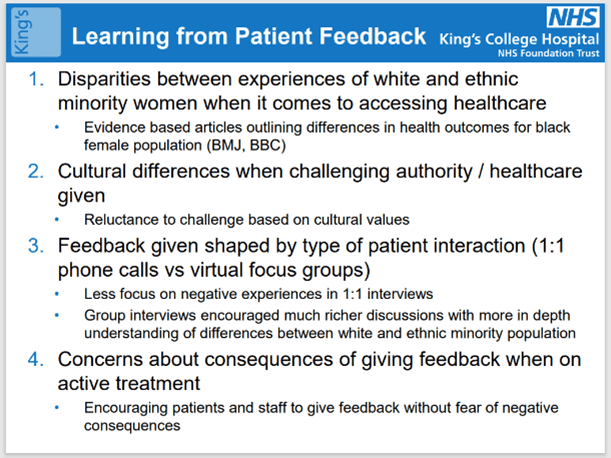
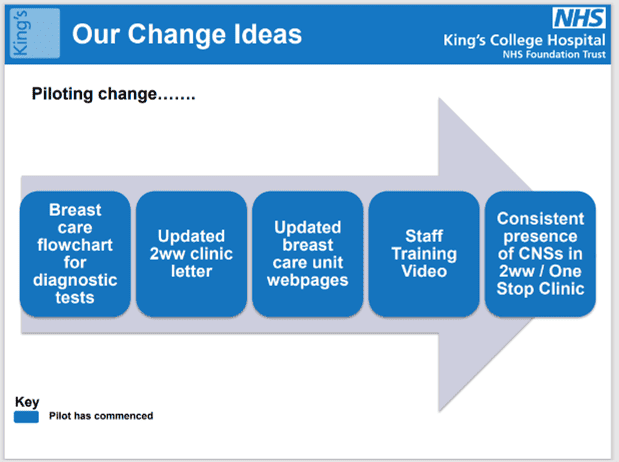
Impact
The project team completed 44 patient follow-up interviews since implementing these resources. Feedback showed significant improvement in patients’ experience as well as highlighting further areas for improvement:
- Breast Care Flowcharts
- Consultation undertaken with local GPs to address how patients would access the flowcharts at the point of referral
- 10 patients who had a CNS present in their OSC upon receiving the results of their biopsy were surveyed about how useful they found it to have a nurse with them.
- All 10 patients said that they found the CNS presence helpful or very helpful when receiving their results14 patients given the flowchart
- 86% (12/14) of the patients said the flowchart was easy to understand and helped them to understand what tests to expect.2 patients said they did not understand the flowchart due to a learning disability and anxiety whilst waiting for her appointment.
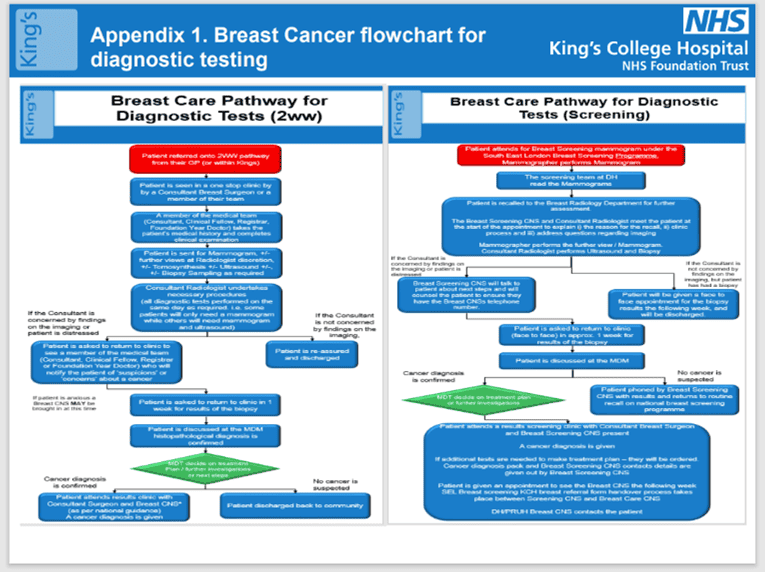
- Urgent referral letter
- 26 patients who were asked questions about their ease of understanding the content in the letter
- 87% (22 / 26) of patients who received a copy of the revised urgent suspected cancer referral appointment letter said they found the letter easy to understand
- . Updated breast care unit webpages
- Analysis of the webpages 2 months prior to the updated webpages going live (July 2022) and 2 months after (August – September 2022) shows a slight increase in page views from 979 to 1079
- The amount of time spent on the webpages has also increased from 3.05 mins to 3.17 mins.
- Staff training video addressing cultural differences awareness when communicating with patients from different backgrounds
- The video is available on the King’s learning and development platform. Staff are encouraged to complete as part of their induction. Within the first few weeks 22 staff members have completed this training
- The team were awarded the Great Idea Award by NHS England at the Cancer Experience of Care Improvement Collaborative Recognition Event, for easy spread and potential impact of this innovative idea
- CNS presence in one stop breast clinic (OSC)
- 10 patients who had a CNS present in their OSC upon receiving the results of their biopsy were surveyed about how useful they found it to have a nurse with them.
- All 10 patients said that they found the CNS presence helpful or very helpful when receiving their results
The Future
The project team have undertaken several measures to increase the likelihood of sustainability and are working with partners across SELCA and NHS England/Improvement, namely:
- The project team presented change ideas and our evaluation to the breast multi-disciplinary teams at our main hospital sites and at the SELCA breast tumour groups to ensure changes are understood and embedded in practice
- Rollout of multi-media communication to support patients around their diagnosis. For example, the team are working our digital transformation colleagues to pilot the sharing of urgent referral letter on a digital platform
- Continued use of the NCPES and the trust’s own Real Time Feedback Survey to monitor the impact of improvements and respond to changing needs
-
- Continuing quality improvement aimed at ensuring presence of CNSs in all breaking bad news (BBN) clinics
- The project team have been instrumental in influencing changes to the language and content of the urgent referral letters (beyond breast care) to better reflect patient’s views
- The team shared their learnings with SELCA and other breast teams, and more widely to other tumour groups multi-disciplinary teams including head and neck, lung and colorectal, more meetings being arranged. These colleagues have expressed interest in how they change practice to ensure the experience of patients from ethnic backgrounds can be improved at point of referral and throughout their pathway
- The project has also been presented at a national recognition event and launch event, hosted by NHS England / Improvement. Further presentations have also been made to the Pan London Lead Cancer Nurses groups
- The team have liaised with the learning disability charities and networks to co-design the easy read patient flowcharts
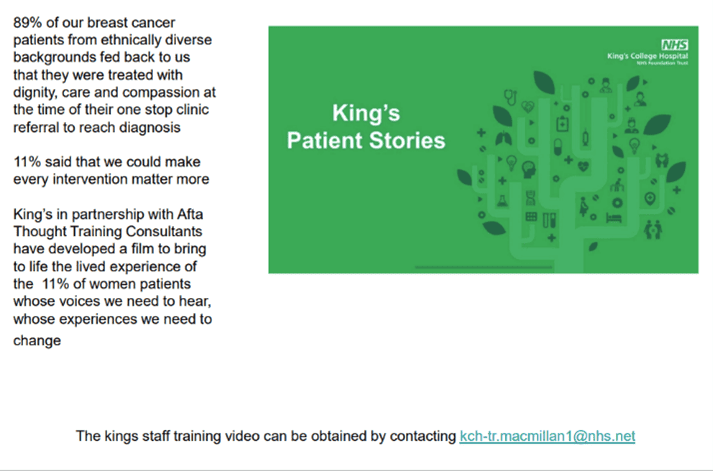
Standing Out
The key contributor to this project’s success is the co-design relationship between clinical staff and patients towards improvement. From the conception of the project, in reviewing NCPES data, designing patient questionnaires to gain a deeper understanding of where the issues might be, through co-designing all aspects of improvement, undertaking the PDSA cycle and reviewing data that has demonstrated success.
The project has also lead to the development of a staff training video, as outlined in section ‘impact and results achieved’. The video has received positive feedback from staff within the SELCA, NHSE/I and beyond, with 21 organisations making a request for the video to share with their staff.
Key Learning Points
Our key learnings include the below elements:
- Importance of ensuring executive level sponsorship prior to undertaking any large change project. This has been particularly valuable when tackling the need for changing behaviours and processes
- Good engagement needed from the whole project team, including representation across the whole multi-disciplinary team
- Importance of having lived experience partners/patient representatives involved at every step of the project from inception to close down
- Importance of understanding the problem, as evidenced by data collected both nationally and through locally conducted patient experience surveys, breaking this down to understand where variations exist between different groups of patients
- Importance of having flexibility to pivot on your original aim. Data may present a situation that is different to what you originally envisaged. As outlined in the above section ‘planning and delivery’.
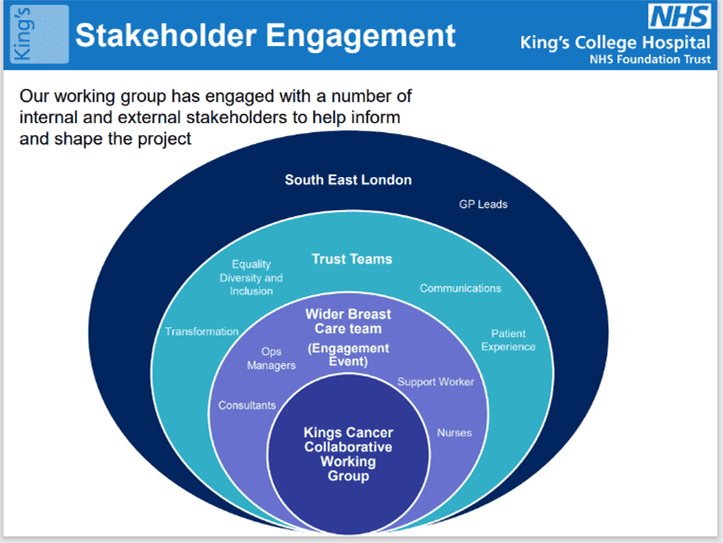
-
Listening to Sign Language Users – Improving Access to How Experience Can Be Shared - Public Health Agency
Winner – Engaging and Championing the Public
Contact: Dalrene Masson - Dalrene.Masson2@hscni.net
Organisation
Within Health and Social Care Northern Ireland (HSCNI) the Public Health Agency (PHA) is the major regional organisation for health protection and health and social wellbeing improvement. With a workforce of approx. 400 the PHA is a multi-disciplinary, multi-professional body with a strong regional and local presence. A key function within the PHA is to support the citizens of Northern Ireland to be involved with services in Health and Social Care, from design to implementation and evaluation. This includes learning from experience and feedback through the Regional Patient Client Experience (PCE) Programme, led by the PCE team within the Directorate of Nursing & AHP. To support learning across the whole of Northern Ireland the PHA partners with the six Health and Social Care (HSC) Trusts (including Northern Ireland Ambulance Service) to engage with the experience of service users, families & carers through the vital support of Trust PCE Facilitators.
General Summary
Accessibility to health and social services is of fundamental importance yet despite efforts there remain significant challenges for many groups in our population. Patient experience becomes a vital learning tool for a system that aspires to be proactive in this mission to address accessibility issues. Improving accessibility is a priority within the annual business plan of the PHA Regional PCE Programme. In 2023 the PHA co-designed a process with the deaf community to provide a method for sign language users to share their feedback through an Online User Feedback Service (OUFS) using sign language. The OUFS, Care Opinion, is embedded across the HSCNI system and provides a way for service users to share in their own words the experience of their journey of care. The small number of stories submitted on the website relating to the deaf community demonstrated the difficulties that sign language users can experience, with particular reference to effective communication. In collaboration with the British Deaf Association (BDA) the PHA committed to empower sign language users to share their experience in their own language. The design of the process for sign language users was co-designed with four deaf clubs across Northern Ireland an in partnership with HSC Trusts.
Rationale
The aim of this project was to develop a process for sign language users to share feedback on health and social care services on the Care Opinion website. The website already includes many features to enable accessibility, but it assumes the story teller can engage with the written word. Within the deaf community there are low literacy levels meaning that the method of sharing feedback in the written word directly on the website has access barriers. Through Care Opinion it is also possible to receive a response from the service, demonstrating that the service is listening. This too is in the format of the written word. Care Opinion can translate stories and responses into other languages, both in the written format and with audio functionality however this does not support the needs of sign language users. In Northern Ireland the 2 main sign languages used are British Sign Language (BSL) and Irish Sign Language (ISL). This project has enabled a method for people to share feedback in BSL and ISL and to view the responses by services in BSL and ISL following translation that is provided by PHA (www.careopinion.org.uk)
Planning
This project enshrined partnership with service users and stakeholders at each stage:
Engagement
Stakeholder liaison was the cornerstone of this project and the PHA worked in partnership with the BDA. At the planning stage the wider stakeholders were identified and meetings organised to ensure that service users and carers supported the design through to final outcome. We connected with the Sensory Support Services and Equality teams within HSC Trusts. These teams were pivotal to facilitate links with the deaf community groups. The process was co-designed with the Belfast Sign Language Forum, the Derry User Group, the Lurgan Deaf Club and with the stakeholders listed in February 2023. This involvement provided critical points on what was essential within the process and what challenges that the delivery of the process would have to consider. Meetings were also held with Strategic Planning and Performance Group (SPPG) within the Department of Health, Royal National Institute for Deaf people (RNID) and National Deaf Children’s Society (NDCS) to support implementation of the process. Sign Language Interactions (SLI) was identified as a key partner to enable the sign language user to share their experience anonymously through the Care Opinion telephone number.
Testing
The process was tested at workshops with the Belfast Sign Language Forum and the Derry User Group in March 2023. The testing stage provided learning for all key organisations necessary in the delivery of the feedback method set out in the process, including PHA, Care Opinion, SignVideo (video relay service from SLI), and the translation supplier. Stakeholders were informed about the outcome of the testing and helped agree the finalised process.
Video production
The focus of this project was accessibility and it was of vital importance that the information and promotion of this process is accessible to sign language users. The BDA supported the PHA to produce a video in both BSL and ISL for this purpose. During planning for the video in April 2023 an invitation was extended to the 2 groups that had supported the testing of the process to ask for their participation. Service users kindly accepted and with good humour became actors within the videos as part of their continued involvement to support this project. The video was filmed in the two languages in May 2023 and the video production, led by the BDA, should be complete by the end of July 2023.
Promotion
From July 2023 the video will be made widely available to promote this new process across the deaf community to BSL and ISL users.
Impact
This project addresses the issue of accessibility and highlights importance of supporting all users of health and social care services in Northern Ireland to be able to share their experience through feedback, to have an open dialogue with HSCNI services, and to contribute to learning and improvement across the system.
This project demonstrates that services can make best efforts to communicate effectively with sign language users, that solutions to barriers can be co-designed, and that to learn it is essential to listen.
The outcome of this project is that sign language users have a continued method to be able to share experience on health and social care services in Northern Ireland in BSL and ISL2. The impact of this is two-fold:
- Service users will know that the system values their feedback, is listening through responses in sign language, and is addressing communication barriers
- The services within HSCNI can engage with feedback from sign language users, have a robust method to facilitate this, and use the learning for meaningful action through an open and transparent platform.
The co-design approach adopted in this project built good relations and led to a method that was approved as fit for purpose by the deaf community. Sign language users and advocates have shaped the design of the process, tested the method in practice, and supported the positive promotion of the method.
Stakeholders conveyed during the project discussion that the deaf community has faced ongoing difficulties related to communication issues. The approach taken by this project is transferable in that services can involve service users in improving services and make efforts to build relationships with stakeholders.
2Process for Sharing a story on Care Opinion through SignVideo
The Future
The method for sharing experience through the OUFS, Care Opinion, is an established process for HSCNI and a priority for the Programme for Government (Department of Health). It is integrated as a key element of the PCE Programme for Northern Ireland which is led by the PHA in partnership with HSC Trusts. At an organisational level there is a commitment by the Senior Management teams of each HSC Trust to promote the OUFS and maintain a rolling programme of awareness, training and promotion with staff at a service level. This will include the process for sharing experience using sign language.
Standing Out
From the beginning, the project engaged with and listened to sign language users and stakeholders within the deaf community. The project was open to all comments in a supportive manner and is a good example of co-design. At the first meeting the frustration by service users on repeated issues they experienced and little sign of change despite promises of learning was clear. The project emphasis on building relationships and co-design in turn led to a conducive environment for design and improvement. The PHA in this project has highlighted the importance of accessibility for sign language users and has provided an ongoing platform for sign language users to participate in the conversation. Northern Ireland are the first nation to embrace a region wide OUFS which is accessible to people who use sign language.
The partnership between the PHA and BDA was vital to the project success in that every action was scrutinised to advocate for the deaf community, invitation to meetings and fora were facilitated, and the quality of the communication strived for excellence. Service users were engaged at each step and provided a meaningful contribution to the project, and their continual involvement is recognised and is the factor that makes this project stand out.
Key Learning Points
1- Early engagement with stakeholders & partnership approach: Listening to and being guided by those that have lived experience and those who advocate provided an informed process and enabled solutions to challenges to be sought.
2- Continual involvement & relationship building: The process was developed, then tested in workshops, and then filmed to create an informative video with the continued support from service users of 2 sign language groups, the HSC Trusts of these localities and BDA. The supportive relationships contributed to the feeling of inclusion and to the high quality of the outcome.
3- Effective communication: It was important that information was made accessible during the project to everyone involved. There were 3 different languages that were used and this required sensitivity to each other, and logistical planning to ensure everyone was communicated with in their first language, e.g. Interpreter services, Participant Information in easy read3, video in BSL and ISL to explain method and promote how to share feedback.
4- Integration into core service: The outcome of the project delivered a method for sign language users to share their experience and contribute to learning within HSCNI as part of the online user feedback core service already established in the system.
-
Cancer Prehabilitation Service - Nottingham University Hospitals NHS Trust
Winner – Partnership Working to Improve the Experience and Personalisation of Care
Contact: Abi Burrows - abi.burrows@nuh.nhs.uk
Organisation
With more than 18,000 colleagues, Nottingham University Hospitals NHS Trust (NUH) is the largest employer in Nottinghamshire and one of the biggest and busiest acute NHS Trusts in the country, serving more than 2.5 million residents of Nottingham and Nottinghamshire and a further four million people across the East Midlands and beyond.
NUH is a key member of the Nottinghamshire Integrated Care Board (ICB) and has built strong relationships across organisations and boundaries. We are proud of our collaborative culture and recognise the key role these collaborations play in helping to improve the health and wellbeing of citizens that live and work in the area.
General Summary
NUH launched a new cancer Prehabilitation Service in April 2022. Co-designed with patients from the outset, the purpose of the service was to prepare patients ahead of their cancer surgery through improvements in physical fitness, psychological wellbeing and healthy eating. Research has demonstrated this approach can reduce length of stay, limit post-operative complications and support enhanced recovery.
The value of this service is system wide, achieved through a unique collaboration of health, social care, and independent and third sector partners to deliver a personalised care approach. We worked with our patient and community partners to empower patients to make key behaviour changes and maintain positive outcomes beyond their acute treatment. The creation of strong community networks has helped to improve the long-term health and wellbeing of our local communities.
We are proud of the strong relationships and sense of team developed through the creation of this integrated pathway. Evidenced by the improved patient outcomes, delivery of efficiency savings and positive feedback we receive from patients and their families at every step of the pathway. We are seeking to share these achievements and learning to inspire others and enthuse our own team to future improvements.
Rationale
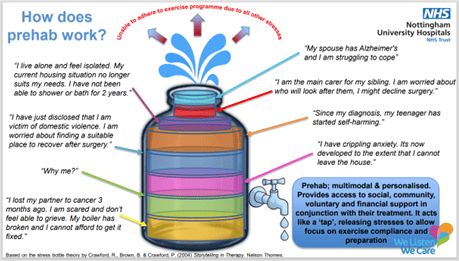
Significant postoperative complications currently occur in up to 75% of patients undergoing major cancer surgery. This is increasing due to the trend in acknowledged risk factors, which include an aging population, frailty, obesity and presence of multiple existing comorbidities. These serve to delay recovery and place a significant psychological burden on the individual while simultaneously placing additional strain on healthcare resources.
Prehabilitation (prehab) provides support to patients to maintain their physical and psychological wellbeing to cope with cancer treatment. This is achieved through promoting healthy behaviours and improving cardiovascular fitness, nutrition and psychological interventions, maximising any available time before surgery. This early intervention provides an opportunity to optimise patients through both medical interventions and to address patient’s individual needs, such a financial, housing and social support.
The evidence base behind prehabilitation is evolving rapidly and has already shown reduction in mortality, complications and length of stay as well as providing an opportunity to improve long-term health. A randomised controlled trial from Barcelona that showed prehab in high-risk surgical patients reduced major complications by 50% and a 2022 independent report into Manchester’s Prehabilitation program (Prehab4Cancer) found a 1.5-day reduction in hospital length of stay (LoS) and a 0.4-day reduction in critical care length of stay per prehab patient. It can help to tackle health inequalities and is aligned with personalised care agenda in the NHS Long Term Plan and NICE guidance. Consequently, prehabilitation is now a key GIRFT (Getting It Right First Time) recommendation to improve a patient safety during and after surgery and reduce post op complications and readmissions and is viewed nationally as a quality standard for cancer care.
As well as delivering these immediate benefits for patients, the team’s longer-term aspiration of the service was to contribute to an overall improvement in long-term health and wellbeing of our local population by empowering patients to maintain positive lifestyle changes. This involved working with community partners to embed participation in exercise beyond that of prehab and encourage peer support networks.
Planning
From the outset the team recognised the value of including patient representatives in the design process, formally inviting two patients’ partners to join the co-design team. Lizzie and Robin, both cancer survivors provide lived experience of cancer and some of the treatments involved.
Partnering with ‘A Better Life’ (ABL) has enabled us to be able to offer community based group sessions. ABL is a provider of health and well-being services, using a community-centric delivery model. This partnership has meant patients can attend clinics in their community, reducing travel time and associated expense. Furthermore it can reduce the stress and anxiety patients can experience when contemplating travelling an extenxed distance or multiple public transport routes.
Working in collaboration with the Clinical Psychology Cancer Service based at a neighbouring Trust, the team have been able to develop a dedicated direct referral pathway that ensures patients requiring a higher level of psychological support are seen with 2 weeks of referral, providing access to a video psychotherapy service.
We also partner with Self Help UK who provide Social Prescriber Link workers to support with the management of our patients social and psychological needs. Without this, some of our patients would not have been able to participate in prehab and ultimately go on to receive their surgery. For example, an agoraphobic patient, unable to leave the house following the death of her partner, received emotional support from volunteers to help manage her anxiety and attend appointments.
Our patient partners highlighted the frustrations they had experienced in having to repeat their story to different health care professionals. We worked with digital colleagues to set up a bespoke electronic information sharing process, which minimises the risk of patient information being lost and patients having to repeat their information to multiple providers, creating an integrated patient record. This automatically shares information between partners and uploads partner information into the hospital record providing two-way communication
A repeated theme of feedback was our patient’s desire to continue with exercise sessions after their surgery (rehabilitation). The team approached the Cancer and Rehabilitation Exercise (CARE) team, an established Cancer rehabilitation programme provided by Nottinghamshire County FC, Notts County Foundation. NUH and CARE have now developed an integrated pathway, which offers transitional rehabilitation sessions to ensure a seamless transition from ‘Prehab to Rehab’, with familiar faces, in a familiar environment, breaking down potential barriers to accessing rehabilitation.
Impact
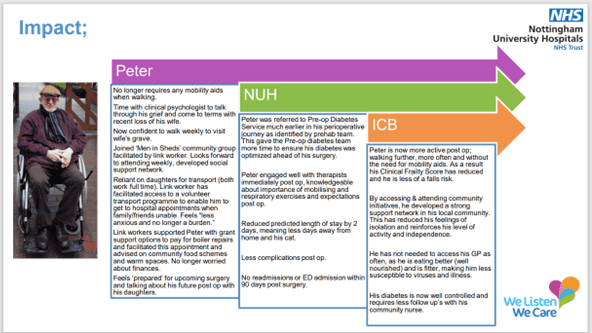
In the 15 months since the service launched, we have seen significant improvements against all the outcomes measures, both physical and psychological. On average;
- Grip Strength (Left)- increased by 1.5kg
- Grip Strength (Right)- increased by 1.9kg
- of sit to stands in 60 secs increased by 6.2
- Incremental Shuttle Walk test (change in m walked) increased by 49.5metres
- of minutes mod/strenuous physical activity per week increased by 144 minutes
- of Strength Sessions per week increased by 2.3
- EQ-5D-5L health score (change in wellbeing) improved by 2.4
- Depression score(PHQ-9) decreased by 2.4
- Anxiety score (GAD-7) decreased by 2.1
- Alcohol Intake (units) decreased by 2.2 units.
Patient and Staff Feedback
In addition to quantitative measures, we collected patient and staff feedback throughout. Unanimously our patients describe feeling more physically and mentally prepared and regaining a sense of control.
Long Term Health/System Benefits
Early indications from 3-month follow up data show that improvements in activity levels are sustained into the post-op period. 27% of patients report being more active within three months post-surgery than before entering the service.
Financial Efficiency
From a hospital perspective, we measure the total length of stay (LoS) and time in a HDU level 2 beds post operatively, compared to the same Health Resource Groups (HRG) historically. This has demonstrated a mean per patient reduction of 1.2 days and 0.5 days respectively, releasing bed capacity to improve flow and support elective recovery. We have also seen a reduction in readmissions and emergency admissions (ED) within 90 days post-surgery of Prehab patients compared to the same HRGs historically.
The Future
Following the successful launch of the service there have been multiple requests from surgeons and anaesthetic colleagues from specialities across the Trust to expand our service to include benign (non-cancer) surgical patients, which has led to the creation of a business case currently going through internal Trust governance processes. We intend to identify and positively discriminate towards those in social deprived areas using the indices of social deprivation (ISD).
A member of the prehab team sits on the Nottinghamshire ICB for Personalised Care group to share insight and learning and the service has recently been asked to support in the creation of Prehabilitation guidelines for the British Gynaecological Cancer Society.
A further piece of work currently being progressed is the development of early screening and health optimisation for all inpatient pathways by April 2024 as part of a new NHSE mandate and is heavily influenced by prehabilitation principles and learning.
The addition of the Exercise Physiologists to the Trust has allowed the service to offer the first placements for Sports Rehabilitation students. This supports role development and succession planning.
Standing Out
Delivery of this cost effective, holistic offer has been achieved by integrating with our community partners’ established infrastructure, minimising costs and providing access to a range of physical, psychological health and care services. Working with Local Authority partners has achieved an ICS cost saving of £60k by using existing underutilised commissioned capacity. This allows us to offer support to a larger cohort of patients within limited resources.
Our partnerships have improved accessibility for patients by offering community based choice and care closer to home. 45% of participants completed structured exercise programmes in six local leisure centres as an alternative to hospital. Our partnership with ABL allowed us to achieve a waiting time standard of three days by increasing capacity that would not be possible within the hospital resources. This allows the hospital team to focus on those with the most acute needs.
One of the unique characteristics of our service is the inclusion of dedicated social prescriber link workers, with 30% of patients accessing their support in the first 12 months. A repeated theme we hear from patients is that they feel able to discuss concerns with Social Prescribers, which they would not have raised with their clinical team, not perceiving them as medically relevant. This ability to ‘off load’ worries and share concerns helps to improve confidence and ability to participate in the wider prehab offer and is intrinsic to the service achieving the positive improvements.
Key Learning Points
- Patient Partners provide valuable insight and knowledge; they are worth their weight in gold!
- Do not underestimate the volume of communication required when launching a service and allow time for a service to become embedded.
- Development of new roles, recruitment and governance all takes time but are the key foundations to a successful service.
- Networking, linking in with the colleagues across the systems and sharing practice are an essential part of collaboration and partnership working
- Whilst data and financial impact remain essential, patient stories are extremely powerful and the patient voice must play an equal part in demonstrating impact.
-
Outpatient Assessment Clinics @ Dorset Health Village - Dorset's 'Think Big' Initiative
University Hospitals Dorset
Contact: Jonathan Wright - jonathan.wright@uhd.nhs.uk
Organisation
Dorset ICS is a collaborative partnership between the Health and Social Care providers across Dorset. It covers a population of circa 800,000 people, with a high proportion of people being over the age of 65. There are also 11 areas in Dorset which have been identified as being some of the most deprived areas nationally.
Dorset Integrated Care System: (Comprising Bournemouth, Christchurch and Poole Council, Dorset Council, Public Health Dorset, Dorset County Hospital NHS Foundation Trust, Dorset HealthCare University NHS Foundation Trust, South Western Ambulance Service NHS Foundation Trust, Primary care estate (79 practices, involving 18 primary care networks), University Hospitals Dorset NHS Foundation Trust).
General Summary
Winner – Integration and Continuity of Care & Partnership Working to Improve the Experience
To develop pioneering, high volume community outpatients assessment centres (OACs) seeing tens of thousands of people across Dorset. Specifically incorporating the lessons learned from the rapid deployment of mass vaccination clinics and Nightingale hospitals throughout the Covid-19 pandemic, providing centres quickly, effectively, safely and within locations where it has the most impact for Dorset’s population. Working in partnership across the system our centres offered a range of vital services to help tackle health inequalities exacerbated by the Covid-19 pandemic creating a new and innovative model of hospital treatment for patients by developing a culture of prevention within the OACs. This focused on delivering three key outputs:
- Improving access to diagnostics and screening services, reducing waiting times and significant backlogs to reduce clinical risk, enable earlier identification to improve prognosis and available options for condition / disease management
- Increased opportunity for MDT approach to clinic delivery and integration of services from different NHS organisations / partners. (e.g. community and acute co-location)
- Focus on waiting well for care, prehabilitation, and support with long term conditions via access to VCSE organisations, health coaches, social prescribing
All delivered ensuring patients and clinicians remained the driving force behind the design and implementation.
Rationale
As a result of the Covid-19 pandemic hospitals were running at 100% capacity and were forced to reduce elective activity, significantly increasing waiting lists. There was also a high proportion of the population postponing treatments or not seeking advice to reduce their risk of being exposed to Covid-19, potentially causing future health problems. Local data shows that when comparing elective to non-elective admissions in Dorset, there is a clear difference in healthcare utilisation, with people from more deprived backgrounds accessing less elective and more emergency care. It was identified that without intervention there would be further detrimental impact on our citizens health
Dorset’s solution was to establish the Health Village, a series of Outpatient Assessment Centres (OAC) located within densely populated areas, with the greatest level of need for outpatient and screening services. By moving some services closer to the community we had the opportunity to not only reduce waiting times and increase access, but also enable earlier identification of disease and improve outcomes for our patients.
The impact of Covid has demonstrated the importance of good health and wellbeing and that disparities do exist between different communities. Therefore, the centres provide opportunities to design new clinical pathways and new ways of operating outpatient and screening services to ensure wellbeing services are fully integrated and embedded to provide advice, information, and support for people to make healthy behaviour changes to improve the health of our residents.
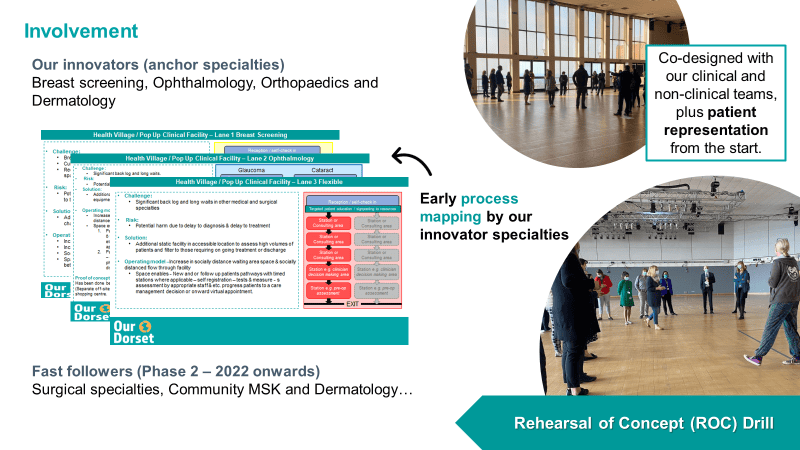
Planning
The planning and delivery of the project brought together patients, staff and wider stakeholders from various teams within Dorset ICS and beyond. To enable the phenomenal pace of delivery of facilities, strategically placed in the heart of communities, the team used militarily planning techniques including the Rehearsal of Concept (ROC) Drill. By bringing together patient and staff from across all areas of the ICS (e.g., digital, operational, clinical, admin) the group was able to ‘walk the patient journey’ and map the requirements for both the facility and patient flow, adopting a test, adapt and evolve philosophy throughout .
Our clinicians took leading roles in working with colleagues from multiple workstreams, including with architects to design the physical space and flow of patients moving around the clinic.
Patients, carers, and the public played a crucial role in the planning process and regular touchpoints were embedded in the project delivery from the start. Besides regular engagement with ICS patient engagement group, patient governors (representing the voice of the local community) played an active role in project delivery as leaders within the communications and engagement workstream, relaying feedback from their wider patient networks.
Public engagement events also took place – a 3-day event held in Poole enabled the project team to engage with the public around plans for the Health Village, enabling views and concerns to be captured, 3D models for the facility to be shared and wider communication to take place.
Members of the public in volunteer roles have been actively engaged from the outset and continue to play a crucial role in supporting the patients who attend the facilities.
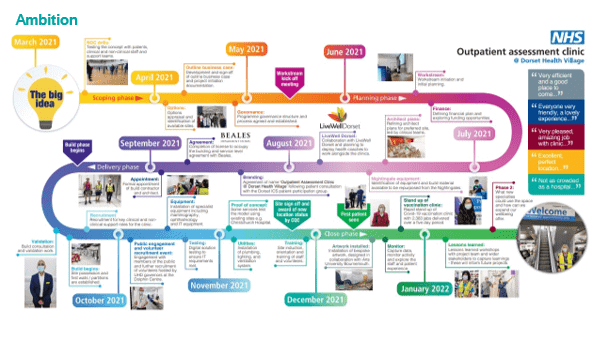
Impact
Our benefits workshop, held with stakeholders across the project, identified benefits across several domains. Metrics within these domains continue to be evaluated to measure impact.
Some of the key successes so far:
Since opening, we have seen over 10,000 patients. The Orthopaedics speciality has seen a 92% reduction in 78–104-week waiters and a 31% uplift in activity, including 25% increase in appointment utilisation. With over 280 Livewell interventions to help patients ‘wait well’ for their definitive treatment. In addition, over 2,000 COVID-19 vaccinations were administered at the site in the week prior to Christmas 2021 in rapid response to the government mandate.
Analysis of patient feedback at the OACs indicates that 96% of patients had a positive experience. The increased satisfaction has improved outpatient attendances and increased confidence, whilst also ensuring that our workforce time, resources, and expertise is utilised in the most efficient and productive way.
The way in which we were able to design, build, implement and operate these facilities at pace and during the height of the Covid-19 pandemic has created and accelerated a test bed for new and different ways of working; informing the way in which services can be delivered at acute hospital sites and across the healthcare system for better efficiency.
Integration of several services under one roof, reducing touchpoints for our patients by ensuring the wellbeing services were given the physical space to incorporate into the patient journey. Since opening, the Health villages, continue to onboard and incorporate additional service provisions, with Poole now offering eight speciality services as well as ongoing wellbeing provision.
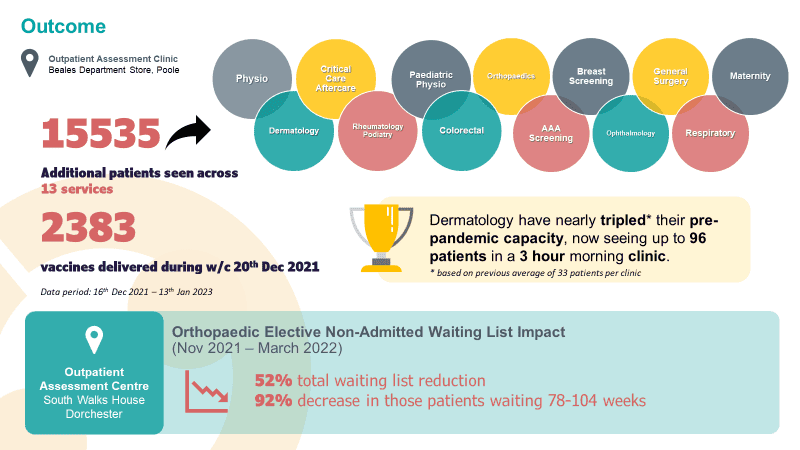
The Future – We have already secured a further twenty-year lease for our assessment centre at Dorchester along with additional funding for the next 3 years to incorporate a ringfenced 24 bed orthopaedic ward as well as ongoing wellbeing service provision.
Bringing care closer to peoples’ homes and working with patients to design the provision of services ensures that services are fully embedded, sustainable for our current and future populations and put patients at the heart of design to improve access and equity of care.
We have adopted a quality improvement approach to the way in which we deliver our Health villages ensuring we maintain a proactive approach to seeking, listening and responding to public and patient feedback. This includes our “You said, We did” engagement approach (see supporting evidence), which has already made significant changes to our patient experience.
Dorset ICS is committed to the delivery of the Health Village and as we continue to deliver benefits to outpatients on the high street, we will help build the case for further sustainability. Services are being supported by strengthened networks of GP practices, offering patients a wider range of services. As well as aligning commissioning intentions across the ICS partners for sustainability. We are actively seeking further funding to continue the initiative for further years and in future locations across Dorset through the Community Diagnostic Centre programme.
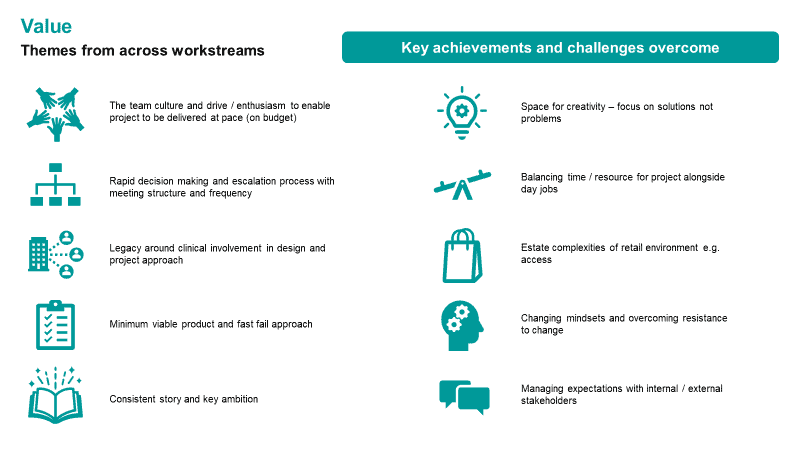
Standing Out
The unprecedented situation brought about from the Covid-19 pandemic brought a unique opportunity to ‘think differently’ about how we delivered our services. The Health Village has left a legacy for innovation in Dorset, notably some of the key areas that made this area stand out:
– The use of military planning techniques – Dorset was able to rapidly bring together and engage stakeholders across a number of partner groups and build a team culture that enabled rapid delivery of the project
– The redeployment of Nightingale equipment – supported the sustainability and financial aspects of the project. Architect plans were based on availability of equipment and material, led by clinical teams.
– Patient leadership – the embedding of patient engagement throughout course of project and leadership roles within project governance structure enabled ongoing ‘sense-checking’ against plans for facility and link to patient voice.
– Co-location of health and wellbeing services within acute services – for the first time, Dorset physically co-located health coaches and social prescribing alongside acute services which enables a more holistic approach to delivering patient care.
– Partnership with retail – repurposing existing estate enabled rapid delivery of facilities and the creation of unique NHS – retail relationships to support both population outcomes and socioeconomic development of local community.
Key Learning Points
A full lessons learned evaluation has taken place, engaging stakeholders across the project and including representation from our patients to enable key themes to be identified.
From this evaluation the following lessons have emerged:
– Clearly defined programme governance and roles and responsibilities– this enabled rapid decision making and escalation plus early identification of risks and issues to enable rapid delivery.
– Providing space for creativity and allowing evolution of ideas – ensure all stakeholder groups are heard, focus on solutions not problems and embed the voice of patients and clinicians throughout the project.
– Develop a Minimal Viable Product (MVP) model – whereby decisions are made on the principle of whether it will meet the required outcomes, this enables focus on end goal, remaining within tight deadlines and budget, and helps reduce scope creep.
– Regular touchpoints and face-to-face planning – enabled rapid formation of team and culture, alignment of shared vision across partners, maintained momentum and helped overcome resistance to change.
– Agility in running different due processes in parallel – by thinking innovatively around how due processes associated with cross sector partnership working can be facilitated in a more rapid and agile manner to enable ambitious timescales to be achieved.
– Learnings – applying expertise and methodologies from across different industries and internal partners to inform transformation and delivery of new services.
-
Little Voices - Walsall Healthcare NHS Trust
Winner – Communicating Effectively with Patients and Families And Overall PENNA 2023 Winner

Contact: garry.perry1@nhs.net
Organisation
Walsall Healthcare NHS Trust is an integrated Trust and provider of NHS acute care, serving a population of 286,700, providing inpatient and outpatient services at the Manor Hospital as well as a wide range of services in the community. Walsall Manor houses the full range of district general hospital services under one roof. The £170 million development was completed in 2010 and the continued upgrading of existing areas ensures the Trust now has a state-of-the-art Critical Care Unit, Neonatal Unit, Obstetric Theatre, and Integrated Assessment Unit facilities. Work has also been completed on our new multi-million pound new Urgent and Emergency Care Centre which houses a new Emergency Department (including Children’s Emergency Department), co-located Paediatric Assessment Unit, Acute Medical Unit and Urgent Care Centre. This opened officially in June.
General Summary
As our youngest patients, children have a unique perspective on their wellbeing. Their views and experiences can differ from what we, as adults, assume or expect. When we listen carefully to children, their experiences and opinions can enrich and even alter the course of our decisions and the plans that we make. Little Voices helped inform and support our ambition towards delivering care in a setting that is child-friendly and equitable for all children. The amplification of the children’s voice, children of such a young age provided meaningful participation that was not just child led but provided for an understanding of what accessing care is really like for a child seen through their eyes and not that of a parent or carer. Our initiative opened an opportunity to shape both place and purpose which has resulted in actions that demonstrated we have listened and acted on the feedback our ‘little voices’ have given. The importance of hand hygiene, mealtimes that matter, play that is engaging, reducing fear and anxiety are set to improve the way that we involve children in the care that is provided to them and ‘all about me’ becomes the norm in practice.
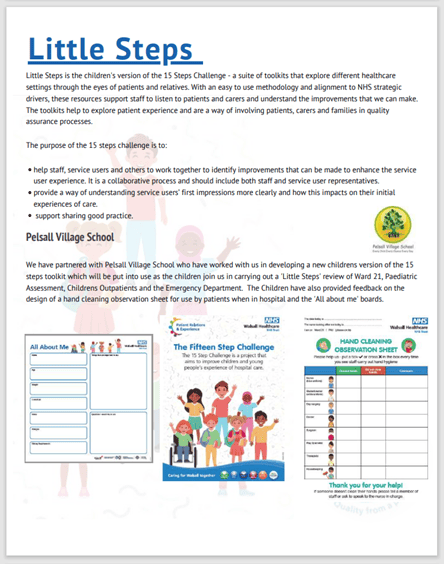
Rationale
Following the 2021 Children and Young Peoples (CYP) survey, the CYP Division launched an improvement programme called back to basics. There were several drivers for this including post-pandemic recovery (some aspects of service provision such as play had been restricted), a worsening position in several responses to questions than the previous survey and an identified need to re-focus on patient and family involvement about the way services would change and develop in future.
Led by the CYP Senior Leaders and the Patient Experience team, the use of patient feedback was seen as crucial to how we could learn and improve from the lived experiences of those who use access our services. As a start existing mechanisms of providing feedback were strengthened including the implementation of bedside posters using QR codes and the introduction of a digital mystery patient scheme.
The children’s ward identified a Clinical Support Worker Patient Experience champion to work with families identifying areas for improvement based on the feedback received including promotion of the ‘Tops and Pants’ line. One thing that was missing was the voice of the child and involvement with children was seen as something that is often overlooked in favour of more conventional methods such as surveys and the feedback given primarily by parents/guardians. This is where Little Voices was borne to include the child’s voice in re-designing and improving services for children and young people whilst also validating article 12 of the United Nations Convention on the Rights of the Child – the right to an opinion, for it to be listened to and taken seriously.
Planning
The Patient Experience team firstly secured a partnership with a local primary school – Pelsall Village, who identified a group of children aged 7-10 to work with us. Planning sessions were held at the school and the children worked independently with the headteacher identifying what mattered most to them when accessing healthcare. The children reviewed the 15 steps toolkit and re-designed the approach and in turn produced a new child friendly booklet for use when carrying out a visit. The children looked at what information they would want to see when attending the hospital or if they were admitted. Their feedback and insight shaped the installation of a new ward welcome board. In addition, ‘all about me’ boards were designed with a view to personalising and including the child and parent/guardian in their plan of care.
In preparing for the 15 steps inspection visit, we held a ‘what to expect’ workshop attended and led by the Patient Experience Team, Play Specialist and Head of Infection, Prevention and Control. The workshop explored the children’s feelings associated with being poorly and sought to understand more about patient anxiety and worry when attending the hospital. The children learned about infection control and how quickly germs can spread and the importance of washing hands. In addition, they learned about staff roles and who they would likely encounter in a hospital setting. The children also co-designed a simple hand hygiene checklist for use by patients in hospital aimed at reducing the risk of cross infection and hospital acquired infections. The children also participated in a hand hygiene test where bacterium was grew following the passing around to each other of a soft toy. The Play specialist spent time listening to the children explain their likes and interests so that a hospital play session could be designed around individual and collective needs ahead of the 15 steps visit.
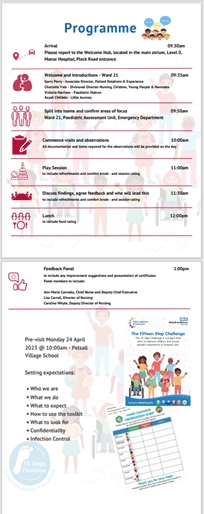
Impact
Back to Basics’ was the improvement plan that was a catalyst for this innovative piece of work. This meant a focus on responding to the less favourable outcomes of the 2021 CYP National survey and to attest that we were improving the recommendation scores in the Friend and Family Test and associated themes.
Using a themed analysis of paediatric FFT comments, the trust can track changes in positive and negative comments over time. Since January 2023, inpatient paediatric services have received consistent positive comments about staff attitude, with PAU seeing an increase in comments throughout the period to June. On average, paediatric services have maintained 40% or more positive comments received during the period specifically mentioning staff attitude in a positive light. This improvement in staff attitude, whilst following an improving trend across inpatient areas, is proportionately higher than the trust inpatient average of 30%.
From a review of complaints and concerns there has been a 70% reduction from 21/22 to 22/23 (30 and 9 respectively) and of the mystery patient comments received all were positive in relation to staff courtesy, environment and facilities, dignity and respect and involvement in care (themes from the national survey).
In addition, a clinical group was set up to put into effect the actions arising from the Little Voices + feedback. The motivation is to utilise this group to track and monitor improvement actions and to mirror survey the questions against those in the National Survey as we prepare for this year’s sampling. This renewed focus on patient and carer involvement also led to paediatric services being open to include volunteers in their engagement with children and their parent/guardians and we now have four young volunteers working across the service – called EWE’s (Enhancing the Ward Experience) who work on placement with us in partnership with Walsall College as part of their protected services course.
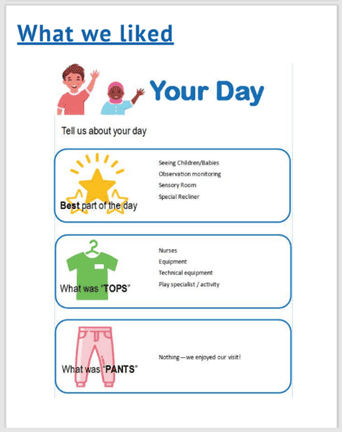
The Future
The Little Voices team will be returning in December on a ‘you told us we have’ visit and to also assess the children’s outpatient area. We have a plan for annual involvement in different workstreams and to date these include the re-design of the children’s outdoor play area and involvement in recruitment processes using a concept called the ‘Children’s desert island interview process’. We have since held a youth forum with a focus on mental health and to support the development of a Walsall wide strategy for young people’s wellbeing. The intention is to form additional school partnerships and plan for the development of a mealtime, playtime, and sleep time charter for the in-patient areas. We are currently working with the Little Journey App team to develop our own pre-hospital package of information. This will help reduce anxieties for pre-hospital and pre-theatre, it will orientate families to the ward before they arrive, and it can be used to share information to support care at home. The Little Voices team have already reviewed the app and given it their ‘nod’.
Standing Out
This is a unique approach that has ignited excitement on a multi-professional level in the importance of levelling up the involvement of children in service design and improvement. It’s different because it has been child led, its different because it affirms the core principle of article 12, its different because it provides staff with insight that enhances practice and adds greater depth of understanding from a child’s perspective. This is a different approach because it’s not conventional in terms of the way we would usually obtain feedback and act on it, furthermore organisations tend to focus patient involvement on those considered more able to speak for themselves or of adolescence. The key elements of our success have been the partnership with a school, this is because sometimes children are not in the hospital setting long enough for meaningful engagement to take place or are too poorly, however they have all either had or have familial experiences of coming into or accessing hospital services. Another success marker has been the creativity of the programme to adapt to the children’s viewpoint when it has differed to that which we anticipated. This has led us to act on areas which we did not consider to be a problem at the time – sometimes this is a simple solution such as changing a mirror in the sensory room which was viewed by a child to have potential danger. The collaborative team approach between the CYP team, Patient Experience, Infection and Prevention and Emergency Department was another success measure.
Key Learning Points
Of importance is the investment of time in building the relationship and interest of the children. Expect the unexpected as once the children are engaged, they can often take an interest in the things that you may not have thought of such as a relaxation chair, themed side room and child friendly linen. Make it interesting too – let them take an observation, sit in the back of an ambulance, and use a stethoscope – it’s all about the stethoscope. From a staff perspective it’s all about team collaboration and a multi-disciplinary approach, in the planning of 15 steps take time to risk assess what the children could inadvertently be exposed to which is why the pre-planning visits are also crucial, and smile – the children respond positively to kindness and are reciprocal when the visit is made fun.
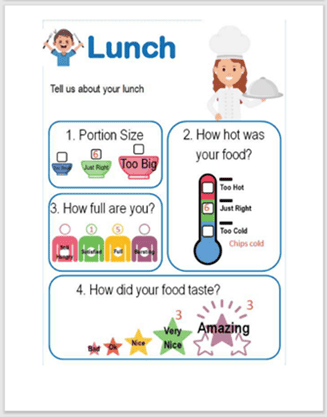
-
Let's Talk Cancer!
Royal Free London NHS Foundation Trust
Contact: Azmina Rose - azmina.rose@nhs.net
Organisation
Winner – Cancer Experience of Care Award 2022
The Royal Free London NHS Foundation Trust (RFL) serves a local population of 1.6 million people and employs more than 10,000 staff. The Royal Free London NHS Foundation Trust (RFL) is one of the largest providers of cancer care in England, receiving the highest number of urgent suspected cancer referrals in London and second highest in England. In 2021 the Trust completed 2,830 first cancer treatments to newly diagnosed patients with various modalities including surgery, systemic anti-cancer therapy (chemotherapy and immunotherapy) and radiotherapy. These numbers will continue to grow as the incidence of cancer continues to rise. RFL hosts a portfolio of cancer tumour sites including specialist tumour sites, HPB, Kidney cancer and rare cancers such as neuroendocrine. RFL is an active recruiter to clinical trials and we offer anti-cancer treatment across all our sites which comprise Barnet hospital, Chase Farm Hospital, the Royal Free (Hampstead) hospital, and Finchley Memorial hospital. The size, scale and diversity of our cancer services, and the large geographical area we serve, adds complexity to our everyday service delivery and our quality improvement initiatives. Implementation of change and roll-out of new initiatives in a Trust of this size requires significant resource and time.
General Summary
Our INNOVATIVE “Let’s Talk Cancer!” initiative was developed in response to patient feedback received via the National Cancer Patient Experience Survey (NCPES) which told us that our Trust needed to improve its Communications. Patient and carer INVOLVEMENT guided our initiative and we worked very closely with patient and carer partners to construct 6 key foundational principles of good communications. These are summarised as:
Always Introduce.
Always Support.
Always Involve.
Always Confirm.
Always Ask.
Always Provide.
The 3 main OUTPUTS we created include:
- A pocket sized aide-memoire card for staff;
- A companion resource for patients called “TenTop Tips”,
- An INNOVATIVE online interactive staff training module https://rise.articulate.com/share/jV_hNUep9ZDKVxTkNhsTXO7BXOg5t1Hz
Internally, we launched these at DISSEMINATION roadshow events with support from senior Executive Trust LEADERSHIP. Our roadshow venues included the canteen, main hospital foyer, and other areas of the hospital with high staff and patient footfall.
Externally, we have presented our work at the pan-London lead Cancer Nurse Forum which has led to expressions of interest by other Trusts to duplicate and roll out our inventions at their own trusts. We are actively pursuing this opportunity for further TRANSFERABILITY and broader DISSEMINATION beyond our own Trust across London.
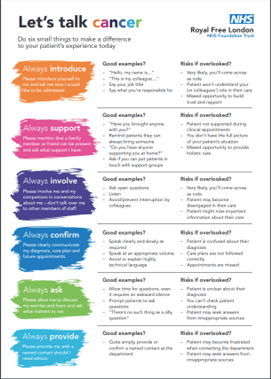
Rationale
The CONTEXT for this work is that our Trust had historically performed poorly in the National Cancer Patient Experience Survey (NCPES) when compared to other Trusts in London. NCEPS results had highlighted communications as an area for improvement together with a need to provide more understandable information to patients about anti-cancer treatment, and whether or not treatment is working.
These NCPES results inspired us to develop a series of quality improvement initiatives under the umbrella of “Let’s Talk Cancer!”. Our RATIONALE was that Communication and Behaviours can be influenced and modified at all levels, via learning, awareness and incremental step changes backed-up by positive reinforcement.
Planning
PLANNING: Patient and carer INVOLVEMENT guided our initiatives and we worked very closely with patient and carer partners to construct 6 key foundational principles of good communications. These are summarised as:
Always Introduce.
Always Support.
Always Involve.
Always Confirm.
Always Ask.
Always Provide.
DELIVERY:
OUTPUT 1. To assist staff to remember to use these principles in daily interactions with patients, we developed a pocket-sized ‘aide memoire’ card which could be clipped to staff lanyards and worn alongside NHS ID badges.
OUTPUT 2. In parallel, we developed a companion information resource for patients, which we called Ten Top Tips…
This outlined the key principles of communication that patients should be able to expect.
OUTPUT 3. We also developed an innovative “Let’s Talk Cancer!” online interactive training module for all staff (clinical and non-clinical) which features an animated (avatar) patient narrator to teach the 6 principles. Feedback from learners have complete the module have unanimously commented on how the interactive design is a fresh approach and NEW THINKING, when compared to more traditional forms of NHS online learning.
We launched these resources at DISSEMINATION roadshow events with support from senior LEADERSHIP across the Trust, including the Group Chief Executive, Site Chief Executive, medical Director and Director of Nursing. Our roadshow venues included the canteen, main hospital foyer, and other areas of the hospital with high staff and patient throughflow and footfall. The Ten Top Tips… resource for patients has been included in the information & support pack that every newly diagnosed cancer patient receives, with larger poster versions displayed in outpatient clinic settings.
Impact
OUTPUT 1. The IMPACT of the staff pocket-sized ‘aide memoire’ card for staff to wear on their lanyards along with their ID badges was measured by staff recall of the 6 principles: [Always Introduce. Always Support. Always Involve. Always Confirm. Always Ask. Always Provide.]
The RESULTS ACHIEVED through staff remembering, and implementing, and these 6 principles when they have been interacting with cancer patients has translated through into improvements in NCPES scores in the latest annual iteration of the survey. These NCPES improvements have been quantitative (higher scores) and qualitative (thematic analysis of the free-text comments have reflected greater satisfaction with staff communication.
OUTPUT 2. The IMPACT of the companion information resource for patients, Ten Top Tips… which summarises key principles of communication that patients should be able to expect has been evaluated by assessing patient knowledge of this resource. We include a copy of this flyer in every ‘new cancer diagnosis’ information and support pack. These packs are given to newly diagnosed cancer patients by their CNS (Cancer Clinical Nurse Specialist). To ensure that patients do give their attention to the Ten Top Tips flyer, the CNSs point it put when they talk the patient through the contents of the pack. Other items within the pack include a Macmillan booklet on Holistic Needs Assessments, the local Clinical team’s contact details etc. The RESULTS ACHIEVED through patients having this knowledge are measurable through adhoc feedback received in clinic via the Comments Box, and also in the patient satisfaction questionnaire which the individual tumour group teams send out to their patients. Since the Ten Top Tips flyer has been deployed, we have also seen a decrease in the number of complaints about staff communication and behaviours (direct to Oncology and via PALS).
OUTPUT 3. We also developed an innovative “Let’s Talk Cancer!” online interactive training module for all staff (clinical and non-clinical) which features an animated (avatar) patient narrator to teach the 6 principles. Feedback from learners have complete the module have unanimously commented on how the interactive design is a fresh approach and NEW THINKING, when compared to more traditional forms of NHS online learning. We are still working to have the module adopted as MaST (Mandatory and Statutory Training) and also to have it incorporated into Trust Corporate Induction. Our RESULTS ACHIEVED include having already rolled out this learning package to all staff undertaking Trust Nursing Induction, and all cohorts on the nursing preceptorship programme. At the time of writing, over 100 learners have completed the “Let’s Talk Cancer!” online interactive training module and feedback has been universally positive.
The Future
Internally, we launched these at DISSEMINATION roadshow events with support from senior LEADERSHIP across the Trust, including the Group and Site Chief Executives, Medical Director and Director of Nursing. Our roadshow venues included the canteen, main hospital foyer, and other areas of the hospital with high staff and patient footfall.
Externally, we have presented our work at the pan-London lead Cancer Nurse Forum which has led to expressions of interest by other Trusts to duplicate and roll out our inventions at their own trusts. We are actively pursuing this opportunity for further TRANSFERABILITY and broader DISSEMINATION beyond our own trust across London.
We expect that the efficacy of our interventions will be further evidenced via progressive and SUSTAINABLE improved annual National Cancer Patient Experience Survey results, improved patient satisfaction scores in our regular local tumour type surveys, audits, and a decrease in both frequency and absolute numbers of complaints about communication.
Standing Out
We have received feedback that the level of NEW THINKING and INNOVATION really STANDS OUT and is refreshing because our interactive online learning module is animated and the ‘story’ of an outpatient clinic appointment is told entirely through the patient’s eyes. The audio/script/narrative is voiced from the patient’s own perspective and this confers unique insight and in-depth understanding.
Direct quotes from a sample of learners who have completed the module https://rise.articulate.com/share/jV_hNUep9ZDKVxTkNhsTXO7BXOg5t1Hz
“My first impression was that it was good and powerful. I think it is most important to see it from a patient’s view, and this makes it more emotional and so memorable.” [Service user]
“I just went through the training module and it looks great, very professional and flows really well. I think it’s important to reflect on things that can easily happen (eg; speaking to another colleague or not introducing yourself) and how they can impact on patient’s experience.” [Trust Staff – Manager]
“I think the training is excellent and would be useful for junior nurses and even for more senior staff as a reminder. I do r3alise that showing it to senior staff may not work because they may feel they know it all and think the training is insulting.” [Patient of the hospital]
“I have completed the module and I have to say, it’s really very good. It gets the message across loud and clear, to all levels of staff, not just young trainee nurses. The audio scenarios are extremely thought provoking and really do help to put oneself into the patients frame of mind as well as see things from their point of view. The link to the cancer patient experience survey is good and the statistics in the survey are very useful, interesting and quite shocking in parts! The six key parts are a great way of breaking down every vital area which must be considered and applied when communicating and//or discussing things with the patient. They also carry the same ‘corporate image’ if you like, as the Royal Free Trust’s values (welcoming, respectful, reassuring and communicative) so there’s a nice internal flow going on, in relation to conveying ‘best practice’ etc.” [Carer of a patient of the hospital]
Key Learning Points
Implementation of change and roll-out of new initiatives such as “Let’s Talk Cancer!” in a Trust of this size requires significant resource and time. We would encourage others to carefully estimate the time (e.g. for project management) and resources that doing quality improvement to a high standard requires. Budget (or lack thereof) can also be a barrier. The most important LEARNING POINT we would share is how crucial patient / public engagement and involvement is. Likewise, buy-in from senior executive NHS leaders is essential. Finally, we would wish any others with an interest in doing something similar the very best of luck, and we would want to offer to share our learned expertise with them.
-
Finding Cards – Improving the experience for friends and family on arrival at the Emergency Department
Queen Alexandra Hospital, Portsmouth Hospitals University NHS Trust

Contact: Joanna Rowlinson - joanna.rowlinson@porthosp.nhs.uk
Organisation
Using insight for Improvement Category Winner 2022
Winner – Using Insight for Improvement
Sub Category: AccessQueen Alexandra Hospital in a large District General Hospital on the south coast of England providing care to people across the city of Portsmouth and south east Hampshire. The Emergency Department (ED) sees 130,000 patients per year. The ED provides care for the immediate assessment, diagnosis and treatment of adult and paediatric patients presenting with serious and life-threatening illnesses and injuries. The department is open 24 hours a day, seven days a week, with consultant-led emergency care. The ED team is large and includes 18 consultants, 52 Doctors in training, over 150 nurses and nurse practitioners, and further allied support staff. The department has a dedicated 6 bed Resuscitation area, 42 Majors beds spread across 4 major treatment areas (Majors A, Majors B Low, Majors B High, Majors Surge), an ambulatory seated care area with 12 chairs, waiting room and a dedicated 11 bed children’s emergency department. The corridors connecting bed space treatment areas are interconnecting, opening into bays of care area bedspaces, spread across a very large footprint.
General Summary
Finding Cards are a fresh idea, dedicatedly focused on addressing needs and emotional support of friends and family when first arriving at a busy Emergency Department(ED). Cards given to family in reception help family remember their patient’s named location, reassure and give confidence that help is available if they become lost, empower to approach any staff for help, and make feel at ease. Proactive engagement, surveying and collection of feedback from family and staff was reflected upon. Feedback was globally positive with multiple enthusiastic comments. The uncomplicated inexpensive straightforward nature enabled the Cards to be easily implemented without lengthy meetings, additional staff recruitment, training or funding. Finding Cards also improved patient safety through minimising staff interruptions. Staff quickly read the card, immediately help with onward direction, avoiding lengthy database searches, shortening interruptions. The Cards also improved staff experience. Finding Cards are a creative solution addressing a common problem and are easily adoptable by many healthcare settings. The tool is very easy to sustain, only requiring card reprinting and restocking. The tool has proactively been shared locally and internationally. Following the observed benefit to friends and family and staff, Finding Cards are now routinely given to every visitor entering the ED.
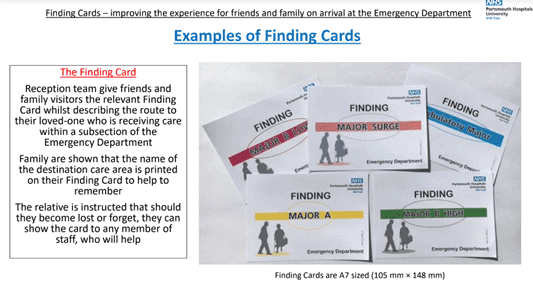
Rationale
Finding Cards are a creative solution to improve the support and experience for friends and family when first arriving at our large Emergency Department(ED). They vitally remove a layer of worry, confusion, stress and unease for friends and family when trying to first find, and see, their loved-one who is receiving treatment within one of the many subsections of the busy ED.
As an ED Consultant I frequently observed friends and family repeatedly became lost, and also forget the name of their destination after their welcome at the ED reception, despite receiving directions and signs. Formal hospital CQC inspections also commented they observed people becoming lost and confused. Relatives understandably interrupted staff for help, or were found disorientated, unaware who to approach. We felt it was essential to introduce a new solution that focuses on improving the support we are giving to friends and family arriving at our ED, to make their initial experience less stressful and challenging, and feel more welcomed and valued in the ED.
“Finding Cards” were the novel and innovative solution. The simple, inexpensive, coloured cards are A7 sized. The top of the card reads ‘FINDING’. The centre of the card has printed the name of a specific subsection of the ED e.g. ‘Major A’, ‘Major B-High’. The reception team gives visitor friends and family a relevant bespoke card whilst describing the route and signage to their patient. The relative is shown that the name of the care area where their patient is located is printed on their Finding Card to help remember the name. The relative is instructed that should they become lost or forget, they can show their Finding Card to any member of staff, who will happily help. The Finding Cards helps friends and family remember their loved-one’s location, reassures and gives confidence that help will be available if they become lost, empowers relatives to approach any staff member for help, and supports relatives to feel at ease.
Friends and family unexpectedly coming to hospital following hearing of a health emergency, often yet to discuss the seriousness can feel overwhelmed. It is a time of heightened emotion and worry. Remembering the unusual title and several steps of instructions for the route to their loved-one may be understandably challenging. They must navigate multiple corridors, doorways, and unfamiliar signs which can feel confusing and can feel further distressing and frustrating if become lost. ED layout and signs may feel logical to staff, but can be less clear to visitors. The naturally busy and dynamic environment of an ED can appear chaotic to visitors. It may be unclear which uniformed member of staff to interrupt and approach, thus relatives feel daunted and isolated. A patient in the ED may worry about the burden their health emergency may have upon their family. Steps to ensure friends and family have a positive ED experience are also very important to the patient. During times of NHS pressures it is equally important to include innovation specifically for friends and family. Finding Cards are a completely new fresh idea within the field of emergency medicine, dedicatedly focused on addressing further the needs and support of friends and family when first arriving at an ED.
In addition, Finding Cards also improved patient safety by minimising interruptions to doctors and nurses. To identify a patient’s bed location when staff are asked for help, they must undertake a dedicated ED computer database search taking several minutes, due to the multiple care areas and large number of patients within our ED. This interruption distracts medical and nursing staff from their current task and workflow. Interruptions are harmful for patient safety and contribute to negative consequences including drug errors, delayed treatment, and loss of concentration. Through using Finding Cards, doctors and nurses can quickly read the card and immediately help relatives with onward direction. A repeated database search not needed. The length of interruption is shorter. Finding Cards also allow more ED staff to help with onward directions (including housekeeping, security) as access to confidential database is no longer required. Finding Cards also improved staff experience.
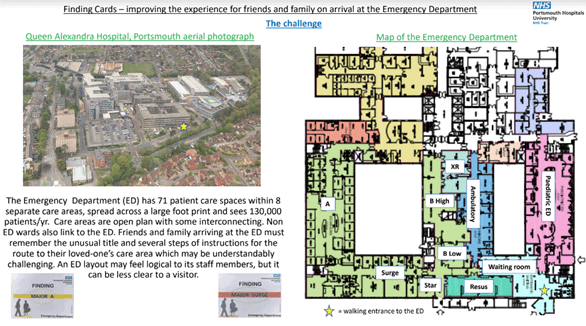
Planning
Finding Cards implementation didn’t need lengthy planning, training, budgeting and meetings and was relatively quick and simple. The idea was discussed with the senior nurse and reception team manager who were very supportive to proceed. The cards were designed using powerpoint. Complex IT skills and software were not required. The hospital medical photography department printed and cut A7 sized cards, costing £25 per 1000 A7 cards. Initially 6 different care area’s Finding Card sub types were printed. Once printed, Cards were kept next to reception staff in accessible boxes, ready to be used. Cards were reused or disposed.
Consultants, senior nurses and reception leads were briefed further on the project. Simple short briefings were then given to the wider team at handovers by the team leaders to make all groups, including reception, nursing, and medical teams, aware of Finding Cards. These briefings took less than 5 minutes and included discussing the current friend and family experience, the problems they encountered, the staff interruptions and patient safety, whilst demonstrating the cards. Briefings were repeated several times each week during the initial introduction phase. Adhoc reminders and demonstrations were also given to staff throughout shifts. Open communication and discussion were encouraged throughout. As the concept and cards were uncomplicated, formal ‘training’ was not needed. Emails to the team included images of the Finding Cards. These methods overcame the challenge of reaching the breadth of an entire ED multidisciplinary team working shifts 24hours/day 7days/week.
Card printing became more predictable and plannable once the frequency used of each Card subtype became apparent during the first weeks. During the initial pilot, a map of the department was printed on the reverse of the card. We became aware from family feedback that the map was rarely consulted and did not add to the overall aim of the card. Subsequent cards read solely the title of a patient care area.
Feedback comments were collated from family and staff, and all comments were proactively reviewed and reflected on.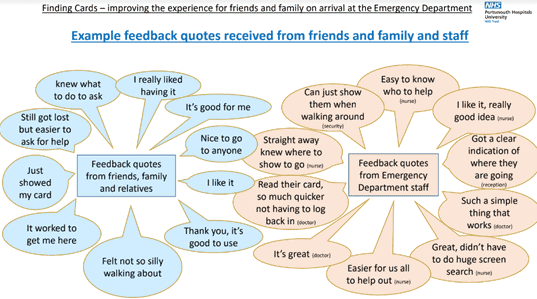
Impact
Feedback from friends and family was globally positive. Informal surveys asked for feedback following using a Finding Card to arrive at their specific care area. Verbatim accounts of all comments were collected. The theme from relatives was how much they liked the cards. They felt more encouraged and able to ask for help and less troubled reaching loved ones. Families asked to keep cards when going for coffee for reassurance in case needed help on return. Following feedback that the map did not have any added value, cards were promptly changed.
Staff feedback was gathered through team briefings, informal surveys, interviews and email. Staff stated it was immensely quicker to support relatives and saved time. The team found cards easy to recognise, uncomplicated and straightforward to use. It was much easier to identify relatives in need of help and support. Family members appeared very comfortable when they approached staff. The reception team observed relatives appeared more confident and reassured to enter the main ED. Staff acknowledged the easily adaptable nature of Finding Cards as when bedspace treatment areas were renamed, newly printed cards were available within a few days.
Given the observed benefit to both friends and family and staff groups, Finding Cards with explanations are now routinely given to every visitor entering the ED.Standing Out
Finding Cards are a completely new fresh idea within the field of emergency medicine, focused on the needs, well-being and emotional support of friends and family when first arriving at a busy ED. Being in an ED as a relative is a time of heightened emotion and worry for family also about to providing comfort to their loved one who is receiving emergency care. It is essential to take all possible opportunities to support friends and family. This uncomplicated innovative project specifically and visibly reaches out to this group.
Finding Cards are easily transferable to any other healthcare setting and require no marked additional funding, staffing and training and are future proof. This makes this initiative particularly unique. The ease of communicating and adopting the tool for a large multidisciplinary team working 24/7 adds to the initiative’s success.
The further benefits of improving staff experience, and improving patient safety by minimising interruptions to doctors and nurses, is also hugely significant.Key Learning Points
A department’s layout and signs may feel logical to the staff, but reaching out to friends and family may identify the need to provide additional support. Finding Cards are low cost and don’t necessitate extensive additional training, staff recruitment, finance and resources to implement. Teams should therefore not feel nervous when considering introducing. Reprinting and designing cards is undemanding for the project lead. Simple card designs were the most effective. Costs can be reduced through using thinner, black and white cards. Collecting feedback from friends and family and staff during pilot phases will give valuable insight to the specific bespoke needs.
-
Bereavement Support Service
Calderdale and Huddersfield NHS Foundation Trust
Contact: Gillian Sykes - gc.sykes@hotmail.co.uk
Organisation
Calderdale and Huddersfield NHS Foundation Trust employ more than 6,000 staff who deliver compassionate care from our two main hospitals, Calderdale Royal Hospital and Huddersfield Royal Infirmary, as well as in community sites, health centres and in patients’ homes. We provide a range of services including urgent and emergency care; medical; surgical; maternity; gynaecology; critical care; children’s and young people’s services; end of life care and outpatient and diagnostic imaging services. We provide community health services, including sexual health services in Calderdale from Calderdale Royal and local health centres. In 2019/20 we cared for more than 119,000 men, women and children as inpatients (stayed at least one night) or day cases. There were also more than 445,000 outpatient attendances; 154,000 accident and emergency attendances and 5000 babies delivered. There were some 261,000 adult services contacts by our community teams as well as 217,000 contacts with our therapy services.
General Summary
The Bereavement Support Service is a unique collaborative initiative with bereaved relatives at its heart. The service has 2 elements:
- A bereavement box is sent to families of deceased patients – it contains marigold seeds, a handwritten card, bereavement support numbers and a knitted heart. Relatives are made aware that a knitted heart is placed with the deceased patient.
- Calls to relatives – take place 5-10 days after the death.
The service was developed in response to the passion of Trust staff and feedback from our local community. The service is innovative and epitomises the Trust’s vision ‘Together we will deliver outstanding compassionate care to the communities we serve’. It was set up to support bereaved relatives at unprecedented times and the fantastic feedback received both from staff providing the services and relatives has made it clear that this service is hugely appreciated and one that we intend to continue.
The service has clear operational goals, is delivered through a committed workforce and the Trust is fully supportive. The initial aim of the service was to provide support for bereaved relatives. It has also enabled the Trust to respond quickly to feedback provided, sharing positive messages, and addressing learning opportunities.
Rationale
The country went into lockdown in March 2020 due to Covid and following government guidelines Trusts were advised to cease patient visiting immediately. Staff expressed concern that patients were dying alone which may cause relatives to have lasting distress and unresolved grief. We also had feedback and concerns highlighted through the Patient Advice and Complaints department about end of life care.
The Trust agreed to look at what extra bereavement support could be introduced to provide a workable, equitable, organised support system for all bereaved families. The new Bereavement Support Service was for relatives of all adults (over 18) that die in the Trust – exceptions were ICU patients, where support was already in place.
The Trust has 4 recognised behaviours, known as our ‘four pillars’. The way this project was co-ordinated clearly demonstrated these:
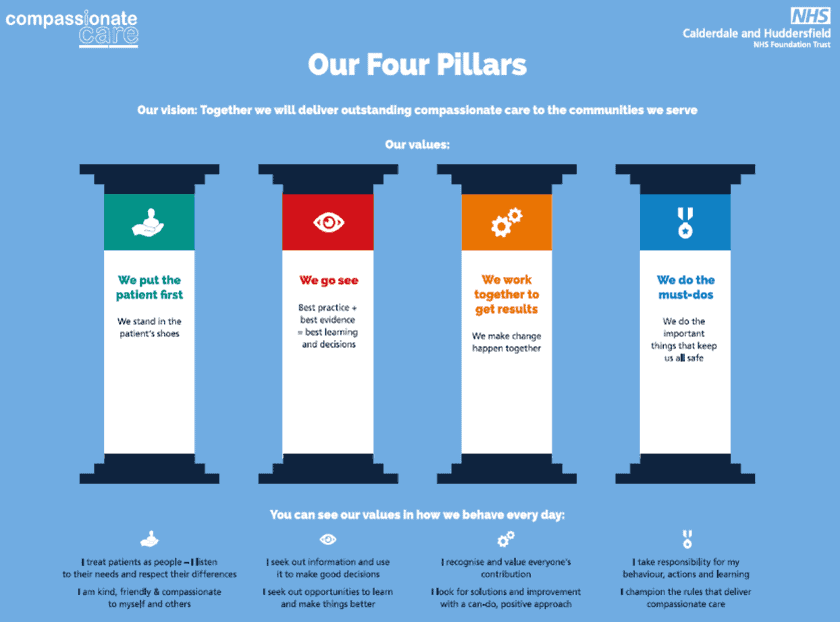
- We put the patient first – in this case the bereaved relatives
- We go see – identifying evidence of what comforts and supports relatives to manage their grief
- We work together to get results – a team to agree the scope and a team to deliver the initiative came together
- We do the must-dos – a support separate from the ward staff enabled the front-line teams to focus on direct patient care; ensured the system introduced was compliant with GDPR – advised by Information Governance team.
Planning
The project lead brought together a working group to review ideas gathered from colleagues to devise a plan for what the additional support for bereaved relatives would be and the resources required.
It was agreed the End of Life Care team (EOLCT) were best placed to co-ordinate and manage this new support rather than at ward level. The team benefited from the use of redeployed staff to enhance the service, enabling staff who were unable to contribute to direct patient care to continue to use their skills.
To support staff joining the team and provide assurance that those making the calls were following the required process a Standard Operating Procedure was developed. New staff shadowed experienced colleagues and where staff found calls challenging the EOLCT followed up.
The potential emotional impact on these staff was acknowledged, including by the Trust’s Patient Experience and Caring Group which formally recognised the ‘fantastic job’ and enquired if there was support required from the organisation. This was co-ordinated via the Trust’s Health and Wellbeing offer and the Trust Psychologist.
From previous experiences the EOLCT knew offering relatives a number to call for support was unlikely to achieve many calls therefore the team were keen to make proactive phone calls. Through experiences of running an Experience Based Co-design (EBCD) bereavement workshop the team knew a personal handwritten card rather than a printed one was preferred.
Key components of the service were specified and an assessment of who was placed to deliver these. The following are now an integrated part of the project delivery team:
- Clinical Governance Team: daily administration support
- General Office: provision of relatives’ details
- Mortuary: placing hearts with deceased patients
The content of the box was agreed as – handwritten card, marigold seeds, bereavement support telephone numbers, a handmade heart and information that a heart was also placed with the deceased patient. Telephone calls were made to the Next of Kin (NOK) 5-10 days after the death. Any feedback for the ward is timely, with an agreement to ring the relatives and address issues immediately rather than letting problems potentially worsen, with a follow up call from the Bereavement team to ensure issues had been dealt with. The team supports staff who have struggled with deaths on the wards by providing 1-1 meetings and signposting to the Trusts health and wellbeing initiatives.
Impact
Since March 2020 the Trust has had 1949 deaths and 1710 (88%) boxes have been distributed and 1239 (64%) phone calls made to bereaved relatives with follow ups and referrals onto different professionals too. As this was a service set up in response to the Covid pandemic it hasn’t been possible to provide quantitative benchmarked measures. Outcomes to date have been measured through qualitative feedback which has described the impact for relatives and staff involved in the process:
Examples of relatives’ feedback:
- “Heartfelt thanks for the card and heart, I loved that the card was handwritten as it made it more special, and that Mr B also had a heart. I slept with the heart the day it was received and had it with me when I did the eulogy. I am going to put the seeds on his grave”
- “I can’t describe the feeling when we got the box. Totally overwhelmed and speechless. Made us feel so connected and close to A – we were happy knowing he had a heart too”
- “As an employee of the Trust and someone with personal experience of dealing with the sadness of Covid, I would like to say, we are getting it right. My family found the bereavement box, containing a heart, some marigold flower seeds and a heart-warming message from the Trust comforting.”
Staff making the calls:
- “This service has really supported grieving families and friends who are feeling the sadness and loneliness of loss. So many people have thanked us for contacting them, providing help with any questions and passing messages of thanks to ward teams and providing a caring and compassionate approach at such difficult times. I feel that the development of this vital service underpins the core values of our organisation and the staff who work within.”
Staff supporting the administration:
- “During this scary and uncertain time it was very sad to see the daily large numbers of families who lost loved ones, however supporting this service felt like a very worthwhile small way we could help relatives and made us feel like we were playing our part.”
At the start of the pandemic impact was monitored via paper records unaware at that stage how long the project would run and how well received it would be. Once informed it would continue a more robust method of capturing the calls commenced to provide a more effective way of evaluating the service. Following discussion with Patient experience Quality Improvement colleagues we now have a section on the Datix reporting system, this will enable us to monitor outcomes, trends, and impact.
Standing Out
Our Trust believes this initiative is special as it places the relative’s wellbeing at the heart of the service. Being able to provide support for grieving families who may feel sadness and the loneliness of loss is a real honour and privilege. It is proactive service, provided for the NOK of all deceased patients – it embraces everyone – no one is left out. As far as we are aware no other Trusts provide this service, so ours is unique.
Main impact relates to the relatives’ experience with us as a Trust. The feedback has been incredibly positive. It has opened the 2-way dialogue with relatives which has been hugely appreciated. Trust colleagues have been open to hear concerns and deal with them in a timely manner to support families
Key elements that contributed to the success
- The staff who have been part of the team are from different areas and professions all coming together with a shared goal of supporting our bereaved relatives
- Being able to maximise the input from redeployed staff
- A very clear aim and structure where everyone knows what is expected of them
- The backing of the Trust from all levels.
Key Learning Points
The need to scope the specifics through a working group – considering:
- Workforce – nursing, General office, Clinical Governance administration, mortuary, support staff
- Funding – including any that can be accessed via charitable funds
- Storage – for the boxes
- Content of boxes and where the supplies will come from
- Hours of service – availability of staff
- Equipment – funding for laptops and telephones
- Day to day management – who will make calls, send boxes out, update deaths, maintain spreadsheet etc
- Governance – reporting/monitoring impact /GDPR / access to interpreters
Requires a business case detailing the service and where workforce will be sourced, potential costs and benefits. In addition, we recommend walking in the shoes of patients and their relatives – seek feedback regularly ensuring that it contains no bias and represents the extent of service users (e.g. use interpreters if needed).
Plan formal ways of evaluating the service and monitoring the impact from the start.
-
Improving our Colorectal Cancer Pathway Patient Experience
Nottingham University Hospitals NHS Trust
Contact: James Blackwell - james.blackwell@nhs.net
Organisation
Nottingham University Hospital Trust – With 15,000 staff, we are one of the biggest employers in the city with a central role in supporting the health and wellbeing of our local population. We play a leading role in research, education and innovation. We have a national and international reputation for many of our specialist services, including cancer services and we are the tertiary referral centre for colorectal cancer in the region. We operate upon approximately 250 patients with colorectal cancer per year, with many more patients having contact with our department via diagnostic, treatment or surveillance pathways.
General Summary
We have created bespoke, innovative and high-quality digital content (animations + social media) to guide and support patients through their colorectal cancer treatment journeys. Triggered by QR codes embedded in bespoke cancer patient pathway literature, this digital content condenses the huge quantity of patient literature previously given down to engaging, easy to share digital media.
Clear objectives and multi-level leadership have benefited this project. The governance group meets regularly and receives feedback from clinical champions within stakeholder working groups.
We report a 23% increased positive response rate (agree/strongly agree) to patient experience surveys. Our resources are in full clinical use and can all be updated in response to patient feedback and changes to clinical practice.
The design process centred around patient feedback and cancer survivor testimonials from the outset. We consulted multiple clinical stakeholders, working groups, addressed key elements of the pathway and connected discrete elements of the multi-disciplinary team. Since roll-out we have established continuous patient experience feedback.
Digital outputs from this project are fully transferable across the UK colorectal cancer population and indeed across other cancer groups. We have presented this project locally and are exploring dissemination via the colorectal expert clinical advisory group (ECAG) and Cancer Alliance.
Rationale
A pathway wide audit of our colorectal cancer service (externally commissioned via Johnson & Johnson) highlighted areas of excellence but also areas for improvement. The overall patient experience was highlighted as needing improvement. Concerningly, there were fundamental questions within the National Cancer Patient Experience survey where we fell below not only the national average but also standards we would want our patients or family to experience during contact with our service. For example Question 10: Patient completely understood the explanation of what was wrong, we scored 69% vs National average 79% and Question 12: Patient felt that treatment options were completely explained, we scored 78% vs National average 85%. We identified ten key questions requiring improvement having scored significantly below the national average. Our group felt that we should aspire to achieve 100% positive response rate to these questions.
We also saw opportunity to develop truly personalised stratified care, particularly during the period before treatment starts. In medicine this term is known as prehabilitation (like rehabilitation but before treatment). We wanted to develop an individualised risk assessment, targeting modifiable chronic health parameters, with measurable outcomes to target surgical risk factors.
We wanted to empower our patients to engage with their healthcare journeys. This requires clear communication, education about new diagnoses/how chronic disease increases their individual risk from surgery (and how we can support patients to modify this risk), whilst ensuring they feel fully informed and supported throughout. We wanted to improve the patients’ perception of continuity despite the huge number clinical/non-clinical staff involved in a patients’ care.
We are confident that our service delivers gold standard clinical care and it is important that this is reflected in the patient experience for both personal and professional pride across our workforce. Before this project patients received upward of >26 booklets upon receiving their cancer diagnosis. Many reported feeling overwhelmed by this and that the pages of written text were too much to digest.
We aimed to address the issues raised above by distilling current patient information into a single patient booklet, complimented by a series of informative/engaging animated videos. These resources guide the patient through their treatment journey from diagnosis to discharge and beyond. This addresses healthcare inequalities in those patients who have difficulties understanding written concepts and conveys large amounts of information in a visual format which is easily digested away from clinical environments.
Planning
A pathway wide audit of our colorectal cancer service (externally commissioned via Johnson & Johnson) highlighted areas of excellence but also areas for improvement. The overall patient experience was highlighted as needing improvement. Concerningly, there were fundamental questions within the National Cancer Patient Experience survey where we fell below not only the national average but also standards we would want our patients or family to experience during contact with our service. For example Question 10: Patient completely understood the explanation of what was wrong, we scored 69% vs National average 79% and Question 12: Patient felt that treatment options were completely explained, we scored 78% vs National average 85%. We identified ten key questions requiring improvement having scored significantly below the national average. Our group felt that we should aspire to achieve 100% positive response rate to these questions.
We also saw opportunity to develop truly personalised stratified care, particularly during the period before treatment starts. In medicine this term is known as prehabilitation (like rehabilitation but before treatment). We wanted to develop an individualised risk assessment, targeting modifiable chronic health parameters, with measurable outcomes to target surgical risk factors.
We wanted to empower our patients to engage with their healthcare journeys. This requires clear communication, education about new diagnoses/how chronic disease increases their individual risk from surgery (and how we can support patients to modify this risk), whilst ensuring they feel fully informed and supported throughout. We wanted to improve the patients’ perception of continuity despite the huge number clinical/non-clinical staff involved in a patients’ care.
We are confident that our service delivers gold standard clinical care and it is important that this is reflected in the patient experience for both personal and professional pride across our workforce. Before this project patients received upward of >26 booklets upon receiving their cancer diagnosis. Many reported feeling overwhelmed by this and that the pages of written text were too much to digest.
We aimed to address the issues raised above by distilling current patient information into a single patient booklet, complimented by a series of informative/engaging animated videos. These resources guide the patient through their treatment journey from diagnosis to discharge and beyond. This addresses healthcare inequalities in those patients who have difficulties understanding written concepts and conveys large amounts of information in a visual format which is easily digested away from clinical environments.
Public: We sough expert patient opinion from the colorectal expert clinical advisory groups (ECAG) patient liaison chair. This provided excellent insight into both his personal experience and lessons learnt on a regional level.
Delivery: We provided multiple staff education sessions frontline staff involved with the patient journey. We had a soft launch and three month pilot phase from February 2022. Cancer nurse specialists select appropriate patients to undergo the individualised risk assessment and they then receive the patient booklet.
Impact
An unexpected impact of this project has been upon staff groups not directly involved in clinical care (i.e. administrative support staff). They report greater understanding of the patient pathway and clinical terms used in patient correspondence. Staff report being proud to present patients with the booklet and believe it is a realistic representation of the care delivered.
Results (please see supporting evidence document):
Forty-three patients have received the booklet to date (22 patients having completed treatment and follow-up). We report a 23% increase in positive response rate (agree/strongly agree) to the ten key questions, which would have correlated to a mean of 17% higher than national average.
Patient quote: “After hearing ‘cancer’ I glazed over. The booklet and videos helped me understand what was happening to me and helped me cope with the whole experience.”
Patient quote after using booklet: “I did find it really useful that I could input into it as well as the clinical stuff. Doing the activity diary, saying I needed to be as fit as possible for the operation gave me the green light to get back running and boosting my fitness level up so I could be ready for the operation.”
Staff quote: “Patients have been able to show family members, ‘this is my diagnosis and this is my treatment plan going forward’. This have helped everyone’s understanding”.
Standing Out
This pathway wide intervention was designed to improve the continuity of care for patients and staff. Many projects impact discrete elements of the patient journey, we aimed for an over-arching intervention which connected many smaller elements, creating a seamless patient journey to enhance patients’ continuity of care.
Striving to deliver individualised stratified care with the patient at the centre. We believe that we have displayed intention and delivery of this key recommendation of the NHS Long Term Plan.
Thorough consultation process which included canvassing opinion, agreeing the common goal and designing interventions/solutions that worked for all. The sheer number of stakeholders makes this project stand out from others.
The overall professionalism and design quality of our resources has received high praise as this is not always experienced with the NHS. Clear objectives with the patient experience at the centre has allowed us to make impactful resources which are engaging and informative to patients. Bridging the gap between clinical knowledge and patient facing information is key to patients understanding their conditions and treatment options.
Key Learning Points
Patients told us what information they wanted – always involve patients from the outset, listen and give them what they want!
Patients retain a limited amount of information once they are given a cancer diagnosis. Information we provide often looks poor, is outdated or undigestible. We had to look critically at the information we were giving out to make positive improvements.
Ensuring patient understanding and expectations are set at point of diagnosis and then met throughout their treatment journey is key to maintain high patient experience levels.
Engage a large group of stakeholders – this allowed us to look at pathway wide issues, many of which were aspects of care traditionally separately delivered (i.e. preoperative assessment and post operative care).
Engaging all staff, with a common vision and goal, remembering that every patient contact counts maximised the patient experience impact of this project.
-
Closer to Home Virtual Clinic Project
Dementia UK
Contact: Helen Green - helen.green@dementiauk.org
Organisation
We’re Dementia UK – the specialist dementia nurse charity. Dementia is a huge and growing health crisis. Almost all of us will know someone with dementia – whether it’s a family member or a friend. There is no cure for dementia. But there is care. And care can change lives.
Our nurses, called Admiral Nurses, who we continually support and develop, provide life-changing care for families affected by all forms of dementia – including Alzheimer’s disease. For families affected by dementia, they can be a lifeline.
When people are struggling, our nurses help them take back control. When family and friends are worried about a loved one, they give them confidence to manage their future with dementia. We help people living with dementia stay independent for longer and support the people caring for them. We help to give them the strength to cope with the bad days, and the energy to enjoy the good days.
General Summary
A new virtual clinic launched during lockdown offering free, confidential, easily accessible appointments with an Admiral Nurse by phone or video call which quickly expanded to meet the increasing demand for support.
The development of a bespoke booking platform with user-friendly technology to facilitate sessions, achieved by sharing clear objectives, use of common language and a strong leadership presence driving the project forward.
Collaborative working between Dementia UK, an external software consultancy company and the Lived Experience Advisory Panel (a panel of people living with dementia and family carers) led to a highly valued service that continues to grow and receives consistently high feedback. 6-monthly evaluation of appointments booked and reasons for making appointments demonstrate both the complexity of support given and benefits gained by families.
The service has been established for just over a year, having helped over 1,900 families and continues to grow. The model is now being replicated for other areas of the charity and a business model for other agencies is being developed which is already being trialled.

Rationale
Closer to Home was created thanks to a partnership between Dementia UK and Leeds Building Society. The original plan was for a mobile support centre travelling around the UK offering Admiral Nurse appointments in local communities. Due to the pandemic and instructions to stay at home, this service needed to be adapted quickly so support could still be offered.
The Closer to Home project was restructured within 4 weeks into a virtual clinic offering families free, confidential phone or video appointments with an Admiral Nurse. This was at a time when other services were reduced or withdrawn and families were often in crisis, experiencing high levels of carer stress with no support available.
The online self-booking system meant people could chose a time and date convenient to them and not have to make alternative care arrangements. It negated any concerns around travelling to an appointment location, allowed families to adhere to government guidance, and removed any issues in relation to physical health or reduced mobility or taking time off paid employment.
Planning
Launched in June 2021 using a basic booking system embedded in the Dementia UK website, sessions were facilitated by telephone or by Zoom. The initial offer was 12 appointments/day, three days/week supported by one full-time Admiral Nurse and sessional Admiral Nurses from other areas of the charity.
As Clinical Project Lead, I instructed how sessions could run, provided training and support for nurses, and recruited nurses from across the charity. I provided leadership to ensure a strong team ethic whilst working remotely, and consistency in service provision. Through identification of key people required, a steering group drove the project forward consisting of:
- Information Services, to create suitable platforms and software
- Social media and Communications, to develop web content
- Insight and Evaluation, to collect user feedback and generate 6-monthly reports
- Lived Experience Advisory Panel (LEAP), to give guidance on terminology used and ways to make booking process simpler
Initial feedback collected identified the virtual clinic as a beneficial resource with an increasing demand for appointments. The service was therefore extended to four days/week. However, the booking system struggled with increasing volume. A review of data collected after six months highlighted increases in missed appointments and technical issues, or available appointments not being taken, as well as high levels of administration.
It became clear a new booking process and software was required. Through collaborative working with an external software company, guided by the steering group, a bespoke booking system was created that simplified the booking process, clearly showed available appointments and automated many administration tasks. Members of LEAP were involved in to ensure questions asked and terminology used was clear and respectful. Family carers who had accessed the service were asked for their views and feedback on changes made.
Closer to Home has now expanded to five days/week, supported by four full-time nurses in addition to the Clinical Project Lead. A Project Manager was recruited to support the planned operation of the mobile support centre alongside the virtual clinic, with plans to add more nurses and an administrator in the next few months.

Impact
Since launch over 1,900 families and allied professionals have accessed the clinic for support. Admiral Nurses have assisted families throughout the world. The use of video enabled family members to share concerns and information from Admiral Nurses at a time when government guidelines meant many families were separated.
The first 6-monthly evaluation, compiled from the charity’s clinical database and user feedback, shows both the high number of people accessing the service and the reasons for their contact. Along with high levels of satisfaction with the service, it also shows the range of support and complex situations Admiral Nurses were able to advise on when other services were either reduced or withdrawn (see evaluation report submitted for further details).
The use of quality measurement tools to measure concerns and their underlying causes led to areas for improvement being identified and actioned. Tracking the effectiveness of changes made has shown decreases in missed appointments and administration time needed. This has enabled service expansion from three to five days/week, with an increase of 150% in appointments offered since service launch (see FNF presentation poster).

The Future – The increased demand and positive feedback demonstrate both value and need, so virtual clinics will now continue beyond the project end date and operate indefinitely, possibly alongside Dementia UK’s existing telephone helpline service, to offer alternative support to those living with dementia.
A business model is being created based on Closer to Home to promote to other organisations. The virtual clinic can be tailored to the host’s needs to offer support to their workforce. Good examples of this are the trial clinics with a sporting association and a prison service, providing specialist support to associations that in turn support ex-employees, or professionals who may work with people living with dementia.
Closer to Home has also pivoted to provide virtual support during periods of extended absence of community Admiral Nurses, so that families in the area continue to access Admiral Nurse support. This method of clinic delivery extends service sustainability which may have otherwise been interrupted.
Ongoing collaboration with the software company is now enabling the charity to further bespoke the new booking system and tailor this to the needs of other hosts. For example, carers will be able to reschedule their own appointments should circumstances change, rather than currently cancelling then rebooking.
The service is looking to recruit more full-time nurses and is taking the mobile support centre on the road in 2023, offering face to face appointments across the UK alongside the ongoing virtual service.
Standing Out
This project identifies the needs of families affected by dementia and recognises difficulties they face in getting support and attending appointments when they have numerous other commitments.
It was developed very quickly in a pandemic when other services were reduced or even withdrawn. Despite the obstacles government guidelines and restriction of movement created, Closer to Home has supported hundreds of families, minimised the risk of carer breakdown and offered a much-needed lifeline.
The system is adaptable and can be tailored to the needs of any potential host. Using virtual platforms reduces costs such as travel, office space and related costs. The booking system is simple to use and easy to amend to offer timings of appointment timings.
The strong leadership and supportive team of Admiral Nurses, plus input from other Dementia UK departments, means the service tackles challenges with speed and efficiency. The mix of clinical skills, experience and ongoing training from Dementia UK means Admiral Nurses offer the latest evidence-based advice to families affected by dementia.
The Closer to Home service is also completely free and can be used by anyone in the UK regardless of their physical location.
Key Learning Points
- Start with a clear vision of what you want to achieve, focusing on who will benefit and what you want to deliver.
- Prepare to be adaptable and open to suggestions or alternative solutions from other parties.
- Strong leadership and effective communication, using shared terminology, will help drive your project forward. Identifying key people who can support and implement development of the project is essential.
- Be prepared to think outside the box and explore different resources. Ultimately a strong team bond and support for each other will help see the project to completion and successful ongoing delivery.
-
Homeless Patient Guidelines Initiative
Gloucestershire Hospitals NHS Foundation Trust

Contact: Shona Duffy - shona.duffy@nhs.net
Organisation
Gloucestershire Hospitals NHS Foundation Trust consists of Gloucestershire Royal (GRH) and Cheltenham General Hospitals (CGH). Our Trust employs more than 7,500 members of staff and sees in excess of 700,000 patients every year. These specialist hospitals provide emergency care, specialist inpatient care and outpatient appointments to our urban and rural communities within Gloucestershire and further afield.
General Summary
This project was innovative in that it was started from fresh with no foundations to build on. By working as a team, we have created guidelines, documentation and created multiagency pathways direct from the Emergency Departments.
The Leadership style initially started as democratic in nature. With social equality as a focus, as the momentum around the project grew it turned to a more transformational collective leadership.
The project was effective as staff now report feeling supported in making more holistic assessments of homeless patients. The documentation we have created has become a core part of Emergency Department documentation, leading to homeless patients being better supported on discharge from the ED.
The success of this project has been measured on the number of referrals made to the local authority and other homeless services. The support we have had from our teams has been phenomenal. This project will be sustainable as our teams have seen a real time reduction in the number of no fixed abode attendances, leading to reduced pressures on the ED. The success of the project has lead to further support and interest from other departments, and it is now included in the role of the new Homeless Specialist Nurse to adapt, transfer and disseminate the project across the acute trust.
Rationale
There are 320,000 homeless people in Britain. This number is on the rise and has risen by 169% since 2010. Gloucestershire Hospitals Foundation Trust (GHFT) sees between approximately 400 – 700 No Fixed Abode attendances to its two Emergency Departments (ED) annually and this number is rising. These figures are do not take into account hidden homelessness – those that are staying with family or friends, squatters, those in overcrowded accommodation and victims of abuse. These are deemed to be in the “at risk of homelessness” group. It was vital we implemented measures from ED that could potentially break the cycle of homelessness by initiating support early at the ‘hidden homeless’ stage before it moves onto street sleeping.
In 2017 the Homeless Reduction Act was introduced. This places a legal “duty to refer” on the trust to refer all those that are homeless or at risk of homelessness to a Local Authority. Long-term homelessness is characterised by tri-morbidity (combination of mental ill health, physical ill health and drug or alcohol misuse).
This results in emergency care costs that are eight times higher than for patients who are not homeless. Clinicians in the ED may well be the first and only healthcare professionals that a homeless person may see. It is therefore important that it be recognised that this encounter could be a key opportunity to improve the lives of this group of vulnerable people.
In 2013, Dr Pippa Medcalf initiated a Time To Heal project in the Trust which saw the employment of a Housing Officer for homeless inpatients at GRH. This project was very successful with the housing officer securing accommodation on discharge in 84% of referrals to him.
The main limitations of this project what that it only covered inpatients at one hospital site and as ED’s are classified as outpatient departments, she often found resistance and barriers to improving care in the EDs.
At the time the cultural norm across Emergency care in the Trust was to discharge homeless patients back to the street’s day or night with no ongoing support offered. The Trust also had no overall policy or documentation in place to support staff in caring for homeless patients.
Although I have worked in unscheduled care for the last 8 years, I was suddenly more aware of homeless patients being discharged back to the streets with no support. I started volunteering with local homeless charities and spent time with the Homeless Healthcare Team (community-based GP services).
Main aims at this time were:
- to see if there were services that we could refer homeless patients on discharge from ED?
- If so, when could we refer
- Was it realistic?
- Would it meet the demands of the ED staff who are under enormous pressure
The overwhelming response was that all services felt they needed communication from the ED and that there was a lack of joined up care when it came to homeless patients.
I worked with the Local Authorities and local services to create referral pathways and the ED homeless patient guidelines were initiated. This gave staff options to refer patients 24 hours a day to the Street Outreach Teams. I used this as an opportunity to improve the overall care we give to our homeless patients by implementing immediate ongoing support from the ED.
I gave a presentation to the Medical Division Showcase in the Trust. Here the initiative gained more management support and we could initiate the project across both EDs in the Trust.
Planning
We set up a working action group which had one team member from each staff group (doctor, nurse, modern matron, emergency nurse practitioner and senior sisters). These groups were key in delivering the initiative.
Becca and I undertook Quality Improvement training from our Trust Academy and set about creating our documents and collecting data. Dr Helen Mansfield (ED consultant) supported us throughout the Quality Improvement process and helped with data collection. She worked with IT to provide us with a report that allows us to see No Fixed Abode presentations in real time.
We created the ED homeless patient checklist. This was trialled in the departments and altered as per feedback from staff before going through the documentation committee. This document covered our duty to refer but also enables staff to refer homeless patients for ongoing support immediately on discharge from ED.
We updated our Homeless patient information leaflets with help and support from the Trust Information Governance team.
We worked with local charities to ensure our homeless clothes cupboard is well stocked with sensible supplies for homeless patients.
I continued to volunteer with local charities and keep up the Multi agency working to ensure the new referral pathways continued to work for all involved and any issues were resolved quickly.
We provided teaching for all staff groups in ED, both regular and Ad hoc teaching sessions were provided. Working with reception staff was important are key to identifying NFA patients. We also used noticeboards in staff rooms for poster presentations and communicated with our teams via email for updates and to share positive results.
As I worked on one site (GRH) and Becca in the other (CGH) we were able to educate and problem solve as we worked, with our teams feeling comfortable enough to contact us with any issues.
Impact
We used data from the IT report and our completed checklists to monitor response.
Our target group was homeless patients that were medically fit for discharge from the ED.
Those that did not wait for assessment were discounted from the figure as all referrals can only be made with the consent of the patient.
We took the figure from the IT report and compared it with number of checklists completed to give us a compliance rate. As this was a new process, a new document to complete and staff were used to discharging patients back to the street. We were also heading into the busiest time of year in ED, so we set an initial compliance aim of 30% over 6 months.
Our results showed that at time of audit, we had hit a compliance rate of 84%.
3 months data isn’t enough to show a definitive trend yet, but certainly as our compliance rate is increasing so the re-attendance rate for homeless patients is reducing, therefore reducing the pressure on ED. And more importantly homeless patients are receiving early vital support.
There are still some IT limitations; our report only picks up No Fixed Abode attendances and not those who book in with old addresses or a friend or relatives address. We have emphasised in our teaching how important social assessments are in picking up on the hidden homeless group and the at-risk group. While auditing we have had a lot of checklists completed for patients who weren’t on our report. So, we are hopeful that staff are doing some very good social assessments and initiating support, therefore leading to improved continuity of care and reduced admittance to the acute trust.
We would normally expect our NFA attendances to increase over the winter months, however so far we are seeing a downward trend.
Homeless patients often present with complex social, mental, physical and emotional needs. As a trust we had no policy, or guidance to support staff in making good holistic assessments of homeless patients. Armed with work undertaken for this project we met with commissioners in May 2019. We secured funding for an additional housing officer to work at Cheltenham General Hospital and a Trust Homeless Specialist nurse. This role will be utilised to initiate guidance and support for staff in caring for homeless patients and to keep the momentum going with this initiative in the Emergency Departments. This role will bridge the communication gap between the acute trusts and community services – leading to better joined up care and better outcomes for homeless patients.
Relevance to Others
This initiative is relevant to any group that cares for homeless people.
ED traditionally doesn’t communicate out to community teams but work for this project has led to close working relationships being formed with local services that provide ongoing support for homeless people. Street outreach teams now feel comfortable enough to come into the ED and assess patients. This new working relationship has led to some homeless patients being accommodated direct from the ED instead of back to the street.
Parts of this initiative have been presented nationally as part of Dr Medcalf’s inpatient initiative. This has led to other hospital trusts emailing us and asking for guidance in implementing similar measures in their own Emergency Departments.
Standing Out
This initiative has been started from scratch. From volunteering, learning and communicating GHFT now not only meets legislative requirements but ensures ongoing support is implemented 24 hours a day for this vulnerable group of people. Work for this initiative has led to homeless patients now being safeguarded by the trust.
Becca and I working in the ED teams has played a big part in seeing a cultural shift and implementing a change. Adding in a document to workload isn’t easy, but I think our knowledge and understanding of the service has led to this initiative being successful. All our referral pathways were made with ED service demands in mind and what could realistically be achieved. The community services were very understanding about this and we worked together to create pathways to suit all our services. This led to a higher than expected compliance rate and improved care.
Key Content Points
Be realistic and find out from staff that will be carrying out the work what is important to them.
- Making a cultural change can be hard- some negativity is to be expected. Use it constructively.
-
Continuous Engagement & Communication Through a Pandemic
Welsh Ambulance Services NHS Trust
Contact: Gareth Thomas - gareth.w.thomas@wales.nhs.uk
Organisation
The Welsh Ambulance Services NHS Trust is the national ambulance service to 3 million residents across Wales. The Trust employs more than 3,000 people with a mix of skills, ranging from advanced clinicians, through to a variety of clinical and non-clinical and support staff. We operate from in excess of 100 different bases across Wales, including traditional ambulance stations, shared facilities with other services, clinical contact centres, maintenance, repair and cleaning facilities, administrative and training centres. We are also the host for NHS 111 Wales service, which is an amalgamation of NHS Direct and the front end call handling and clinical triage elements of the GP out-of-hours services.
General Summary
This last year has been like no other and for us as a public service; the need to effectively listen to people during the pandemic, help them with their concerns about covid-19, invest time in sustaining our relationship with communities and be a visible source of support, comfort and information has been vital.
The pandemic helped nurture a creative and innovative environment to engage online, we acted quickly to deliver information and resources. From the outset we recognised that not everyone was able to access or interpret Government, local public health information; people told us they felt overlooked and invisible, heightening their sense of worry. Acting as the public/patient voice we ensured this was shared across the Trust, Public Health and Welsh Government. Through continuous engagement and surveys we have asked people the impact our response has had with engagement reports being shared with our Quality Committee. This last year has enabled us to reimagine the role and function of patient experience and as we move out of the pandemic we have developed a vision for sustaining a far reaching online channel supported by face-to-face sessions, re-enforced through continuous engagement.
Rationale
Prior to covid-19 pandemic the Patient Experience & Community Involvement team within the Welsh Ambulance Service had a well-established, very strong continuous engagement model. This model provides a rich, ongoing conversation between the public and the Trust. It creates and nurtures a sustained relationship with the public that stimulates interest, encourages involvement and builds trust needed to achieve service improvement whilst ensuring the delivery of quality services.
Overnight our working practices changed but peoples need for help, advice and information didn’t. We needed to ensure continuity of engagement, access to relevant information and having a point of contact within the organisation for communities. We didn’t want people to feel ‘abandoned’ when the announcement came to stay home, self-isolate and only use the NHS for emergencies. For the public an ‘emergency’ meant many things, we prioritise 999 calls against three categories ‘Red, Amber and Green’.
We heard that people with genuine emergencies were not contacting 999 when they should. This was due to worries about covid; not wanting to put pressure on the NHS and not wanting to go into hospital. For many others they were confused by the messages; they couldn’t access information and struggled with the sense of isolation and loneliness of lockdown.
From previous engagement we anticipated that learning disability; dementia and sensory loss groups in particular would be experiencing the impact of the pandemic harder than most. We wanted to ensure we address this and shared our learning with other teams across the NHS.
Planning
The Covid-19 pandemic impacted on the way we engaged and communicated with patients, their families, carers and the wider public. Our continuous engagement model moved online, we continued to talk/listen to communities throughout the year without losing pace.
It quickly became apparent that people with a learning disabilities were feeling frightened and nervous about seeing NHS staff wearing PPE and; for people who were Deaf, PPE was creating a barrier to communication. In helping people understand the need to wear PPE and alleviate any anxieties or fears we created 2 key resources explaining the need for PPE. We developed an animation video explaining the PPE staff wear and presented it in such a way that the community would understand the contents and an easy read information sheet to accompany the video. To improve communication we sourced clear masks and provided information to staff on what they could do to help communication with people who were Deaf.
Throughout the year we worked in partnership with communities in considering their needs and the key messages/information needed and how we would present the information. Requests ranged from immediate, up-to-date covid information; self-help information and access on what we were doing to keep people safe. Influencing factors included the need for translation; managing communications and behavioural practices of the audience; and responding swiftly and meaningfully to those with different language and communication needs.
A number of consistent themes from all communities was that covid-19 meant changing our engagement approach; improving communication and accessibility to information however; four groups in particular were significantly impacted. The following examples show what we achieved during a challenging and unique year:
Learning Disability (LD): we adapted to the new virtual world of communication overnight, we carried on building strong partnership links and maintained those we already had with the community. We continued to communicate and stay connected by facilitating community/group events via virtual platforms ensuring access to information that they wanted in a way that they understood. The LD community were really grateful that their voice and been heard and importantly that we had listened to their fears and decided to take positive steps by developing these resources
Dementia: we quickly moved our engagement to digital platforms where we worked heavily with third sector partners to listen to issues people affected by dementia were faced with. Skills in using online technology was a concern for many and many people were not able to get help, advice and peer support due to this, so writing letters and telephone calls become common place. As well as concern over staff using PPE equipment and this being a barrier to communication for most, another area of difficulty for people living with dementia was their carer not being able to be transported with them into hospital. We carried out a lot of information sharing to let people know what we were doing and alleviate anxieties in advance.
Information for people with sensory loss: Right from the very start of the pandemic we began receiving feedback from the sensory loss community, telling us that they were concerned about communication and accessing all the information they needed about how to keep themselves and their families’ safe during the pandemic. Some told us they felt abandoned as there seemed to be so much important information out there, but none of it was accessible to them. Others also told us that the additional PPE our staff must now wear was creating an extra barrier for them when trying to communicate with us.
We produced our own bespoke information in formats that were accessible to people with a sensory loss. These included a BSL video about what coronavirus is, symptoms to look out for and when to isolate. We produced an accessible video in BSL and with voice over audio that explained PPE and why staff wear it, as well as an accessible video again in BSL and with audio voiceover that encouraged people to download and use the NHS Covid symptom tracker app.
Children: with children being home schooled during the pandemic we were unable to deliver our annual face to face ‘Shoctober – life saving’ sessions in schools across Wales, so, in partnership with Centre of Sign Sight Sound, we developed a trilingual (Welsh, English and British Sign Language) educational animation for foundation phase and Key stage 2 learners. Watched as an assembly, classroom lesson or as part of blended learning, the animation explains when to call 999 by playing a big/little accident quiz and how to do CPR safely while help is on its way (considering Covid safety measures). The animation has been supported by the Welsh Government and hosted on the educational platform Hwb for all learners across Wales to access.
Following discussions with a Clinical Psychologist and a Cardiff Lecturer in Social Development to understand and consider how to influence positive behaviours and encourage children/young people to become resilient members of the community, in partnership with DotC Studios Ltd a bilingual gaming app ‘Blue Light Hub’ was developed. The app hosts four games covering content around familiarisation of uniforms (including the wider NHS and emergency services), what happens when you call 999, appropriate use of 999 and managing expectations regarding Ambulance resources.
The lightly challenging elements allows the player to become familiar with appearances, and take on various roles and challenges taken on by the emergency services. The player is encouraged to return to the hub frequently, developing a familiarity with the theme, further encouraging them to make better choices about how to treat the emergency services, and what to do in difficult situations.
Impact
An important question we have kept asking ourselves is ‘So What’? With all this engagement carried, so what effect has it had? So what has been the outcome for people? The challenge with patient experience is that it is often difficult to measure the impact.
What we have demonstrated is that ‘Engaging & Championing the Public’ is not a one off activity but works by being part of an integrated system, in our case, part of a continuous engagement model. We engaged, listened, involved people in developing and disseminating information and captured feedback on how this had been received by communities. The ‘public’ is not one homogenous group but is made up from many characteristics and needs, a one size approach to communication and information does not work and you have to consider the reach and accessibility of information and your organisation.
As part of our Trust wide evaluation of how we responded to the pandemic, we ran a Covid-19 Patient Experience survey. This allowed us to better understand what people thought about the services we delivered, how we continued to engage and the information we produced during the first stages of the pandemic. To enable us to gather feedback from as many people as possible, we also produced an accessible version of the survey in BSL and with audio voiceover.
Standing Out
The impact of the pandemic, the immediacy in which people were affected and the sudden change in our practices have never been experienced before and have shaped and strengthen the way we plan engagement in the future. In the past our approach was very much on the needs, experiences and expectations of a particular group. In looking at the larger picture and how we, as a service, impact on people from an equality perspective means that we no longer engage with groups as a particular characteristic. Instead we look at whether our services, information and systems reflect the needs of all.
Key Learning Points
- Develop a strong foundation with your communities.
- Invest in time; time to build trusted relationships and get to know their needs, expectations and preferences.
- Always listen and consider the reach and accessibility of your messages, information and organisation
-
`Butterfly Cornwall` A Scheme to Enhance End of Life Care for Patients and their Loved Ones
Royal Cornwall Hospitals NHS Trust
Contact: Elizabeth Thomas – elizabeth.thomas26@nhs.net
Organisation
The Royal Cornwall Hospitals Trust Treliske Hospital is located in Truro, Cornwall.
Royal Cornwall Hospitals NHS Trust (RCHT) is the main provider of acute hospital and specialist services for the majority of the population of Cornwall and the Isles of Scilly, approximately 450,000 people. The population we serve can more than doubles during busy holiday periods. The Trust employs approximately 5,000 staff.
We deliver care from three main sites – Royal Cornwall Hospital, Truro; St Michael’s Hospital, Hayle; and West Cornwall Hospital, Penzance – as well as providing outpatient, maternity and clinical imaging services at community hospitals and other locations across Cornwall & the Isles of Scilly.
General
The Royal Cornwall Hospital Trust `Butterfly Cornwall ` is an innovative initiative to improve the way patients and their loved ones spend their last day’s together .The Scheme is led by the Trust’s Specialist Palliative and End of Life Care (SPEOL) team.
The scheme acts as an enabler for quality at the end of life. It aims to enable all staff to provide equitable care and compassion for patients and their families who die in our care. The scheme helps staff provide extra support when required such as offering refreshments, keeping noise to a minimum and checking if relatives or carers need additional support. The outcomes being improving support and communication to patients /relatives at end of life and enabling staff to gain confidence in caring for patients at end of life.
The sustainability of the scheme will be ensured by a further twelve-month project post to continue to embed the scheme and will be linked to the Trusts ‘Ward Accreditation Scheme’. Financially the scheme has support from the Trust’s Charitable Funds Committee, League of Friends and Macmillan.
The scheme itself is a model that can be easily adapted for use in other settings. There are plans to roll out the scheme in the community hospitals in the County this year.
Rationale
The aim of the initiative is to empower staff with the required skills and confidence to care for patients approaching end of life and their relatives. Encouraging communication and identifying what is important to the patient. The initiative was developed as the team realised that often the needs of the relative were overlooked with a variation in what wards were offering in the form of support. Similar schemes have been implemented in other areas with success.
The butterfly is the symbol for end of life care in the Trust and appears on the Trust’s End of Life paperwork.
Butterfly magnets and stickers along with yellow `dignity clips` were funded by the Hospital League of Friends. The magnets are placed on the door or above the bed of the patient that is approaching end of life to identify to staff that sensitive conversations may be taking place, to be aware of noise levels and to ensure relatives are offered extra support such as food and drinks. The clips are placed on curtains that may be closed around a bed in a bay to again highlight an end of life situation. Consent is gained from the relative or patient prior to these indicators being used.
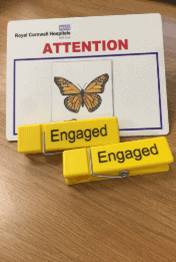
A letter is given to the relatives explaining what the scheme entails and what they can expect under the scheme.
The scheme includes, snack boxes, hot drinks, open visiting, parking permits, guest beds, meal vouchers and pet visits. In addition the SPEOL team also have developed :
- Comfort bags ‘which contain the essentials that relatives may forget when they have a loved one admitted suddenly. These contain toothbrush, toothpaste, comb, details of shower facilities, drink, snack etc.
- Butterfly Bags which are for the deceased belongings – these bags aid sensitive communication and are a dignified way of returning belongings.
- Wedding Boxes – containing a picture frame, disposable camera, confetti, bunting, photo album, candle, champagne flutes and wedding card. These are held by the chaplaincy team for end of life weddings.
- Rainbow Days` adding colour to someone’s day has also been introduced as part of the scheme.
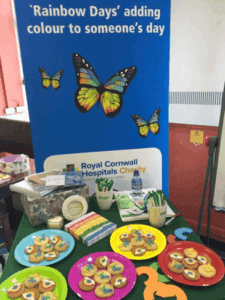
This particular aspect of Butterfly Cornwall is supported by the trusts `Charitable Funds` it aims to encourage staff to ask the patient what is important to them. Since the introduction of the scheme we have had ad-hoc gestures by staff such as , providing a favourite tipple, a bacon sandwich and arranging for a cat to visit. We have also facilitated a visit to the beach, a manicure and arranged for a hairdresser to visit. Requests could be as simple as wanting to read a favourite magazine or eat a special meal. The aim of the Rainbow Days initiative is to make the granting of these wishes accessible to more patients highlighting just one of the elements of the holistic approach to care that is already widespread across the hospitals teams. Giving staff permission to `break the rules`. Staff that are nominated for facilitating a Rainbow Day are presented with a rainbow badge and certificate.
- Tea sets for each ward for use for families following bereavement, to add a more personal touch at a difficult time.
- `Comfort Boxes` containing fleece blankets/crochet blankets for patients and `Comfort Bags’ for all areas including the emergency department to optimise comfort for relatives and patients. The blankets are single use and loved ones often take them home as a memory.
- Meal Vouchers for use in the hospital canteen – to enable a break for loved ones
Planning
The scheme was originally planned and led by the Specialist Palliative and End of Life team. The scheme was initially piloted on an acute stroke unit to measure the test of change. The SPEOL team trained 50% of staff in use of the scheme prior to roll-out with ward-based education sessions on how to use the scheme, anticipatory medication guidance and priorities for care paperwork. The education continued until all staff had received the required training. Since the initial pilot of the scheme in August 2018 a twelve-month project post was funded by Macmillan to enable the scheme to be rolled out trust wide by December 2019. Funding for a further twelve months has been applied for from March 2020.
The scheme is also supporting the redecoration of side rooms and quiet rooms throughout the trust. The pilot ward obtained funding for redecoration of a side room to include artwork and new flooring. This work is now completed and remains a dedicated side room for end of life patients. Other wards throughout the trust are following this initiative. The SPEOL team have additionally obtained funding for a guest bed for each ward in the hospital to ensure comfort for relatives staying overnight. The project lead and the SPEOL team maintain supportive visits to ward areas.
Impact
The impact/success of the scheme has been measured and presented in a clinical audit report undertaken by the project lead.
A pre–training questionnaire was given to staff and this was followed up by a post training questionnaire with tick boxes and space to add notes for personal reflection, ideas and comments. Data was collated onto an Excel spreadsheet by ward and then a cumulative sheet for analysis to identify learning and develop future plans for analysis. Five main areas were looked at for the purpose of the audit.
An example of the results of one of the questions:
Do you feel ‘Butterfly Cornwall’ has improved end of life care on your ward?
155 answered this question and 90% feel they can see an improvement in EOL care on their ward. This is really positive as the success of the scheme is reliant on the engagement of staff, so where they can see an improvement they are more likely to continue the practice and maintain the momentum of the scheme. When we looked at the results for individual wards, we can see that some areas (4 of 14 sampled) had 100% ‘yes’ to this question which is fantastic. Ward specific comments for this question are generally positive talking about raised awareness, increased knowledge, better understanding and closer links with specialist palliative care team.
Relevance to Others
`Butterfly Cornwall ` has been presented at the senior nurses meeting for the local community hospitals. The community hospitals plan to roll out Butterfly Cornwall throughout 2020. Resources have already been shared to ensure standards are maintained.
The butterfly magnets have been adopted by the trusts Neo-natal unit for use in end of life situations.
The Wedding Box idea has been utilised by other trusts following interest from the teams twitter page alongside the `Butterfly Bags` for deceased belongings.
A relative shared their poor experience of their loved ones care with Healthwatch. As a result of this a short film highlighting the issues around the case is shown at mandatory training. The concept of `Butterfly Cornwall` was shared with the relative and representatives from Healthwatch who felt the scheme addressed some of the issues raised regarding communication and personalised care.
Standing Out
This initiative is particularly special as it aims solely to improve the support and care we give to patients and relatives approaching end of life in a personalised way. It removes the clinical aspect and focuses on what matters to the patient and family. The acute setting can be a difficult place to implement personalised care at end of life, however there are many patients that remain in hospital for the last few days of life and the scheme aims to ensure effective communication between patients and carers and ensure that the needs of both are met at a difficult time.
One of the aspects that have contributed to its success is the simplicity of the scheme. It is easy to use and does not put additional pressure on staff working within the clinical areas. Feedback from staff is that they found it easy to use and it helped them think differently regarding caring for patient/relatives at end of life. Noting that it is often the small things that make the most difference. Feedback collated through an audit of the scheme has evidenced this.
It is also inclusive of all staff working in the ward area including ward clerks, house keepers, nurses, doctors.
This we have found has made non-clinical groups of staff fell more involved and aware of end of life situations on the wards. Taking the education to the ward area enables us to work around the staff during busy periods.
Although there are similar schemes in other areas Butterfly Cornwall has developed its own individual and original initiatives such as `Rainbow Days` a highly successful initiative for staff which makes this scheme stand out from others. Additionally, the team are involved in developing high profile countywide fund raising ideas that promote the scheme and raise awareness nationally. An article regarding the Scheme has appeared in Macmillan Voice and local newspapers.
Key Learning Points
- Keep it simple as staff do not have time for long periods of training
- Take the training to the staff – keep it ward based
- Training certificates and butterfly badges are used an initiative for training completion
-
Digital Patient Stories for Service Improvement
Swansea Bay University Health Board
Contact: Prue Thimbleby – Prue.thimbleby@wales.nhs.uk
Organisation and General Summary

Swansea Bay University Health Board is one of the seven NHS Health Boards in Wales. We have over 12K staff delivering all primary and secondary health care, including mental health care, to a population of 400+K in South Wales. The Health Board is divided into 5 delivery units: the 3 main hospitals, Community & Primary Care, and Mental Health & Learning Disabilities. We cover the geographical area of Swansea and Neath and Port Talbot councils.
The patient story work in the Health Board is led by the Arts in Health coordinator (Prue Thimbleby) working closely with the Deputy Director of Nursing and Patient Experience (Cathy Dowling) and the Patient Experience Manager (Marcia Buchanan).
Winner – Turning it Around PENNA 2019
We improve services through listening to our patients and taking action in response to their stories.
- We use digital storytelling as our methodology.
- A digital story is a 1st person voice recording put together with images to create a 2 to 5 minute video.
- The process of making a story is deep listening and brings profound resolution to the teller. The completed story creates empathy in the listener – thus leveraging changes of attitudes and practice.
- The patient remains the director of their story, they own the story and do as much of the editing and presenting the story as they wish to.
- We train and support frontline staff to record patient’s good and bad experiences and then create action plans to improve services. We have built an intranet site where staff can access the governance documents and a library of stories. Stories are used widely in meetings, training and business cases. We can demonstrate significant service improvements as a result.
- We are training a network of story facilitators across Wales and plan to build an all-Wales library of stories so that we can make our patient’s voices central to our learning.
- Health providers in England are also asking for training.
Rationale
In 2012 the Health Board appointed an Arts in Health Coordinator who had a background in digital storytelling. At that stage there was a very large backlog of complaints and the Arts coordinator was asked to make digital stories with the complainants. It proved to be a very effective way of patients finding resolution after many years of waiting. One woman said ‘the night after I had told my story was the first time I slept through the night in 22 years’.
At the same time the Board of Directors meetings were starting with patient stories, but they were often poor quality and time consuming – ranging from power points to transcriptions to patients telling in person. Gradually some of the digital stories were used at board meetings and the Board of Directors said then that they wanted all stories to be in the digital story format.
At this point (2017) a new Deputy Director of Nursing and Patient Experience was appointed and saw the potential for these stories to lead service improvement. She worked with the Arts coordinator and the Patient Experience Manager to take this early initiative and turn it into a robust programme which delivers real service improvement through listening to patients and championing their voices.
Planning
By 2017 we had been making digital patient stories and training staff for five years. Many stories had led to impact – they had stopped cases escalating to court, transformed incident reporting, improved end of life care, and provided patient and staff views on service issues such as perinatal mental health. But the governance was not robust and the training of frontline staff to make stories was proving to be ineffective.
The Deputy Director of Nursing and Patient Experience set up and led a Task and Finish group consisting of the Arts in Health Coordinator, the Head of Risk and Legal services, Head of Complaints and the Patient Experience Manager to oversee the development of the strategy and governance for digital patient storytelling.
Together we wrote the standard operating procedures, created an online sharing site for governance documents and forms, and built a library of stories. The forms include a visual capacity and consent toolkit for using with patients with reduced capacity.
We did a survey of all staff who had been trained over 2014-17 and discovered that staff were too busy to transfer the training into practice and soon lost the knowledge about the software used to make the videos. So we implemented changes to the training – getting it accredited at MA level by the University of South Wales. We now require a first patient story to be submitted as part of the accreditation.
Two years later, there are now 24 story facilitators in frontline services – especially in PALs team – who listen deeply to patients, record and edit their stories and make sure that other staff hear them in Quality & Safety meetings, Board meetings, ward level meetings and at training events.
When each story is initiated, senior staff are asked to think clearly about the possible benefits and who will listen to the story. The Unit Nurse Director is responsible for ensuring that an action plan is created and the actions are completed. The story is then uploaded to the holding point in the online library; the patent experience team listen to all the stories, provide feedback to the facilitator and notify any corporate managers of new stories that are relevant to their work.
The work is growing fast.
- Within SBHB we are nurturing new storytellers through a story facilitator’s forum with regular teaching input, peer support, trouble shooting and gathering feedback.
- We are running internal training courses three times a year.
- We are focusing on supporting staff to transfer training into practice.
- There is a waiting list of external people/trusts who want training from across Wales and England.
- The Department of Health in London has asked for a presentation on the work
- There is a filmmaker who is currently working with the Arts coordinator to ‘research the particular characteristics of this effective and culture changing arts in health project…. Looking into the methodologies developed to encourage patients to speak about their experience of being cared for by the NHS.’
- In conjunction with this work we have convened two International Storytelling for Health Conferences. See artsinhealth.wales/conference
- There are talks, meetings, conference presentations and newspaper articles planned for the coming year.
- To ensure the continued support for this growth we have appointed a digital story apprentice in the patient experience team. The Arts Coordinator is dropping some other projects to focus more on developing this work. We are talking to national bodies such as Public Health Wales who have offered support to establish an all Wales library. We are also continuing to train and develop the next generation of story facilitators.”
Impact
Digital patient storytelling is now our main-stream methodology for listening to patients. It is primarily for helping patients be heard, advocating for service improvements and creating action plans when patients describe poor quality care and following serious incidents. It is also used for helping patients process their experiences aa well as for sharing best practice and information with other staff and patients.
We are now in the position of being able to show how complaint stories have led to significant service improvement. Current patients are having a much better experience. For example a story of poor post-natal mental health support was part of the process of improving out perinatal mental health services and women are now telling stories which illustrate the benefit of the improved service. We can show the before and after stories.
We are also measuring our impact through collecting feedback from patients who have told stories.
Here is some typical feedback from a patient who wrote a long email to our CEO following her husband’s death and was then given the opportunity to make a digital patient story:
“The experience was respectful, caring, meaningful and helpful. It became therapeutic in effect. I felt heard. I am proud to say that others have benefited – and continue to benefit – from my stories and I believe some lessons have been learned. My patient stories enabled me to re-establish some control, some sense of empowerment – and crucially, to be able to stop ‘fighting’. It has been an important chapter in my grieving journey, and I am very grateful for the opportunity.”
We constantly monitor the effectiveness of the training and the transfer into practice through evaluation questionnaires as well as meeting regularly with the trainees and providing feedback on all stories. We are planning a more formal piece of evaluation in conjunction with Swansea University researchers.
We have termly digital story showcases where staff can meet the patients and listen to their stories. Each of the five delivery units across the Health Board are now developing their own showcases to ensure that the patient’s voices have a wide audience and that more staff are aware of the story facilitators and consequently more patients are offered the opportunity to be heard.
Stories are played at the Board of Directors meeting, the Quality & Safety Committee and Forum, the Nursing & Midwifery Board, the Medical Senate, audit meetings, training events and many ward level and patient facing meetings and conferences.
We also use the stories on the hospital intranet.
Relevance to Others
Digital patient storytelling is a simple but effective methodology. It champions the patient’s voice and leads to service improvements. It is relevant across all health sectors.
- We have already trained staff from 3 other Welsh Health Boards. We are planning training for 2 further boards.
- Public Health Wales are talking to us about creating an all Wales library of stories for listening and learning.
- We have a waiting list of requests for training from England. We have presenting the work to Neil Churchill at the Department of Health, to the Patient Experience Network and at the 9th International Digital Storytelling Conference in Loughborough.
- We are also starting to look at which stories can be shared more openly, and we will make more stories available on the internet.
- The Times newspaper are writing an article about the work.
Standing Out
This patient story programme is led by a storyteller who understands story theory and how to shape a story that will communicate well. The training course covers many ways of facilitating patients to shape and tell their stories.
The process mirrors person centred counselling. It is important that the facilitators voice does not interrupt the recording – because of this they are listening without speaking. The patient’s recording is then edited, and their words are played back to them in their own voice. Patients often comment that the recording expresses exactly what they wanted to say and that they didn’t know that they spoke so well! There is a constant emphasis on the fact that the patient is the director of their story – it is not completed until they are entirely happy that their message has been captured accurately. No corporate criteria are allowed to influence the story.
There is a careful informed consent process that is started at the first meeting and signed once the story is finished.
The shortness of the completed videos (usually around 2 minutes) makes them easy to listen to without losing attention. The fact that they are recorded means that they cannot be easily interrupted.
Key Learning Points
Digital Storytelling mirrors person centred counselling and allows deep listening which brings resolution and healing to the teller.
- If the story construction is informed by story theory then the stories will be memorable and they will build empathy in the listener and lead to real change in attitudes and practice.
- People are busy – the 2-minute format of digital stories means they get played in many contexts and listened to by busy, senior leaders as well as frontline staff.
- I have uploaded three example stories to https://www.artsinhealth.wales/storytelling.html
- All other documentation can be shared in relevant contexts such as training courses.
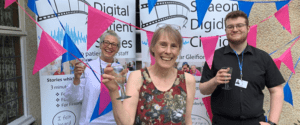
Watch the Presentation Here!
-
#RehabLegend
University Hospitals Plymouth NHS Trust
Contact: Kate Tantam via megan.flower@nhs.net
Organisation
University Hospitals Plymouth (UHP) NHS Trust is the largest hospital in the South West Peninsula, providing comprehensive secondary and tertiary healthcare and we are the region’s Major Trauma Centre. We offer a full range of general hospital services to around 450,000 people in Plymouth, North and East Cornwall and South and West Devon, including maternity services, paediatrics and a full range of diagnostic, medical and surgical sub-specialties.
The population is characterised by its diversity –the rural and the urban, the wealthy and pockets of deprivation, and wide variance in health and life expectancy. Population ageing is a recognised national trend, but is exacerbated locally by the drift of younger people out of the area and older people in. The proportion of our population aged 85 or over is growing ahead of the national average by approximately 10 years, giving Plymouth the opportunity to innovate on behalf the
nation in services for the elderly.The Trust has an integrated Ministry of Defence Hospital Unit which has a staff of approximately 250 military personnel who work within a variety of posts from lead doctors to trainee medical assistants. The Trust is developing rapidly as a centre for research in partnership with the Peninsula College of Medicine and Dentistry and Plymouth and Exeter Universities. We provide services for patients at the following main sites as well as through clinics provided at other local hospitals and care centres:
Derriford Hospital
More than 48,000 people pass through the main entrance of Derriford in a week. The hospital has more than 900 beds and 1,000 public car parking spaces. Derriford Hospital is the second largest bus terminal in Plymouth, beaten to first place only by Plymouth central bus station.Plymouth Dialysis Unit
This purpose-built unit opened in August 2011 and provides outpatient haemodialysis, education and dialysis training to patients with advanced renal failure who are living in Plymouth, East Cornwall, North and South Devon. It also offers holiday haemodialysis to visitors to the South West.Child Development Centre
Developmental services for young children are provided at the Child Development Centre, Scott Business Park with close partnership working between University Hospitals Plymouth NHS Trust, Livewell Southwest and Plymouth City Council.
UHP has one of the busiest Critical Care Units in the country admitting over 1,500 patients every year (cardiac patients taking this up to 3,000).General Summary
THIS PROJECT WAS THE OVERALL PENNA 2019 WINNER
The ‘#RehabLegend’ campaign sees a new person each day awarded with ‘#RehabLegend’ status. This includes Intensive Care Unit (ICU) survivors, their loved ones and anyone who actively supports rehabilitation in ICU. This simple message promotes rehabilitation among staff who are not in traditional caring roles.
The use of #RehabLegend on social media, #RehabLegend badges and lightboxes makes it an accessible campaign for anyone to contribute and raise awareness of the importance of rehabilitation in ICU.
Rehabilitation in ICU has been associated with improved functional outcomes and reduced length of stay. Continued pressures to reduce length of stay in Critical Care and a frequent shortage of beds means it is increasingly important to identify patients at high risk of re-admission.
#RehabLegend has been used to shape, share and facilitate cultural change within the team and organisation, nationally and internationally. Specialist Sister in ICU, Kate Tantam has worked tirelessly to promote the #RehabLegend ethos and seizes every opportunity to highlight teams and individuals who assist with or promote rehabilitation.
Since the launch of the campaign, #RehabLegend has had 17,000 tweets, 40.2million impressions, 4,000 users tweeting and 6,000 badges awarded. All of this has helped raised the profile of rehabilitation within Critical care.
Rationale
Post Intensive Care syndrome is the name for a collection of symptoms
found in patients after critical illness. These include psychological (PTSD, Anxiety Depression), cognitive cognitive (memory loss, inattention) and physical health problems (walking, swallowing, breathing problems).
These issues make recovery after critical illness very challenging and there is a significant impact on quality of life. This population therefore require specialist rehabilitation interventions and an inter-professional team approach.
Kate is fiercely passionate about her work and is dedicated to improving rehabilitation and recovery for survivors of critical illness.She was inspired after hearing a patient story that moved her to tears. Kate then undertook an 18- month audit which showed that 30% of ICU patients develop symptoms of Post-Traumatic Stress Disorder which can cause flashbacks and recurring nightmares. Kate then advocated for service development to meet the need her research identified. Her energy ultimately led to the recruitment of a dedicated Critical Care Rehabilitation Team. Kate’s work has introduced new roles, improved patient care, and taken the Critical Care team with her on the journey increasing skills and knowledge. She remains at the centre of this innovation and brings it to
her role as a clinical educator, inspiring nursing staff to understand the importance of delirium identification and prevention.Before this, patients were reporting signs of ICU related PTSD but UHP had no formal support service. Kate and the team are making huge changes in the culture of rehabilitation. Outcomes at University Hospitals Plymouth (UHP) are measured clinically in measures such as length of stay in ICU, length of stay and the verbal feedback of patients, staff and their loved ones.
This work inspired the #RehabLegend campaign.
Planning
Following the audit, Kate wanted to do some work on early rehabilitation and measure the results. Kate’s Masters in clinical research focused on post-traumatic stress disorder. Her innovation ultimately helped develop a culture in critical care of understanding more about the ICU survivors’ population, recognising the often on-going impact psychologically, physically and cognitively for patients.
The Critical Care Rehabilitation Team is currently made up of a Specialist Physiotherapist, two Physiotherapy Assistants, a Clinical Psychologist, a data analyst, expert Information Visualisation input from Plymouth University and students from the Clinical Psychology department and the school of computing. The team have developed a toolbox of #RehabLegend resources available online to support rehabilitation in the NHS, including the use of Patient Diaries, a proven
effective intervention for patients and families, enabling them to process the complex and distressing experience of critical illness.The team are actively writing up projects and are tackling the issues faced by patients after ICU by regional study events, in partnership with the University, South West critical care network, BACCN and the trust. Their success is thanks to
their enthusiasm and use of patient experience to embed and share clinical understanding and its impact in recovery.To promote the work of the team and empower patients, Kate initially bought 50 #RehabLegend badges, unsure of what the response and success would be. The campaign grew organically from there. With a fantastic initiative and Kate’s driving force behind it, 6,000 badges have now been handed out and the campaign has had global reach.
Impact
The campaign gives an outward recognition to patients that the hard work they have put into their recovery has not gone unnoticed. This has the compounding impact of empowering them and motivating patients to continue dedicating themselves to getting better. Providing them with this motivation gives them a sense of control over their own recovery and places them at the centre of their care. It has been noted that patients who are more motivated to recover are likely to spend less time in hospital, thus positively impacting the cost of their care.
This campaign also serves to support staff and loved ones. Through presenting staff with badges and lightboxes, it gives notice to the time and dedication staff put into their patients. When staff feel appreciated and valued it reduces the rate of burnout and increases motivation for them to continue doing the wonderful job they do. This has a looping effect on patient care as increased appreciation encourages staff to consider ways to look after patients that are not always conventional.Since the launch of the #RehabLegend Campaign in June 2018, #RehabLegend has had 17,000 tweets, 40.2million impressions, 4,000 users tweeting and 6,000 badges awarded. All of this has helped raised the profile of rehabilitation within Critical care.
It has impacted people from many different backgrounds and shown the importance interdisciplinary teamwork in recovery for intensive care, the effects of Animal Assisted Therapy and the pure commitment and kind-heartedness that all staff in Critical Care have to do the job they do.
Relevance to Others
Kate has successfully integrated her research and the work of the Rehabilitation Team into the delivery of a number of training and education events, locally and regionally. The team have taken part in initiatives such as a recent Fab Change Week, widening the skills, knowledge and experience of the ICU staff team.
In the longer term, the Rehabilitation Team aims to contribute to the research and evidence base for recovery from critical illness. Kate’s innovation has had a ripple effect and has opened up conversations about the psychological health and wellbeing of not only patients but also family members and staff. Kate’s innovative approach has led to a shift in the culture of the ICU, developing services and the learning of the staff team.
The team celebrate their patients’ achievements and champion colleagues in all areas of the Trust, delivering badges and light boxes which serve as a gesture of gratitude, encouragement and are a small resource that have made a significant difference. The campaign has grown beyond expectations and Kate’s passion which is shared with her colleagues locally and internationally has demonstrated the success of #RehabLegend and the understanding of the importance of the ethos
behind it will only continue to grow.Kate is now working on plans to implement ‘Rehab Champions’ in ICUs across the country so that other hospitals can have ownership of their #RehabLegend journeys and stories.
“Every year 170,000 people are admitted into Intensive Care in the UK. 75% of survivors are left with physical, cognitive and/or psychological impairments, collectively referred to as Post Intensive Care Syndrome.
UHP has one of the busiest Critical Care Units in the country admitting over 1,500 patients every year (cardiac patients taking this up to 3,000).
Rehabilitation in Critical Care has been associated with improved functional outcomes and reduced length of stay. There are continued pressures to reduce length of stay in Critical Care and a frequent shortage of beds; therefore it is increasingly important to identify patients at high risk of re – admission.
Kate’s tireless effort has resulted in her work being recognised and shared internationally. She has harnessed the power of social media, resulting in an international campaign. She has had requests for #RehabLegend light boxes from hospitals in Switzerland, France and Australia.
Kate presented data at the fifth European Conference on Weaning & Rehabilitation in Critically Ill Patients and at the Annual John Hopkins Critical Care Rehabilitation Conference in Baltimore, which is home to the biggest rehabilitation centre in America and the State of the Art meeting for the Intensive Care Society meeting.
Kate has organised three conference study events in partnership with the British Association of Critical Care Nurses, Plymouth University, The Peninsula Trauma Network and the South West Critical Care network. All of these events have had patients present and patient stories embedded in the conference. Each event had over 150 attendees.
Standing Out
Standing Out
#RehabLegend uses a multi-disciplinary approach to promoting rehabilitation in ICU. Anyone can be a #Rehablegend.
This encourages staff, patients and their families to be actively involved in rehabilitation in any capacity. The hashtag is short and catchy which makes it easy to remember and the message is both light-hearted and at the same time, empowering which adds to the inclusivity of its use.Culture has shifted so seismically at UHP that the ICU have been able to introduce a Pets as Therapy initiative. ‘Hovis’ the Labradoodle, is the only dog in the UK who is officially a rehabilitation team member as well as acting in his ‘Pets as Therapy’ role. Hovis even has his own Twitter account run by his owner, Moira to help promote #RehabLegend. Hovis is key in promoting physical and psychological rehabilitation and adds another dimension to the #RehabLegend message.
Key Learning Points
We have found that the patient stories our survivors and their loved ones give us are the key to unlocking the cultural change we are seeing clinically.
#RehabLegend also offers the healthcare community the opportunity to innovate and share best practice
The growth of this campaign and the associated benefits to patients has happened over time thanks to a lot of hardwork and dedication. The increased awareness of the importance of rehabilitation in intensive care has had a knock-on effect in other areas. For example, the introduction of a rehabilitation garden for patients. Real estate at Derriford Hospital, particularly outdoor space, is near impossible to come by. Despite this, Kate identified an outdoor space which was overgrown and unusable in its current state. With a clear vision, determination, and a lot of elbow grease, Kate
set about clearing the space, drafting in support from staff, volunteers and local businesses. The garden opened and now sees 2-3 patients daily for fresh air and fun with their loved ones.Further anecdotal evidence of Kate’s hard work is evident on Twitter from a quick search for #RehabLegend’ as well and the accounts run by Kate and her team: @TantamKate @PlymouthICUReh1 and @Hovistherapydog
Case Study Resources
-
A Team Approach to Streamlining Therapeutic Apheresis Services in the North West
NHS Blood and Transplant and The Royal Liverpool and Broadgreen University Hospitals NHS Trust (RLBUHT)
Organisation
NHS Blood and Transplant (NHSBT) is a Special Health Authority employing over 6000 staff, dedicated to saving and improving lives through the wide range of services:
- Encouraging people to donate organs, blood, stem cells and tissues
- Optimising the safety and supply of blood, organs, stem cells and tissues and matching them to patients
- Commissioning and conducting research and development to improve outcomes for patients
NHSBT has a long history of providing life-saving and life enhancing therapeutic apheresis services and currently undertakes over 6000 treatments for over 1000 patients each year. Our Therapeutic Apheresis Service (TAS) offers a portfolio of therapies across a range of clinical specialities using technology that exchanges, removes, or collects certain components within the blood. NHS Blood and Transplant also supports a network of Regional Transfusion Committees (RTCs) which oversee the safe and appropriate use of blood in hospitals and the delivery of evidence based care for patients who might need a transfusion
The Royal Liverpool and Broadgreen University Hospitals NHS Trust (RLBUHT) is one of the largest hospital trusts in North West England with an annual budget of over £400 million, with 5,600 staff. The Trust provides a range of general and specialist services for the population of Merseyside and beyond. The Roald Dahl Haemostasis and Thrombosis Centre is a regional Haemophilia Centre, taking referrals for patients with bleeding and clotting disorders from across the North West Region and North Wales.
General Summary
This initiative is the first of its kind to develop a collaborative regional approach to develop referral pathways for patients requiring timely access to life-saving treatment with therapeutic apheresis. The project was ambitious; we wanted to find a solution to service delivery problems across North West England. This collaboration responds to the NHS strategy whereby specialised services should be consolidated and are best delivered by centres of excellence. Strong leadership was required to change traditional service patterns which were failing patients and persuade clinicians to refer to a single service delivering the highest quality care. Within RLBUHT, leadership following a high-level incident led to a successful business case for the development of a regional centre of expertise. The service redesign engaged with patients from the start. Patient outcomes have improved dramatically with 100% survival and high levels of satisfaction. The service is now the provider of choice for rare conditions requiring apheresis’ supported by the development of a regional online roadmap which simplifies the referral process with a single point of access- The joined up working between the teams has strengthened the equity of access for patients in the Northwest under an umbrella of improved clinical governance. Our approach to the development of high quality service provision will be shared with others by developing a national service specification and working with commissioners; a similar project is now commencing in Yorkshire and The Humber and we hope that other regions will follow suit following our success.
Rationale
Apheresis is a commonly employed method for the removal from the blood of harmful substances and proteins such as antibodies that drive various disease processes. All therapeutic apheresis (TA) procedures require the use of specially designed machines operated by experienced healthcare clinicians. The medical conditions requiring this are often unpredictable, severe and frequently require specialist medical and critical care as well as access to the apheresis procedure itself. Historically within the North West of England and North Wales, there was an absence of a standardised referral pathway for the management of patients requiring TA. Access to life-saving
treatment was very variable putting patients at risk particularly if they required urgent intervention. One of the conditions that presents as a medical emergency and needs urgent TA is a rare, life threatening condition called thrombotic thrombocytopenic purpura (see attached patient information leaflet for further information). The incidence is about 6 cases per million per year. Without treatment patients have a mortality in excess of 90%. TA dramatically increases the survival rate, but the treatment has to be commenced within 4 – 8 hours of presentation. In 2012 it was recognised that patients in the North West were dying due to delayed diagnosis and treatment and the service had to be improved.
As a joint collaborative between the North West RTC and NHSBT, a small project team was set up to review the current availability of TA within the region and to formulate strategy to improve this. Further collaborative work with the haematologists from The Roald Dahl Haemostasis and Thrombosis Centre at RLBUHT helped streamline the provision of timely specialised services for the clinical management of TTP and other conditions requiring TA.
Planning
1.The development of a robust referral pathway or roadmap for Therapeutic Apheresis (TA) in the North West of England and North Wales To understand existing provision of and gaps in TA service delivery,, a questionnaire (Survey MonkeyTM) was circulated to relevant lead clinicians in all hospitals in the region. The questionnaire aimed to identify the regional experience of TA service delivery and highlight any challenges encountered over the preceding 12-month period. The overall response rate was poor and as a result targeted phone questionnaires were conducted to achieve 100% from response from lead haematologists in the region. Haematologists were singled out as it was felt they were most likely to have experience of accessing TA service provision. The data
obtained was entered into an Excel� spreadsheet and analysed internally by a data analyst. Further intelligence into the regional challenges in accessing TA was obtained via two multi-speciality focus group meetings with lead clinicians, service users and managers. This was followed by a one day educational symposium delivered by national experts in the field.
Feedback demonstrated the regional appetite for uniformity of practice and standardisation of care with access to timely treatment 7 days a week, 24 hours per day. Using the feedback from the survey and focus groups, a series of referral pathways were developed which highlighted the access point for TA service delivery, depending on the patient�s underlying condition. Each Trust in North West England and North Wales was given access to a specific page on the Therapeutic Apheresis section of the hospital.blood.co.uk website http://hospital.blood.co.uk/patient-services/therapeutic-apheresis-services/how-to-make-patientreferrals-to-tas/referrals-in-the-north-west-of-england-and-north-wales/ The information was circulated to Trusts via the RTC network
2.The establishment of a regional TTP service at The Roald Dahl Haemostasis and Thrombosis Centre at RLBUHT. The complex and life-threatening characteristics of TTP justify the need for early referral and responsive�� management in centres with comprehensive multi-disciplinary resources. In an era where compromise of patient safety or experience is unsatisfactory, the provision of specialist-led, organised care for this patient group is essential. Patients and clinical teams continue to lack the knowledge, support and resources required to achieve consistently high levels of clinical care. This formed the rationale for development of a regional TTP Specialist Centre in RLBUHT; in addition, NHSBT had an established TA unit in the Trust. The regional service was established by the haematologists from The Roald Dahl Haemostasis and Thrombosis Centre following the development of a business case. This work was sparked by the late referral of a patient from the North West but outside the normal catchment area for Liverpool who died soon after arrival and before TA could be commenced. The service development was backed by both the RLBUHT and NHSBT and provided 24-hour access to specialist clinical support, including critical care and central line insertion as well as therapeutic apheresis. The service was launched simultaneously with the Regional Apheresis Referral pathways which improved referral times including agreement for a North West Ambulance blue light transfer to RLBUHT.
Impact
- – RLBUHT is now the Regional provider of care for patients with TTP in the North West and further afield. It is one of only two regional services, the other being a long-established service at University College Hospital, London
- – The referral and diagnostic process has been streamlined by the establishment of the North West Apheresis roadmap which provides easy web-based access to the relevant referral information, individualised for each Trust and specialty. In addition, recommendations for diagnostic testing are hosted on the site. Since 2014, there have been: a total of 2035 pageviews and 1428 unique pageviews.
With regards to patients with TTP, since the regional service started there has been 100% survival of patients referred to the centre.
- Time to treatment with TA reduced from days to less than 8 hours
- NO deaths due to no venous access
- NO deaths due to infection
- NO deaths due to delayed treatment
- 90% cases diagnosis confirmed by specialist testing. Link through the roadmap for request form. Previously rarely sent/contaminated/invalid sample
- Feedback questionnaire patients and carers overwhelmingly positive
Educational programmes have been held at local, regional and national levels. There has been meaningful and sustained patient involvement in service provision for this rare disease, thus recognising patient groups as key partners.
Quotes from referring Clinicians:
Consultant Haematologist from Blackburn: ‘The website is easy to use and is useful. Another of my colleagues who has used this recently also agrees’
Consultant haematologist from Lancaster: ‘The roadmap is definitely useful and now we feel safer when dealing with patients with TTP as can access services quicker. Definitely better and quicker than before!’
Quotes from patients:
‘The consultants were brilliant in their explanations and explaining what TTP was. I feel as you have all saved my life’
‘Day and night I was thinking I’m not going to see him again, this is the end. I fainted myself looking at him and ended up in the emergency department. I was there but my mind wasn’t working. The doctors tried very, very hard to bring him back from where he was and staff looked after us really well.’
‘Staff told me he had a 20% chance of survival. Later I found out they were trying to remain positive and his chances were closer to 10%. He had two cardiac arrests during the first 48 hours of treatment. If he’d had a third he probably wouldn’t have left the hospital alive.’
Standing Out
This is a great example of excellent collaboration across organisations- is truly a team approach to quality improvement. There has been multi-specialty input co-ordination under emergence conditions leading to dramatic increase in survival and patient/carer experience
- This change is truly a ‘Patient centred’ which helped streamline services for life saving treatment. These system level changes will have a significant positive impact on patient health outcomes as has already been demonstrated and improves patient experience.
- This initiative corrects the previously unmet need and has created processes that offer patients timely provision of optimal care and services.
- This is in keeping with the NHS Five Year Forward View and supports providing High care quality for All.
- This project directly supports the UK Strategy for Rare diseases and has established a specialised clinical centre to offer the best care and support for a rare but life threatening condition.
Key Learning Points
Successful improvement initiatives need careful planning and execution. Patience and perseverance are vital to carry out and sustain any improvement initiative.
- – It is imperative to understanding the quality and safety of existing services through a comprehensive approach to collecting, analysing and discussing data prior to planning and finalising change strategy. Selecting the right team members is key to plan and deliver change. Seek out people to work with who are brimming with talent, energy, integrity, optimism, and generosity as part of the core team. Collaborative leadership works.
- – Real change in improving quality and safety requires total team buy-in (inclusive of all stakeholders involved). Poor staff engagement and staff resistance is common and overcoming this may be an onerous task. Good and timely communication, transparency and clarity of information re the project, goals, progress and impact is important.
- – Celebrate every success, however little and maintain momentum of the initiative.
- – Use opportunities to share experiences and learn from others and to constantly improvise.
- – Put the patient at the centre of service redesign and the rest falls in to place where patient safety and survival are the most powerful argument for change.
-
Knead to Chat
Leicestershire Partnership NHS Trust

Contact: Alison Kirk: Alison.Kirk@leicspart.nhs.uk
General Summary

Knead to Chat uses therapeutic bread making activities to bring people together within the framework of the Five Ways of Wellbeing.
Connect – creating a safe, relaxed space for people to meet with others, helping develop a social network to support and enrich lives
Be active – encouraging connectivity and mobility providing an opportunity to get up on your feet and use energy in the kneading process
Take notice – baking bread is a mindful activity that gives times to reflect on what matters to you. Through conversation we encourage the sharing of stories, experiences and challenges
Keep Learning – learning new skills or rediscovering an enjoyable activity and using dormant skills. Either way it’s a fun way to learn and build confidence
Give – home baked bread if a wonderful gift to share. To give something you have put time into making can have a positive impact on your well-being and help with good functioning.
A key element of the project is the development of volunteers to lead bread baking activities in the community. As well as enhanced bread making skills, we train and support volunteers so that they are able to stimulate thinking and discussion in groups.
Rationale
I found myself working in a high pressured, potentially stressful job and knew it was important to create time for myself and so I booked on a bread making course at a local cookery school.
At the same time I heard that LPT were looking for volunteers to bake with patients. After attending a workshop, where I shared my ideas on how we could use therapeutic bread making activities to improve health and wellbeing, the concept of Knead to Chat emerged.
The activity is aimed at people who have existing mental health challenges, and also people looking to bring a sense of wellbeing into their lives as a way of dealing with the stress and strains of living in today’s modern world. We definitely see the workshops as ‘preventative’ as much as a ‘cure’.
Planning
1 approach
6 volunteers
40 workshops
239 hours
278 attendees/conversations
over 950 loaves, rolls, pitta and pizza bakedAs volunteers with the Trust we work with the Mental Health Transformation Team who have existing relationships with mental health service users and volunteers. Within this the Community Mental Health Team are already promoting the workshops as a holistic activity to support peoples’ recovery plans and will help refer groups and individuals.
Broadly speaking Knead to Chat targets three different types of attendees:
- Hospital based e.g. Inpatient Wards, LPT staff wellbeing events promoted through social media, quarterly newsletters, in addition to the project has featured on both local TV and radio
- Existing well-being groups e.g. Age UK, Carpenters Arms (residential rehabilitation centre for men challenged by drug and alcohol addiction ), Home Start, local wellbeing cafes, Asylum Seeker and Homeless groups promoted by the groups themselves with their customer base and also through the use of social media
- Local communities promoted through social media, libraries, local councillors and word of mouth.

Each workshop has a minimum of 3-4 people, an average of 6-8 people and a maximum of 12-15 people. Our target was to deliver 20 workshops in 2019, we actually delivered 23 with a reach of over 150 participants.Impact
Data is captured after each workshop in the form of ‘numbers and stories’. Statistically we capture things like the number of people involved, the hours given, the amount of bread makes etc. We also collect feedback based on how the activity made people feel, but in many ways the most powerful data is the anecdotal comments which bring the feeling of wellbeing to life.
“How do I feel?? Overwhelmed, ecstatic, epic! This is the best I’ve felt since coming into the hospital.”
“I would score my pizza 11/10. I only came down to get off the ward but I am so pleased I did. I never realised learning something new could be so much fun.”
“A fantastic afternoon talking to other like-minded people with lived experiences about their mental health problems in a safe environment with being judged by other people.”
Learning can be summed up in one sentence ‘my persistence will always be greater than your resistance’. It’s been a struggle at times but if you believe in what you are doing then anything is possible.
We now have a dedicated Facebook page where we have 115 members activity sharing their baking stories with each other.

Relevance to Others
We bake regularly in the Bradgate Mental Health Unit, and have recently extended our offer to other areas such as Griffin Ward, Stewart House, Willows Unit, and as part of the staff wellbeing offer. In addition, we now bake with a day centre for homeless, and a centre for recovering addicts.
We run a closed Facebook Group ‘Knead to Chat’ which allows dialogue, Q&A’s, photos of all events. People who attend workshops are invited to join and a number of them now make regular contributions showing how they have taken the skills they have learnt into their own kitchen.
We will continue to work with LPT and their partners to identify groups/individuals to involve. The workshops are open and accessible to all communities and have been designed to provide flexibility. They can easily be adapted and have been delivered to a number of diverse groups covering age, race, religion and sexual orientation.
The project can be delivered to any group. The flexibility of the model enables it to be delivered in a range of settings and with a range of groups, all you need is a decent oven and the right ingredients.
Over the last year we have delivered to a wide range of groups including homeless and asylum seekers, older people, those with drug and alcohol dependency as well as inpatient mental health patients and staff. The discussions that have arisen through running these sessions mean that the sessions can cover a wide range of things including:
- Creating time for self, stress, anxiety, health issues, mental wellbeing and self confidence
Loneliness, isolation, social networking and activities, use of community and support groups- Abstinence from drug and alcohol use, disconnection from family and community services
- Food awareness, diets, lifestyle choices and living with long-term health conditions
Standing Out
By aligning ourselves with the five ways to wellbeing we have a flexible project that not just provides people with a set of new skills it also provides a safe relaxed place for people to meet and talk.
We help people develop a social network to both support and enrich their lives and give each person time to reflect on what matters to them. Through conversations we encourage the sharing of stories, experiences and challenges. It’s also an opportunity to engage the senses – particularly touch and taste. For some people baking bread is new, for others is rediscovering an enjoyable activity and using dormant skills.
Either way it’s a fun way to learn and build confidence, and homemade bread is a wonderful gift to share with family and friends.

Key Learning Points
It’s fair to say that we sometimes have to compromise the bread making process a little to meet the needs of an individual or group of people, who aren’t always able to complete all of the tasks. We pride ourselves on being flexible to ensure that everyone produces something that both tastes delicious and that they can be very proud of.
You can bake anywhere you can find a kitchen. Our most valued piece of equipment is an oven thermometer!
Flexibility is the key and by working with our LPT colleagues who fully understand the needs of their service users we can confidently say that we can bake, and chat with anyone, no matter what their challenge.
Case Study Resources
Download the Knead to Chat Presentation Here! -
Bringing Patient Care Closer to Home in Wyre Forest
TICCS - The Integrated Care Clinics
Organisation
The Integrated Care Clinics (TICCS) was established in 1996. Our head office is in Fareham, with additional administrative hubs in Solihull and Bristol. We have grown to become one of the UKs largest privately owned providers of physiotherapy and related diagnostic and rehabilitation services. We deliver many services through subsidiary undertakings, each having a particular clinical solution. Over the last five years we have focused on building a clinical delivery solution which we now offer from over 200 clinic locations nationwide. We employ around 300 HCPC registered healthcare professionals and around 200 non-clinical staff. We carry CQC accreditation in locations undertaking regulated activity. With a 98% positive patient service rating nationally, TICCS is universally recognised for excellent service delivery. We have focused on building strong relationships with the NHS and have gone from strength to strength. We now operate community MSK and triage services for over 37 CCGs across the UK. We deliver over 600,000 physiotherapy treatment sessions each year, of which approximately 200,000 are to NHS patients through AQP and sole provider contracts. These contracts cover all aspects of MSK physiotherapy including spinal and peripheral disorders, alongside specialist MSK services including women’s health, post-operative treatment, vestibular rehabilitation and specialist triage assessment and treatment services. Our growth is in part attributed to our partnership working approach; we have worked in partnership with numerous NHS Commissioners to champion service design including innovative approaches to improving patient and service-user journeys and treatment outcomes.
With a 98% positive patient service rating nationally, TICCS is universally recognised for excellent service delivery. We have focused on building strong relationships with the NHS and have gone from strength to strength. We now operate community MSK and triage services for over 37 CCGs across the UK. We deliver over 600,000 physiotherapy treatment sessions each year, of which approximately 200,000 are to NHS patients through AQP and sole provider contracts. These contracts cover all aspects of MSK physiotherapy including spinal and peripheral disorders, alongside specialist MSK services including women’s health, post-operative treatment, vestibular rehabilitation and specialist triage assessment and treatment services. Our growth is in part attributed to our partnership working approach; we have worked in partnership with numerous NHS Commissioners to champion service design including innovative approaches to improving patient and service-user journeys and treatment outcomes.
General Summary
We have worked closely with Wyre Forest CCG to re-model their MSK triage, assessment and community physiotherapy service to create an accessible service and bring care closer to home. The success of the MCAT Service Pilot, operating from three clinics, led to the model being rolled out across the whole CCG by opening eight further clinics. Our work has:
Innovation – MCAT Service model with ESPs placed within GP surgeries and working collaboratively was one of the first of its kind
Strong Leadership – Formation of the new service required strong leadership structure/channels throughout with strong stakeholder engagement. Clear objectives were formed from the outset: streamline the patient pathway, bring care closer to home and reduce waiting times/referrals to secondary care/referrals for more costly interventions. Our mobilisation team, led by Mark Driver, ensured the project was implemented efficiently
Is Outcomes Based – Performance has been measured through KPIs, PREMS, PROMS, referrer feedback questionnaires and during Stakeholder focus/engagement groups
Sustainability – The model has made a sustainable difference to the GP population of Wyre Forest through no waiting times, a choice of treatment locations and ongoing support via Patient Portal.
Transferability – Model can be adopted by any CCG seeking to streamline their MSK pathway.
This project stands out as it has made a real difference to the patient population of Wyre Forest CCG, their friends and carers. Of those managing long-term conditions, very few are referred back into the service with the same problem in a 12 month period.
The critical success factors have been:
- Strong Leadership throughout
- Implementation of innovative technology to bring care even closer to home via our Patient Portal
- Service design having regard to needs of local population to ensure the service is truly accessible
- Reduction in DNA rate to improve service efficiency and appointment availability
- Improved communication between GPs, clinicians and ESPs
Rationale
In 2011, Wyre Forest CCG was experiencing significant inefficiencies in their MSK physiotherapy, specialist triage and assessment pathway in that:
- The average waiting time for MSK referrals was 16 weeks
- The DNA rate was 14%
- Patient accessibility to the service was poor; the service offered patients one clinic location, many miles from some patients’ homes, with limited appointment times between 8:30am-4:00pm Monday to Friday, offering no flexibility to suit different lifestyles and need
- Limited patient satisfaction data or patient experience measures were available
- Little service integration due to lack of understanding of how to work with the wider multi-disciplinary team to achieve better outcomes for the patients
- Little resource available to patients in terms of rehabilitation material and signposting information
- Lack of integration of MSK services across primary care services
- Lack of internal stakeholder upskilling / promotion of best practice
- No interoperability / clinical data sharing across primary care. Following discussions it was apparent that the root cause of the above-mentioned inefficiencies was poor accessibility to community MSK services and a lack of integration between community services in the region.
As a result we put forward a proposal to re-model their MSK physiotherapy model through a pilot, which if a success, would be rolled out across the CCG.
Planning
Following discussions with Wyre Forest, a 12-month pilot was launched which included:
- Launch of a community physiotherapy service placing a clinician within 11 out of 12 surgeries within the CCG
- Unified clinical pathways with other community services
- Launched patient specific rehabilitation services (Osteoarthritis community exercise and education services)
- Roll-out of GP Education Programme delivered at each clinic location to improve knowledge of MSK conditions, assessment techniques and treatment strategies. This vastly improved the front-line assessment of patients and ensured appropriate referrals were being made
- Set-up of a MCAT service utilising our Extended Scope Practitioners (ESPs) from one central hub in Kidderminster and two spoke clinics in more rural areas.
Utilising ESPs in this way provided a specialist community assessment and treatment service.
The aim was to reduce the amount of inappropriate referrals into secondary care, for diagnostics and for specialist procedures such as peripheral injection therapy. The statistics showed our MCAT pilot would be £200,000 per annum more cost effective if utilised across the entire CCG in comparison to the previous model. Therefore, working closely with the Commissioners and wider MDT, we rolled the model out across the whole CCG to ensure it was truly aligned to the NHS Five Year Forward Plan by delivering care closer to home. The model has vastly improved patient accessibility; we now operate from a central hub in Kidderminster with extended appointment times from 7am to 7pm Monday to Friday and from 10 spoke clinics across the geographical region, some being in very rural areas. We also facilitate Saturday clinics where patient demand requires. We have rolled-out our education programme to all clinics.
Impact
This has been a highly successful project which continues to deliver significant improvements to patient care. Over a three-year period, patients attending almost 65,000 physiotherapy sessions have done so at a convenient location/time. This has been achieved whilst also delivering a cost saving of 9% to Wyre Forest CCG. We have measured the success of the service model through:
KPIs
– Average waiting time for MSK referrals reduced from 16 weeks to 1 week;
– DNA rate fell from 14% to below 6%;
– 40% reduction in number of scans and associated costs; our clinicians always follow NICE guidelines and only refer for more costly interventions if clinically appropriate;
– 45% reduction in referrals to secondary care and associated costs. Of these, 95% went on have surgery demonstrating the appropriateness of these referrals. This validates the success of our rolling education programme – GPs know when to refer to secondary care.
Relevance to Others
The model has vastly improved patient accessibility; patients have a choice of 11 clinic locations to attend rather than one location under the previous model. This is in addition to extended clinic times, including weekend appointments. This has had a significant impact on patient accessibility to care. For example, under the previous model, patients living in Stourport and Bewdley had to commute for up to 40 minutes to their appointments at Kidderminster Hospital. Patients living in both these locations are now able to walk to their appointments within 5 minutes. Furthermore, patients can access rehabilitation and self-care resources along with relevant signposting material from the comfort of their own home via our unique Patient Portal. PREMS – In 2001, referrals were 50 per week. We currently receive approximately 150 referrals per week. We carried out almost 65,000 physiotherapy sessions in 2014.
Patient satisfaction with the service has remained extremely high despite the considerable growth – 98% of patients would recommend the service to family and friends; 97% were satisfied or very satisfied with the service. Our high satisfaction rates are attributable to: –
- Rapid access with short waiting lists
- Choice of clinics near good transport links with free parking and flexible treatment times
- Well trained/efficient/respectful staff
- Telephone service for patients with hearing impairment
- Chaperone facilities
- Liaison with carers/support workers
- Telephone/on-line support
- Provision of relevant local signposting information
- Post-treatment support via patient portal; full access available 12 months after discharge
Referrer feedback – Obtained through formal questionnaires and informally through daily clinician and Account Manager contact. Feedback from GPs has been extremely high; not only has the model brought care closer to home for the patient, but it has also vastly improved collaborative working between GPs and clinicians and facilitated shared decision making between GPs/clinicians/patients.
This initiative will be relevant to many other CCGs across the country. The hub and spoke model has been adopted by many of our clients implementing AQP contracts. It has also been adopted by another client for a sole supplier contract which we are currently implementing.
‘I am sure that this is an excellent model for the future that could be rolled out elsewhere and indeed similarly for other clinical areas.’
– Dr James Goodman
Key Learning Points
We believe the key learning points for Commissioners if considering adopting a similar service model would be:
-Ensure viability of service model is pilot tested
-Ensure clear communication, not just during mobilisation but through service delivery
-Create services fully integrated with existing services
-Incorporate the benefits of interoperability across additional services
-Gain the views of all stakeholders when creating new services
-Upskilling and promotion of best practice is vital
-Rigorous data collection can help provide tangible feedback regarding service operations
-
The Story Shop - Bringing Mental Health Stories to Life
Nottinghamshire Healthcare NHS Foundation Trust
Organisation
Nottinghamshire Healthcare is a major provider of mental health, intellectual disability and community healthcare services for the people of Nottinghamshire. We provide services across the county for people with mental health needs, with needs relating to drug or alcohol dependency, mental and physical health services for people with intellectual disabilities and community physical healthcare. We also provide secure mental health services. We see about 190,000 people every year. Our 8,800 staff carry out a wide range of roles, working together to provide integrated and coordinated care and support to those using our services.
General Summary
Nottinghamshire Healthcare’s Story Shop programme brings the stories of people suffering with mental ill health, and their carers, to life in a way that challenges stigma and promotes understanding and acceptance. Our service user volunteers generously commit both their time and their personal stories, our staff dedicate real skill and sensitivity to facilitate the conversations and our Board and Executive Leadership Team back the programme, all recognising it’s power and importance. It innovates in the way that it enables safe, honest and intimate conversations that encourage inquisition. Evaluation has shown overwhelming praise for the initiative, and we believe that it serves as a model which could be used to challenge a wide range of prejudice and stigma and to invite professionals into the field of mental health.
As the major provider of mental health services in our region, it’s important that we help to tackle the stigma that surrounds mental ill-health. We believe that by challenging stigma, we can encourage the people to talk about mental health as they would any other health concern, and that this will result in earlier treatment, less isolation, better understanding and more focus on recovery. We were aware of the Human Library, which aims to challenge prejudice through social contact by positioning people as books and allowing others to speak with them and ask questions. Social contact is known to be one of the most powerful means through which stigma can be tackled (http://bit.ly/1TgsdwV). We translated this idea to nurture conversations between our service users and young professionals, staff and the public. Our intention was to sensitively facilitate the kind of contact that would encourage people’s inquisition and support our service users to share their stories safely. From this The Story Shop was developed and created. All of the terminology and protocols that we use were developed in partnership with service users and carers and have contributed to its success, but also the sense of ownership that those taking part feel.
We began with medical students. They are an important audience because they are the primary contact for someone struggling with mental health issues and we are aware that there is only a very small proportion of medical training that covers mental health. We wanted to ensure they had a good rounded understanding of mental health and the many issues that come with it. Our Stories talk with students prior to them choosing their career pathway i.e. GP, with the hope that the students will then look at mental health in a totally different way and begin to understand the wide range of complications they cause in everyday life, and will appreciate the recovery journey taken.
We incorporate the carer perspective to ensure that students understand and consider the whole picture. We know that nationally there is a shortage of psychiatrists and the Migration Advisory Committee (MAC) added Core Psychiatry Training to the shortage occupation list in 6 April 2015 and we aim to show that treating, supporting and helping people with mental health issues is interesting, rewarding and hugely worthwhile.
Planning
Daniel Tsoi Consultant Psychiatrist and Clinical Teaching Fellow & Associate Clinical Subdean at University of Nottingham approached The Story Shop Team in 2013 with a view to working together. We now deliver one Story Shop session to each cohort of 4th year medical student during their mental health training (four a year). This work continues and a request from the Medical School to double the number of sessions that we run is currently being discussed.
Daniel Tsoi said The Story Shop is very useful and it really helps students to see the other side of mental health. Students can often become focussed on the pathology and the Story Shop gives them a totally different perspective and see the recovery that is possible. It is important that that they also get chance to speak to carers and their role in mental health, and how this isn’t just about the medical but how vital the social aspect is to people’s recovery.
The Trust Board has always supported The Story Shop, from the very beginning it was signature strength of the Trust’s anti-stigma campaign and since then has been more widely embedded as part of the Trust-wide Involvement & Experience Strategy. In partnership, we decided right at the start that we were a team working together service users / carers and staff.
A Story Shop Steering Group was formed and decisions made on how we:
Engage with a Story – We have regular talks with our volunteers about the Story Shop explaining the process, from this we identify a possible story teller.
Write a Story – We ask the volunteer to write their story in their own words, with a start, a middle and an end. We meet with this person several times talking through what they have written (and usually what they haven’t) and between us we develop a story starting from the beginning of their mental health journey to where they are at present. We usually have the very long story, we condense this into bullet points to help volunteers when telling their story.
Train a Story – We spend time talking through the expectations of being a story explaining that the experience is interactive and you are not only telling your story but that you must listen to questions asked and feel confident to answer honestly. We ensure you ready to tell your story, talk through what to expect and how you may feel and what to look out for. Ultimately our Stories are in charge and at any time they can stop a session should they wish to. We ask all our Stories to read and sign a Story Shop Contract this is an agreement explaining how we will keep them safe and what is expected, also contact details for an emergency.
Support a Story – Before a session all the stories and the member of staff meet up and talk for half an hour about how we are all feeling; this is where the staff member will recognise if a story is feeling vulnerable/emotional. Time will be spent with this individual ensuring that they are happy to go ahead with their story, we go through the signals we use when in a session so that the story is relaxed and emotionally prepared. During the session the staff member makes sure all Stories are facing them so that at all times the stories face and body language is visible, the staff member continually walks around listening and watching ensuring that all the stories are coping and feel comfortable and aren’t struggling in any way.
Keep safe signals whilst Story Shop in session – All Stories have bottled water and a pen on their individual table. During training we explain that at any time should they feel uncomfortable/under strain that they lift their pen and wiggle with it, the listeners are not aware that this is a signal but the member of staff is and will immediately go to the stories assistance. The staff member is extremely vigilant during each session and will notice any small change in a stories body language (this is extremely draining experience). A decision is then made if the Story wishes to carry on or take time out in another room where they can talk through how they are feeling.
Follow up aftercare of all Stories – At the end of day we all meet up again for a cuppa and talk through how we all felt the session went, how interactive were the young medical students, what did we all get out of it. It is at this point the member of staff will identify if anyone needs TLC. We will then talk with this person and ensure that they have someone they can talk to through the night should they need just to talk. The staff member will contact the Story over the next few days ensuring that they are emotionally feeling ok and will continue until they are happy that our Story is back on form.
Staff visit the venue before a session – Liaise with partnership staff ensuring they have an understanding of our values/rules and expectations. We always ensure the room is large enough for all our Stories to sit at a desk facing the organiser of the session. We expect a separate room for our stories to go if they become upset or unwell. We have access to toilets and kitchen facilities for refreshments.
All through the planning and delivering of the Story Shop, Service Uses / Carers and Staff work together!!!! At any time the staff member running the Story Shop or Story Shop Meetings has concerns about a Stories mental health it will be for them to decide if the Story should be used or be encouraged to take a break. As part of the training to be a Story, we discuss that both the Stories themselves have permission to stop at any time and we also give permission to those staff running the event that they can ask a Story to stop at any time; this is in the context of looking after an individual’s wellbeing . The Stories are the most important part of the whole process and without them we would just have an empty shop! De-briefing is always offered after an event, and because of the way that volunteers develop through the Involvement Centre, staff see volunteers that have taken part in a Story Shop regularly afterwards.
Impact
We measure the impact of Story Shop on our Stories by talking with them during an event and when we get together with new volunteers to inspire them to become Stories. We recognise it is a very powerful tool and that although sometimes our Stories are exhausted from this experience they are also exhilarated and get an enormous sense of wellbeing and pride.
The Story Shop works two fold, it educates and reduces stigma for those listening to the Stories but also for those Storytellers taking part it supports their own personal Recovery.
‘Gives my condition a voice; it helps me with my own personal recovery’
‘When I am talking about my story I can see how far I have come, what I have achieved in my recovery and how proud I should feel’
‘As a carer I feel it reduces stigma, opens up opportunities for carers to put their point over to the students who are our future medical professionals. It makes them think about the role of the carer and the importance of listening and understanding their needs. It educates, one comment from a student was ‘I never really thought about talking to carer’ which says an awful lot.
To measure impact on the students The Story Shop Steering Group developed a questionnaire for each student to fill in on completion of each session. A set of questions with answers 1 to 5 are asked; students circling their answer, we then put this information on to a spreadsheet which results in simple pie charts showing by percentage how the Story Shop has impacted on them. In 2015 86% of medical students agreed or strongly agreed that it helped them appreciate the concept of recovery in mental health. 96% agreed or strongly agreed it helped them to understand different dimensions of mental health and 91% agreed or strongly agreed that it helped them recognise how stigma impacts on mental health. We also ask for comments which continually evidence the power of the spoken word and the effect of students listening/talking to Stories.
It’s the clearest and widest picture of mental health I’ve experience so far. Hearing from patients and carers who have extensive life experience of mental health gives more information and perspective than any other teaching method I’ve had so far.�
4th year medical student – Honestly, I am truly inspired by the people I have met. What they have all been through and where they are now, words cannot describe how touched I am. These people inspire me to be a better person, brought tears to my eyes. I thank-you all.
In August 2013 Stephen Kendall, DMS, MBA did a study on The Story Shop with a focus on the work being done with medical students titled; Can mental health stigma be reduced by interactions with the targets of the stigma? In this paper he concluded that although these students started off with a lower threshold of stigma compared to the general population their prejudices and stigmatising thoughts did reduce further after their interaction with Stories in The Story Shop. As far as we are aware we are the NHS Trust that run a long term project like this. Many organisations have picked up on the work of the Human Library, but we specialise in mental health in a way that the broader human Library cannot. Other Trusts do run one off events of a similar nature, but we have developed this and now maintain the project. We had strong links with the Human Library from 2009 to 2012 and we were responsibly for over a quarter of their loans nationally. Since we have developed The Story Shop it is unlikely that any other organisation can claim to have had face to face interaction with over 4500 people in any similar scheme.
Key Learning Points
- All ‘Stories’ have read and understand their Contract/Agreement which they have signed to enable them to partake in a Story Shop.
- Ensure all staff have an understanding of their role and what is expected of them on the day that they know and understand each individuals story and the person telling it.
- Monitor and watch carefully throughout each session, how each Story is and be able to stop any conversation should the Story become distressed, the welfare of the Story is paramount.
- Stories are regularly updated, life goes on and stories are ever changing. Try and have a start, middle and end to each story.
-
Patient Encounter Leadership Programme
Frimley Health NHS Foundation Trust
Organisation
Frimley Health NHS Foundation Trust was created on 1st October 2014 by the acquisition of Heatherwood and Wexham Park Hospitals NHS Foundation Trust by Frimley Park Hospital NHS Foundation Trust, the first ever merger of two Foundation Trusts. It runs Heatherwood Hospital in Ascot, Wexham Park Hospital near Slough, Berkshire, England, and Frimley Park Hospital in Frimley, Surrey. It has 4,948 full time equivalent staff. The Patient Trust was launched in 2014 by Howard Kennedy with the purpose of supporting a consistent, quality experience for patients facing serious illness by raising awareness, providing practical support and working in partnership with doctors and patients.
General Summary
In June 2013, Howard Kennedy received a terminal cancer diagnosis. Reflecting on his experiences as a patient and on a career as a leader of public service system reform, he determined that he would commit the rest of his life to improving the quality and consistency of patient experience. Howard knew that a culture of engagement starts at the top. He knew that leaders shaped culture, where managers responded to it. He set out to develop approaches that would support leaders to strengthen and further enhance the quality of their engagement with patients and the collective support teams offered to patients. This approach was to be about potential and growth, solution focused, not a deficit model. As he worked to develop networks and shape an innovative leadership programme, Howard was told that engaging with consultants was an impossible dream, they were too busy, too focused, too senior to embrace development. Finding, in Frimley Health Trust, an organisation committed to delivering excellent patient experience, he worked in partnership with them to challenge these assumptions. The Patient Encounter Leadership Programme launched in December 2014 with an initial cohort of six senior clinicians, feedback from 359 patients and 102 colleagues and impact beyond.
Rationale
The drive behind the Patient Encounter Leadership Programme (PEL), was Howard’s determination to strengthen the consistency and quality of patient experience. In Claire Marshall, Head of Patient Experience at Frimley Health, Howard found a champion of patient engagement committed to making the biggest positive difference in the hospital trust. This partnership enabled Howard to engage with the hospital board and addressed a number of professional meetings, the first patient in the history of the Trust to do so. Howard’s address was heard by over 200 doctors in total, ranging from newly qualified doctors to consultants. His message was simple, ‘Leadership matters and as leaders you have the power to shape not only the experience of the patients you treat but the experience of all patients throughout the Trust.’
In further developing this theme, Howard outlined three critical factors he had identified during his time leading system reform.
That effective leaders demonstrated three common characteristics:
1)Effective leaders never stop learning
2)Effective leaders are humble, they walk with care
3)Effective leaders understand the gap between intention and impact and they work to narrow this.In describing these characteristics in greater detail, Howard set out a compelling vision for consistent, quality patient engagement. Supporting this vision was the offer to those who heard his address of the potential to participate in the PEL programme, focused on supporting effective leadership through innovative development.
Planning
As Howard engaged with the Hospital Trust it became clear that there was a willingness to embrace new approaches to the development of senior clinicians. In building support for the programme, Howard and Claire Marshall enrolled senior colleagues from within the Trust and outside. One early morning meeting with Kath Evans stands out in the memory, strengthening both the support network and bringing real confidence that the approach was right. In seeking a partner to design and deliver the programme, Howard co-opted former colleagues from system reform days, who were only too happy to contribute time and experience to the cause. Over the course of several months, the design of the PEL programme took shape, with Gareth Cornwall, from the decision point, developing a leadership programme embedding the principles Howard had set out in his address and shaping them into an experiential learning process where consultants could step back and explore their leadership of the patient encounter. In the Autumn of 2014, senior clinicians were invited to apply for the PEL programme, a development programme comprising four days of off-site development, one to one coaching sessions and action learning sets. Within a week, 23 senior clinicians had applied for the 6 places on offer. Following the acquisition of Wexham and Heatherwood Trust by Frimley Park Trust in December 2014, the newly formed Trust, Frimley Health NHS Foundation Trust, endorsed the programme with support and engagement from the Medical Director, Tim Ho and the head of learning and development, Claire Quinn. In Spring 2015, the final cohort was confirmed and the initial cohort embarked on the process of collecting patient and colleague feedback.
Impact
Applying the principles of effective leadership that Howard set out in his address to senior clinicians, the PEL programme is built on three metrics; 1) patient feedback 2) colleague feedback 3) self assessment. At the heart of this is the recognition that feedback drives performance improvement. For the patient feedback measure, the participants undertook the CARE measure, in the process gathering feedback from a total of 359 patients. For the colleague feedback, participants gathered feedback from over 100 colleagues through Hay Group’s 360 Emotional and Social Competence Inventory. For their own self assessment, participants were asked to reflect on their performance, informed by insights from 16PF psychometric profiling. In combination, these measures were selected to provide a robust measure of impact, applying established tools to give participants a real richness of data. At the time of writing this submission, we are in the process of re-running the patient and colleague feedback processes and evidence of impact from these measures will be available in early 2016. Already though, we have evidence of impact from the senior clinicians themselves:
- – The off-site gave me the opportunity to reflect on my work and attitudes towards my patients in comparison to what my colleagues do. I learned from their experiences of patients care and management. I was able to draw inspirations from my colleagues on how best to improve the doctor patient encounter considering our very different specialities.
- – Following the PEL programme I have been able to take a greater understanding of alternative drivers and behaviours to my interactions with patients and colleagues.�
- – Believing in my own capabilities gives me the power to focus more positively on the challenges that present with very sick angry patients and relatives – who have just been diagnosed – and the challenges from non-co-operating colleagues and cultural differences. I am now more able to control my initial responses and give a more balanced reflection which allows for sustained communication channels which in turn is more likely to impact positively on my working day
- – I will concentrate on making the patient feel at ease and including the patient in the decision process and wrap up at the end. I will be more open with colleagues to gain their confidence.
- – I was enlightened by all that we learned and aim to put it into daily practice.
- – I felt privileged to have been given the opportunity to join the group and gained invaluable experience. Programmes such as this provide dramatic insights into everybody’s working practices and provide a fantastic opportunity to tackle difficult cultural changes that are required within an organisation to allow it to flourish. I do hope that other colleagues of mine are given this opportunity in the future.
- – Since the sessions I have already seen a vast change in my working and personal life. as the 2 are inter-dependant – I feel empowered to make sensible and positive changes which impact widely – like the ripples on a pond
- – This programme lifted my mood and made me realise that I am working at suboptimal performance. Gave me an insight into behaviours which I had not noticed. Howard Kennedy’s very sincere efforts of making a difference through this programme made the experience very special. Thanks for a great programme.
Relevance to Others
The initial PEL Programme was a pilot programme, an opportunity to learn and develop approaches which will enhance the leadership of the patient experience. In October 2015, based on the success of the initial pilot programme, Frimley Health NHS Foundation Trust commissioned a further programme, due to launch in Spring 2016. This re-commissioning was personally supported by the Chief Executive, Sir Andrew Morris, who recognised the important space the programme provides for senior clinical leaders to reflect on their practice and sharpen the saw. Howard’s charity, the Patient Trust, is committed to promoting all approaches that support a consistent quality of patient experience. The PEL programme is one element of this approach and in 2016 the Patient Trust will seek to bring in other Hospital Trust partners, alongside Frimley Health. The PEL programme generates significant learning and insight, through the participants themselves and the data that is gathered through the process. In 2016, Frimley Health and the Patient Trust intend to promote lessons learned, supporting a focus on patient experience not only across the host Trust but also through Trusts across the country. The PEN network is an important partner in this.
Awareness building has taken place through the network that has formed as the programme has developed. Interaction and the promotion of consistent, quality patient experience has been highlighted through Howard’s addresses to doctors, through the dissemination of information to Frimley Health Trust’s Health Education Board (HEB) and through the Patient Trust website.
As the programme develops and learning emerges, we believe opportunities will emerge to share approaches and learning with other groups focused on patient experience. We believe the PEN network will be a valuable disseminator of this learning.
Standing Out
The PEL Programme stands out for a number of reasons. Firstly, at the very heart of the programme is the inspiration provided by Howard Kennedy in choosing to respond to the greatest adversity with such positive intentions and actions. The programme is inspired and shaped by a patient working closely in conjunction with a hospital trust to deliver innovation and sustainable change. Secondly, the programme is aimed at consultants, recognising the influence they have beyond their immediate group of patients. By promoting consistency and quality of patient experience with this senior group we aim to shape a broader culture of engagement across the service. Thirdly, the programme seeks to build long term mastery. The programme takes a holistic approach to development, supporting participants to reflect and be mindful of mastering the balance of patient care, professional interaction and self. It is when this balance is managed that the senior clinicians themselves say that they can deliver the most consistent quality of patient care. By focusing on potential and grounding this in reflection, dialogue and feedback the programme seeks to embed performance in capability and behaviour, overcoming the common failings of quick fix approaches.
Key Learning Points
- We’re all human and recognising our weaknesses allows us to better understand our strengths
- Feedback is critical to development and performance enhancement
- Adopting a solutions focus approach allows people to move away from blame and look towards positive shared outcomes
- Partnership between patients and professionals can deliver real benefits
- Nothing is written, one person can make a difference and leadership is about being that person.
- At the core of the programme is the promotion of a quality conversation with patients and about patient care.
Case Study Resources
Download the Presentation Here! -
Rose Vital Tray
West Suffolk NHS Foundation Trust
Organisation
West Suffolk NHS Foundation Trust is a small district general hospital which provides services to the communities of Suffolk, serving a predominantly rural geographical area of 600 square miles with a population of 280,000. We are an award winning hospital employing over 2,800 members of staff who deliver safe, high quality care and strong operational performance.
General Summary
Rose Vital is an innovative initiative designed to make it easier for patients to clean their hands before meals and get a good night’s sleep, which has been rolled out across West Suffolk Hospital following a successful trial. The Rose Vital tray carries the words ‘please use me before every meal’, with an arrow pointing towards packets of hand wipes, as well as a ‘please use me at night’ label alongside some earplugs. It was the idea of nursing assistant Rosario Preston (Rose) to make it easier for patients to ensure their hands are clean before they eat and to get an undisturbed night’s sleep. It was trialled on Rose’s ward and was so well received that the name and logo has been trademarked, with the tray now being rolled out across the hospital.
Rationale
Patients on an elective surgical ward at West Suffolk Hospital were failing to get a good nights’ sleep which affected their recovery and extended their stay in hospital. Health Care Assistant, Rosario Preston, saw there was a problem and thought about a solution; she came up with the idea of a small tray containing wet wipes and a pack of ear plugs, to be given to every new patient on admission. The patients would be encouraged to use the wet wipes before and after meals to reduce the possibility of infection (some patients were bed-bound post- surgery) and to use the ear plugs at night to aid their sleep. When patients come back from theatre or if they feel very unwell, they are not always able to go to the toilet to clean their hands before a meal. Previously, nursing assistants needed to deliver hand wipes individually. By adding them to the tray and reminding the patients to use them, extra time has been freed up for staff to spend on other tasks. The earplugs have also made a huge difference and are helping patients to rest, and it has already had a major impact on the wards in which it has been introduced.
Planning
The successful planning and delivery of this innovation reflects the great team work already in place at West Suffolk Hospital. The ward manager suggested Rose contact the Trust’s Innovation Scout, Laura Wilkes, who is responsible for helping bright ideas become a reality at the hospital by supporting individuals develop ideas for improvements or new ways of working. Laura has been awarded a prize in a national competition for initiatives including a Dragons Den style event, which offers staff the opportunity to pitch their ideas to members of the hospitals executive team, with the aim of attracting funding to help develop them further. Laura worked with Rose to fine tune the idea and communicate this throughout the Trust. It soon became obvious that this new innovation was welcomed by staff across wards and throughout the hospital. Roses husband had already helped her to produce a prototype, and the Trust applied to register the name, initially Rose Tray, as a trademark and then find a company to licence to produce the trays. The trays were trialled on the ward for several months and data was collected measuring the decrease in noise at night complaints. The tray was re-named Rose Vital and registered for trademark protection, which included the name and logo
Impact
There is significant evidence to demonstrate the benefits of this innovation, which include:
Complaints about noise at night have been reduced from 85% to 15% after the introduction of the Rose Vital tray, which means more patients are sleeping well and have a speedier recovery
- Length of stay has been reduced
- Patients are very positive about the trays and use them to store other personal items, such as glasses
- The scope of the items placed on the trays will be extended to include eye masks
- The Rose Vital name and logo was registered as a trademark in October 2014.
- The Rose Vital trays were added to all wards shopping lists via Purchasing in October 2015
Relevance to Others
‘A simple idea but so effective. What really impressed me was the complimentary ear plugs as in the last three years I have been a patient at WSH and Addenbrookes and have always taken my own. Wards are busy and noisy places, especially at night when sound seems to travel and echo. Ten out of ten to whoever implemented this idea.’
‘I am a very light sleeper so when I saw the ear plugs in my tray I thought what a really marvellous idea and how helpful to all patients.’
‘I must say what a brilliant idea it is and how handy. We can keep ourselves nice and fresh after an operation because we cannot get out of bed. Hospitals tend to be noisy at night so the ear plugs are great. Keep up the good work, it makes the stay in hospital much nicer.’
The hospital has awarded Rose a ‘Shining Light award’ for her simple yet hugely effective idea. Shining Lights is an annual celebration of the staff whose contribution has helped make a real difference to the lives of patients and their families. This innovation has also been shortlisted for a regional innovation award.
Key Learning Points
In summary a great idea needs to be allowed to flourish by creating a culture of openness and transparency – which West Suffolk NHS Foundation Trust have demonstrated.
The process behind the success of this initiative included sharing ideas with colleagues, testing its effectiveness and engaging key stakeholders throughout the process.
Case Study Resources
Download the Rose Vital Tray Presentation Here! -
Learning Disability Communication Flashcards
Barking, Havering and Redbridge University Hospitals NHS Trust
Contact: Victoria Miles-Gale - victoria.miles-gale@nhs.net
Organisation
Our vision is to provide outstanding healthcare to our community, delivered with PRIDE.
Working closely with our partner organisations, our 6,500 staff and volunteers care for a diverse community of 750,000 people.
Our PRIDE values of Passion; Responsibility; Innovation; Drive and Empowerment inspire us and keep our patients at the heart of everything we do.
We run two hospitals – King George Hospital in Goodmayes and Queen’s Hospital in Romford and also serve clinics across outer north east London and run some services from Barking Hospital.
General Summary
Communication difficulty is a significant problem for children with learning disabilities or autism and their families. This can become a considerable contributing factor in the presentation of challenging behaviours. It is therefore important that parents and carers are effectively supported to meet their child’s communication needs. It is estimated that 20% to 30% of people diagnosed with autism will never develop speech. It is therefore essential that alternative functional communication is developed for these children. The Pictorial Exchange Communication System (PECS) was developed in 2002. Benefits have been found to include reducing behaviours that challenge, encouraging speech and increasing social communication. PECS focusses on school and home environment but does not have pictures explaining what may happen in hospital which we know is an environment and experience
which can cause increased anxiety and difficulty for children with LD and for their families.Rationale
Alison Dean joined the Trust in September 2015 and was already thinking about how she could develop PECS into a system that could be used in a healthcare setting. In April 2016, Alison met K and his mother A. K is an 11 year old lad who has autism, ADHD, global development delay and PVL. K was non-verbal up until the age of 7,
he has echoalia and repeats what he has heard as a form of communication, but does not always understand the meaning.Because of his diagnosis, he has to attend a number of healthcare settings and mum was clearly having lots of difficulty supporting K in these environments. K would become very distressed and noncompliant and simple procedures became a battleground which left K, A and the healthcare professionals very distressed and upset. When Alison met K and A she could see that finding an alternative way of
communicating with K could have significant benefits for him. Alison showed him a picture of a doctor feeling a tummy prior to an ultrasound scan and noticed this instantly relieved his anxiety and the procedure was successful. Alison wanted to develop flashcards that could be used to communicate with K when he accessed BHRUT for care. In addition, the Voice of the Child audits undertaken in the Trust showed the need for a total communication approach, as many children benefited from the use of pictures to help explain their care, including blood test and radiology. Alison knew that if she could develop a system that worked for K and A, then it could be extended across children’s services throughout the Trust.Planning
Alison began working on a healthcare version of the PECS. She had already identified from nursing and medical colleagues some basic or more frequent things they did with patients or asked patients to comply with – for example, I need to examine your tummy, I need to look in your ears. Images were selected which were child-friendly but would accurately portray the most common requests of the medical professional or patient. The images and requests were shown to a number of patients and families to see if they were beneficial and relevant and feedback was very positive. Alison also consulted with nursing and medical colleagues to ensure the balance between patient need and professional need was addressed. The prototype pack was developed into small 80mmx80mm cards, with a pack of 22 ‘wants’. Alison took the prototype to a number of Trust groups and committees to engage widely with colleagues. Tweaks to the prototype pack were made and the final version was approved by January 2017. An external company were commissioned to produce the packs and the Trust order 50 packs of 22 flashcards (‘wants’) at a cost of £250. This project was funded by the hospital charity who felt that the impact on children with learning disabilities and their families would be significant and therefore something that they wanted to support.
Impact
Once approved the first pack produced was given to A to use with K. At the same time K needed to attend the hospital because of a physical health concern with his tummy. The doctor used the flashcards showing a picture of a doctor feeling the tummy to K whilst also telling him what was going to happen. K then gave implied consent to have the examination. The examination went smoothly and was with much reduced difficulty than previous attempts at examination had been. This method was
expanded to all aspects of K’s medical care and he quickly became aware of what each card meant was going to happen. The visual cards alongside the verbal instruction or request has had a significant impact on K’s experience. He no longer becomes distressed because he knows what is going to happen. He complies with requests or instructions – and just by showing him the appropriate card, can prepare himself for what is going to happen. He can finally have a full examination without himself, his mother or the staff becoming distressed and upset. This has meant that his physical health problems could be addressed appropriately. K now follows a routine which all medical professionals involved in his care have adopted. His anxieties are now lessened as he understands what is about to happen. This in turn has had a positive impact on his family and home life. A has embraced the cards
so much that she worked with all health professionals involved in K’s care so that wherever he accesses care he has the same experience. She has been successful in using these with K’s GP and his clinical team at Great Ormond Street Hospital. Within BHRUT, Alison quickly identified that the same cards could be used for many children. 50 packs were purchased and in order to make them accessible to
the widest number of children, they were distributed across the paediatric services including the inpatient wards, the outpatient areas, the Emergency Departments and Theatres. This means that wherever a child with learning disabilities accesses care at BHRUT, our staff have alternative ways of communicating with the child that will help reduce anxiety and distress. The cards are now routinely used across a number of areas where children access care and treatment. In addition, some families
have requested their own packs. Currently we do not have enough packs to provide one per family but Alison has provided a slide pack directly to families that can be printed and used. Across our 3 feeder boroughs we have approximately 1000 children attending Special Educational Needs schools. All of these children have the potential to require care and treatment from our hospitals. In addition, there are a significant amount of children with learning disabilities who attend mainstream schools and many of these children will access our outpatient services on a regular basis. There is significant potential for this project to impact positively on the lives and experiences of our patients and their families.Relative quotes: “Thank you so much Alison you helped so much yesterday and turned a negative into a positive for Jude. Thank god for people like you these pictures are great help also thanks so much again.” – DL mother of Jude
“K and his family would like to thank you for making his visit to the dentist less stressful with the help of pictures. The Dentist was very impressed with the pictures and followed exactly how the pictures were illustrated.” A
“My child thinks picture cards are a great way to help him understand what they are saying” Anonymous feedback from Voice of the Child audit.
Staff quotes:
“The flashcards have been fantastic to work with especially to prepare the children for a procedures and I have noticed the parents have been more relaxed knowing their child is aware of what is going to happen next.” Lucy – playworker“I have used the cards and it helps greatly in communication with children who have LD. Their faces lit up and the rapport improves. Very good ‘invention. ” Consultant Paediatrician
The availability of the cards is included as part of mandatory learning disability training for staff so there is continued promotion of this option. The compliance and use of these cards is monitored through the bi-annual Voice of the Child audit, which seeks to find out what tools are used in order to communicate effectively. Following the success of this project the Trust is now exploring how this can be expanded to support adult patients who may have an additional need for example those who are
deaf, whose first language is not English, who have had a stroke or have a dementia diagnosis.Relevance to Others
The concept of the flash cards is simple but the impact significant. The flashcards in their current form for children are already being used by parents in other healthcare settings e. g. GP, dentist, other hospitals. We are exploring how the cards could be developed for use by adult patients who have additional communication needs for example deaf, English as a second language, dementia, stroke patients. The concept and format would be very easily transferable to other NHS Trusts – acute, mental health and primary care and could be used on a small, individual scale (e. g. GP practice) or Trust-wide.
Standing Out
The underlying principle of this initiative is the simplicity. The brain processes images 60,000 times faster than text and images are used in so many different ways in everyday life including the use of emojis, memes, gifs, etc. The Special Educational Needs schools focus their learning on pictorial communication tools, yet this is not replicated within the hospital, where anxieties may be far higher, especially if someone is out of routine. There are communication and easy-read materials available but these are often inaccessible to staff at the time they need them. However, practitioners should be able to carry these small cards with them and have them to hand when required to use pictures to help communication. The cards use photos rather than widget symbols which may be misinterpreted.
This card pack fills a previous gap in the market as although PECS are widely used in education there were no PECS packs available which help explain what might happen during a hospital admission, including examination, observation and medication. The way in which the pack has been developed also allows the patient to express some of their wants, for example, toilet, play, home, yes or no, brightness and noise.
Key Learning
The key learning from this initiative is to engage with the people you are aiming the project at. It was essential to ensure that patients and their families were happy with the card content and format however, there was an important piece of work undertaken in engaging the staff who would use the cards with patients. By including staff groups from the outset, people were engaged and could see the benefits –this in turn led to onward promotion of the project across staff groups and when the packs were given out to areas, there was an anticipation already: people were asking when will we get ours!
Case Study Resources
Download the Presentation Here! -
Mid Cheshire Hospitals Endoscopy Team - Withdrawal of Consent
Mid Cheshire Hospitals NHS FT

Organisation
Mid Cheshire Hospitals NHS Foundation Trust (MCHFT) provides good quality, safe and effective healthcare to the people of Cheshire and beyond. The Trust, which manages Leighton Hospital in Crewe, Victoria Infirmary in Northwich, and Elmhurst Intermediate Care Centre in Winsford, was established as an NHS Trust in April 1991 and became a Foundation Trust in April 2008.
It employs more than 4,500 members of staff, has around 540 hospital beds, and provides a range of services including A&E, maternity, outpatients, therapies, and children’s health. The Trust is also part of Central Cheshire Integrated Care Partnership (CCICP), a new and unique local health partnership that provides a range of community health services for people across South Cheshire and Vale Royal. Significant investment in recent years has meant a great deal of clinical expansion has taken place at the Trust and it can now boast about having some of the very best clinical facilities.
General Summary
The Endoscopy department received a complaint from a patient who had undergone an endoscopy procedure and were concerned and distressed that they felt that they were unable to withdraw consent during the procedure. This complaint went through the formal complaint procedure process and staff met with the patient and patient’s relatives to address the issues and concerns raised. In response to and following the resolution of this complaint, a team led by Maureen Brown have implemented numerous local and national interventions to ensure patients fully understand the process around withdrawal of consent during an endoscopy procedure and to ensure high levels of patient satisfaction and safety going forward. Learning from this incident has been shared both nationally and locally. There has been a real focus on education and spreading awareness, both through patient consultation and patient information.
By educating patients on how to withdraw consent, and making this information as accessible as possible via national information leaflets, locally displayed information and discussions with healthcare professionals whilst taking consent prior to the endoscopy procedure, similar circumstances should be avoided going forward. There is an ethos, in Endoscopy, of taking proactive steps to continually improve the service provided to users of the service and their relatives and carers.
The nurses in the Unit are passionate about the quality of care delivered, and the senior nurses endeavour to create an environment in which this is encouraged. The patient is always at the centre of the service, and although receiving complaints can be unpleasant, the Unit strives to turn any negativity into a positive outcome going forward.
Rationale
The overarching aim was to educate and empower patients, improve their patient experience and allow them to feel in control. Through this initiative the endoscopy team aimed to educate both patients and staff working in the endoscopy unit about processes and procedures around consent, with the aim of disseminating learning as widely as possible (both internally and externally).
Also to avoid any further incidents in relation to withdrawal of consent going forward and ensure high levels of patient satisfaction around consent and withdrawal of consent. This is a compelling example of how patient feedback can be used to inform change and improve experience for future patients.
Planning
The Endoscopy Clinical Manager, Maureen Brown led on this initiative supported by Tracy Falkland (Endoscopy Unit Nurse Manager). Below are details of the interventions implemented, aimed at educating both staff and patients around the consent procedure and specifically how to withdraw consent during an endoscopy procedure. Interventions – EIDO are a national private organisation that provide professionals with resources and support around informed consent.
The Endoscopy team have used the EIDO information leaflets, which were distributed to patients prior to the endoscopy procedure. It was noted following receipt of the complaint that the document contained no information about how to withdraw consent during the procedure. The team then worked with the Patient Experience Manager to look into the option of including the process into the national patient information leaflets (EIDO) and this was actioned. EIDO were contacted to establish if information
about withdrawal of consent could be added and the leaflet was updated for use.Changes to the EIDO information sheet for endoscopy procedures, to include the text “If at any point you want the procedure to stop, raise your hand. The Endoscopist will end the procedure as soon as it is safe to do so”. This amendment to the leaflet was publicised via a leaflet update and mail shot, informing all users nationally of the change.
This complaint resulted in the creation of a formal process within the Unit. A flow chart is now displayed in all procedure rooms for patients to see. Additionally a Standard Operating Policy was created giving guidance to staff regarding the procedure around the consent process. Following the meeting the team reviewed and amended all patient information to ensure instructions and information around withdrawal of consent was included. Numerous training sessions about consent and withdrawal of consent were held for staff in the treatment centre. These sessions were very well attended with the majority of the endoscopy team attending the training over a 6-month time frame. The patient experience team hosted some of these training sessions and used a patient story film to emphasise the importance of the consent process to the patients.
The Endoscopy service runs an annual patient satisfaction survey to obtain feedback from patients around the service they are receiving. Following this complaint an additional question was added to this survey ‘has how to withdraw consent been explained to you?’ and ongoing monitoring via a patient satisfaction survey will be carried out on an annual basis.
Question added in response to patient complaint regarding withdrawal of consent (Q1.10)1.10. Was it clearly explained to you how to withdraw your consent during the procedure?
As a result: Flow chart in all procedure rooms; SOP created; EIDO leaflet change; Q to remain in annual patient survey for ongoing monitoring.All of the above issue and interventions were discussed with all relevant nursing teams at staff meetings. The endoscopy team have also presented learning around this issue at the Executive Patient Experience Group, Action Group for Patient Experience and Patient Register Group.
Impact
The EIDO leaflet is used by trusts throughout the UK, thus sharing learning outside of the organisation. There have been no further local complaints received relating to this issue since interventions have been implemented. Additionally the most recent patient survey (2017) indicated that 100% of patients were either completely satisfied or satisfied to some extent with the consent process for this procedure. The team have also introduced ongoing monitoring of patient awareness of how to withdraw consent through annual patient survey.
Patient Satisfaction Survey Results
On average around 100 patients are surveyed per year, about their experiences at the endoscopy unit. Patient comments:
“The leaflet explained the procedure in a manner which was easy to understand” – Annual Survey 2017.“I found I understood all of the information given out. Very satisfied with everything given”
Annual Survey 2017.“Full information provided by Consultant and information leaflet about the procedure” Annual Survey 2017.
“It wasn’t explained to me, but the leaflet said you could put you hand up to stop the procedure”
Annual Survey 2017“Withdrawal of consent was discussed prior to procedure in the treatment centre – private room”
Annual Survey 2016“The information was in the leaflet, I cannot remember being told verbally, but I’m not quite sure”
Annual Survey 2016Relevance to Others
This initiative is relevant to all other endoscopy units across the UK and all endoscopy units should be encouraged to review their practices around consent and withdrawal of consent to ensure that patients and staff are educated around relevant processes. Changes to the national EIDO information leaflet have been shared Sharing the patient concerns and interventions with the endoscopy external accreditation body – JAG, which will be made available to all Units undertaking endoscopy via an online knowledge sharing system – Knowledge Management System (KMS) where users can access examples of best practice in endoscopy services across the UK.
Standing Out
The key standout feature of this initiative is that the learning has been shared externally. The issue around withdrawal of consent would have been brought to the attention of all trusts which use the EIDO leaflet. This is a compelling example of how we have made real and tangible changes in direct response to the concerns raised by a patient. The team has listened to feedback and responded making a difference to future patient experience based upon feedback from users of the service.
Success of this project has been down to the leadership within the team and their desire to make sustainable improvements in response to feedback from service users.Key Learning Points
The importance of listening to your patients
Being proactive in managing patient concerns and seeking feedback
Confidence in sharing negative feedback, and using it to make real improvements
Involving staff and other agencies (external and internal) in creating solutionsCase Study Resources
Download the Presentation Here! -
The Young Carer Identification Card: Uncovering a Hidden Population
Whittington Health

Organisation
Whittington Health is an integrated care organisation providing general hospital and community care across North London. More than 4,000 staff work for the organisation to provide care to over 500,000 patients.
General Summary
Young carers are under 18s assisting in the care of a relative/friend who is ill, disabled or misuses drugs/alcohol. Despite their integral role within society, they remain a largely ‘hidden’ population and initiatives specific to their identification within healthcare are absent. Voices of young carers, healthcare professionals and voluntary organisations were acknowledged to improve young carer recognition. The co-creation of the young carer identification card was led by Colette Datt and Naheeda Rahman from Whittington Health in collaboration with Family Action, Healthy London Partnership and Together Creative. Multiple multidisciplinary team meetings, young carer workshops and presentations were executed to develop and disseminate this project.
By identifying themselves as young carers, users can open up much-needed channels of communication with professionals. This can lead to greater opportunities for young carers to positively contribute towards patient care and receive support. Supporting young carers, mentally and physically, will prevent future burden to the NHS; aligning with the five-year forward view. The identification card is being piloted by young carers across North London. Regular feedback will influence future prototypes and dissemination plans. Young carer identification is a universal issue–identification cards can be adapted and used across London to improve their access to healthcare.
Rationale
This is a quality improvement project initiated by Colette Datt, Nurse Consultant of Children and Young Person services at The Whittington Hospital, in response to engagement with young carers from two local boroughs. Young carers expressed concerns during a workshop held at Whittington Health in October 2017 about their experiences engaging with healthcare. Young carers highlighted their difficulty in accessing services, and communicating with healthcare professionals; they were often not heard, engaged with nor respected by healthcare professionals because they did not know their rights as young people, and certainly not as young carers.
The primary outcome of this project is a cost-effective young carers card that empowers young carers to assert their rights within healthcare and increases their recognition among healthcare professionals. It was anticipated that an increased knowledge of their rights as young people and young carers within the NHS, supported by young carer identification cards, would encourage and empower young carers to confidently assert their rights to access support entitled to them.
Planning
This project was registered as a quality improvement project at The Whittington Hospital and was led by Colette Datt with considerable input from Naheeda Rahman, a UCL medical student as part of her iBSc in Paediatrics and Child Health. Voluntary organisations, Family Action Islington and Camden and Tottenham Early Help and Prevention Service, provided this project with indispensable insight into young carers’ needs; Healthy London Partnership funded and advised the development of identification cards; and Together Creative brought the young carers’ designs to life.
This initiative was only able to reach such levels of success within twelve months due to the communication and commitment offered by the team. A young carers rights workshop was held by Whittington Health in collaboration with Family Action in January 2018. This was in response to young carers who expressed a lack of knowledge of their rights as young people and young carers during the October 2017 engagement session. Naheeda carried out quantitative research during this workshop to elicit whether education on their rights within the NHS would increase their confidence to assert them. Naheeda then conducted semi-structured interviews to determine the awareness of young carers’ rights and support within healthcare amongst young carers and healthcare professionals. Themes extracted from the interviews informed the design and dissemination of this initiative. In total, eight engagement events with twenty-one multi-ethnic young carers aged 11-19 were led in 2018 across North London via Family Action Islington and Camden and Tottenham Early Help and Prevention Service.
Young carer identification was discussed during the rights workshop and a unanimous decision was made to co-develop a young carers identification card. A small amount of funding was secured via Healthy London Partnership allowing the project to invite design company Together Creative to co-develop the identification cards with the young carers. Phase one of this pilot began in June 2018; engagement sessions provided young carers with opportunities to feedback on the usability and effectiveness of the cards. The final feedback session for phase one is in January 2019.
Impact
As a result of the rights workshop, young carers in Islington and Camden reported a 48% and 56% increase in their perceived knowledge and confidence to assert their rights in healthcare. These factors were assessed before and after the workshop via self-assigned 5-point Likert scores. Semistructured interviews were conducted with ten paediatric healthcare professionals, eight adult healthcare professionals and two young carers. Responses were thematically analysed and a lack of awareness and recognition of the young carer phenomenon by healthcare professionals was found to be the inevitable foundation of their poor healthcare experiences.
The young carer identification cards are being piloted via Family Action Islington and Camden and Tottenham Early Help and Prevention Service. Young carers provide feedback every three-months through workshops and questionnaires to establish where, how and why they used the cards and how they have been received by professionals. For example, a young carer in Islington used the card to access information about her mother’s condition from a healthcare professional. Young carers also believe that the card will help them to collect prescriptions they have previously been denied.
Conversely, feedback from both young carer cohorts identified the following barriers: loss of card, misunderstanding of the card’s purpose and limited interactions with healthcare professionals. Young carers have also expressed their desire for the card design to be similar to that of a more widely recognised identification card (i.e. a student identification card) as opposed to the current cardboard material. This initiative plans to re-design and print the cards onto recyclable plastic for phase two of the pilot.
Relevance to Others
The literature has demonstrated that young carer identification is a universal issue and therefore the associated problems will be equally applicable to other groups. While the young carer identification card has been co-created and piloted with young carers in North London, the concept and card can be adapted and used elsewhere. Once fully developed, the final young carer identification card can be implemented across all UK Trusts and services interacting with young carers.
Young carers are eager to use the identification cards across social, educational and recreational services as well as to access young carer discounts (i.e. cinema tickets, supermarkets). This initiative has been presented at external several conferences including: NHS England supporting carers in secondary care, Great Ormond Street Bioethics and Law Masterclass (1st prize) and the young carer quality improvement project has been accepted as an oral presentation for the Royal College of Paediatrics and Child Health conference in 2019. Professionals agree that young carers are a hidden population and that an identification card would not only raise awareness of the individual young carer, but prompt them to consider who else may be a young carer.
Standing Out
This initiative worked in collaboration with young carers – a notoriously difficult population to engage with. Young carers communicated difficulties they face when interacting with healthcare services and their desire for change. Whittington Health partnered with Family Action, Tottenham Early Help and Prevention Services and Healthy London Partnership to use this information to educate young carers and provide them with rare opportunities to advocate for themselves within healthcare.
Working with voluntary organisations through several mixed multidisciplinary team meetings has allowed for enhanced communication between sectors and thus greater understanding of the barriers young carers face in healthcare. Moreover, this project has used the perspectives of young carers and healthcare professionals to create a cost-effective solution. Healthcare professionals acknowledged that they heavily relied on visual cues of caring to signpost them to consider the patient’s wider caring network. It is anticipated that an identification card will encourage healthcare professionals to include young carers in conversations and that improving young carer experiences within healthcare will positively enhance their relationship with the NHS, as well as improve overall patient experience.
This could reduce the rates of mental and physical illness among young carers and therefore save the NHS money in the long-term. Above all, this initiative is exemplar of the work that can be achieved through partnering with several organisations, in addition to NHS users themselves. Young carers have consistently engaged with services to co-create a tool they believe can help them to access support. While there are challenges in partnering with multiple organisations, the commitment and passion shown by all parties is a true testament to this initiative’s potential.
Key Learning Points
- Listening and understanding the views, opinions and feelings of young carers and using their experience to co-develop a resource has proven to be essential in the implementation of an initiative that excites them.
- Working with groups outside of the healthcare sector gave this project access to different knowledge bases and bridged the gap of miscommunication between service users and providers.
- While engagement with multiple organisation strengthened the project, it also made it difficult to schedule workshops. The project timeline was longer than anticipated to accommodate and maximise young carer engagement.
- Engagement with young people is notoriously difficult, but even more so with young carers who have additional responsibilities. This was demonstrated by the varying numbers of participants at each workshop. Similarly, it has been difficult to collect feedback from all young carers participating in the pilot due to their limited availability.
- Finally, it has been difficult to provide young carers with a card that they are satisfied with due to the lack of funding. Thus far, a fraction of the £13,000 required to create and disseminate the ideal young carers card has been accessed.
Case Study Resources
Download the Presentation Here! -
MSK – From Challenged to Great!
Medway Community Healthcare
Organisation
Medway Community Healthcare (MCH for short), an award winning social enterprise and Community Interest Company established in 2011. We work with lots of local partners to support and improve local communities, keeping people healthy and making sure that we are part of a wider picture of all-round health and wellbeing in Medway and beyond. We are one of the largest employers in the area with over 1,300 staff.
General Summary
Medway Community Healthcare is a £57 million business with 1,250 staff providing a wide range of health and social care in local settings such as clinics, inpatient units and people’s homes. In 2011 Medway Community Healthcare (MCH) became a social enterprise Community Interest Company (CIC), providing community NHS services to the people of Medway. They were formed from the services directly provided by the then PCT and have a strong history of partnership working with local GPs, the acute and mental health trusts, as well as local authorities, the voluntary sector and other local stakeholders. MCH is an employee owned organisation with all staff having the opportunity to become shareholders.
Becoming a social enterprise was a significant opportunity for MCH, and for the local community. As an organisation that provides a range of high quality services across Kent and Medway, their vision is to continue to deliver high quality services whilst delivering excellent clinical outcomes for patients and maintaining our financial sustainability.
As a social enterprise, MCH believes it is vital that they have a shared understanding of the values needed to underpin everything they do. To help achieve this, in consultation with staff and stakeholders, they have developed organisational values which encompass being caring and compassionate, delivering quality and value, and working in partnership. Their values have been agreed by the board and form the basis for ensuring that everyone in the organisation adopts and works to the same shared behaviours.
1.Innovation – led by and delivered by the service themselves
2.Leadership – the service manager worked with colleagues from across and outside the organisation through a structured approach ensuring engagement, communication, feedback and delivery.
3.Outcomes – the success of the project is shown in the feedback from people using the service ; 99% recommend the service, improved staff morale; vastly reduced waiting times, improved access, easier journeys and access to free parking. The ability to attend follow-on classes to maintain and continue improvements.
4.Sustainability – the last year has shown the sustainability and enabled continued developments and access to unique and varied treatment, previously unavailable.
5.Transferability & Dissemination – the learning has been celebrated across MCH, in whole or part the methodology has been utilised.
Rationale
Since the mid-1980s, outpatient physiotherapy was based at the local acute hospital. In the last few years multiple problems were highlighted through patient feedback, causing the services satisfaction scores to reduce considerably to 60%.
There was poor road access to the hospital, which also suffers from pressure on parking, and patients were often having to wait up to one hour to find a space in which to park. Patients were also unhappy that they had to pay a minimum of �2 to park at the hospital. This, more often than not, resulted in patients arriving late for their appointments or even missing them completely.
There was a lack of continuity of care and clinicians were consistently running late across the day to try to accommodate those who were late due to the access issues. As a result of this the average waiting time for a routine patient rose 25 weeks and for urgent patients it was 4 weeks, which was considerably longer than is clinically or contractually indicated.
The service clinical area at the hospital had poor patient facilities, the environment consistently failed infection control and cleaning audits, there was ageing equipment and inadequate and poorly cleaned toilet facilities.
All of these issues resulted in the service reporting poor staff satisfaction and frustration at the helplessness of the service to improve things, despite support of senior managers. Reception staff consistently had to deal with the frustration and anger of the people who had been trying to access the service, which led to a high turnover and high sickness levels. There was lip service paid to engagement from the hospital trust and despite years of discussions, meetings and project plans, things were not seen to improve.
Planning
The Physiotherapy Team worked in partnership with the patient experience team to seek the views of the people using the service and staff working in the service to identify the issues the service faced � the service patient satisfaction rating (pre FFT) was very poor and yet most people described being very happy with the service they received and the outcomes of the treatments.
Working together the service and patient experience team developed a number of bespoke surveys including patient journey. A patient journey is a tool used to demonstrate where along the pathway the person feels the issues that led to a poor experience were. The service received lots of feedback, in part because people wanted to demonstrate that they valued the service once they actually got to it!
Most patients identified being frustrated before they reached the physiotherapist � reasons varied but included one or more of the following: waiting times, car parking costs and challenges, building access and appointment times. The service spoke to service users and other stakeholders (eg GPs and Consultants) as well as our commissioners to achieve a solution.
Impact
In 2013 the decision was made to provide the physiotherapy service in a purpose built facility at MCH house. Being a social enterprise has allowed this to be funded and the move to happen in a timely way. A change in contracting, from a block system to an Any Qualified Provider (AQP) system, enabled us to invest in additional staff to reduce the waiting list and meet the increasing demand. The MCH House Physio department now has:
- Free on- and off-site parking
- Purposely adapted new facilities including a gymnasium, six individual treatment rooms and eleven cubicles
- State of the art equipment � MCH invested in new equipment in order to maximise the potential for rehabilitation in people using the service
- Waiting lists reduced to under one week for all categories of people referred to the service, with a good range of follow-up appointments
- The ability to offer a wide range of appointment times � now able to offer appointments from 7am (when the building opens) until 8pm, including some weekend provision (previously opening times had to fit around security at the acute hospital)
- Greater control of the facilities � able to run classes to meet people�s needs, e.g. pilates, rather than trying to fit into unsuitable environments or around other service�s needs
- Developed clinical specialisms to meet the needs of the local population, including a new pelvic health service catering for male and female continence issues
- The ability to recruit people into research studies � taking part in national portfolio studies including low back pain, post-surgical knee and non-medical prescribing both independently and in collaboration with a neighbouring trust
- Investment in new treatment techniques and associated clinical education, with 90% outpatient staff trained in acupuncture, and a shockwave machine for recalcitrant tendinopathy.
- Telephone triage for all people referred into the service, within the first three days of receiving the referral. This has resulted in more accurate triaging, earlier implementation of advice and more accurate screening to ensure the clinician with the right skills is seen first time
These have all resulted in improved reputation and high patient satisfaction scores: 88% in 2013/2014 and currently 99%. MCH continues to collect high volumes of data relating to patient outcomes and satisfaction, which are all very positive.
Standing Out
Staff dedication, enthusiasm and buy-in
The service was highly motivated to improve patient experience, reduce waiting times etc. This has all contributed to their working life improving. The poor feedback and angry patients attending the department (due to poor access and waiting times) were causing the team to be demoralised. They worked tirelessly to reduce the waiting times and happily saw new patients in every gap they had. They worked to support new and temporary staff to ensure that patient experience remained high regardless of who delivered the care.
Working in a building/environment which is fit for purpose and provides everything people need for an outpatient musculoskeletal service
The investment from MCH and commissioners was invaluable to ensure people received the care they needed and deserved. They have received support for all their initiatives and plans to develop the service. Clear business plans enabled the executive team and board to see the benefits that training and staff development would have in terms of patient experience, outcomes of care for people and AQP income generation.
MCH is now the main provider of choice in the local area, and are now able to offer a fully flexible service across multiple sites in the area, offering early morning, evening and weekend appointments. Plus they are recognised as a flexible and responsive employer, all staff work flexible working patterns to meet the needs of the patients and the staff themselves. This is possible because MCH control their own estates.
Key Learning Points
- – You will need clear project plans, timelines and trajectories.
- – Open communication channels between the service, commissioners and board � everyone needs to understand the situation and the progress against plan
- – Encouraging staff involvement every step of the way; the greater the understanding, the greater the motivation and more staff feel empowered and able to influence and manage change.
- – MCH undertook a complete diary restructure based on future contracting intentions regarding appointment times and first to follow up ratios. This enabled the team to transition seamlessly into the new AQP contract, manage the expectations of people using the service, and those of the staff, and created a greater reliance on self-management and empowerment of the people the service was designed for.
- – The use of blitz clinics; full day clinics involving all staff at both our main base and in outreach clinics. Patients were invited to attend during time blocks and were seen in turn. This helped to validate the waiting lists and see large volumes of new people being referred. We ensured all self-management material, appropriate orthotics etc were available to ensure everyone received an assessment and treatment at that contact. The lack of set times meant that people could be seen for the amount of time they needed, allowing a bespoke assessment to be carried out.
- – The staff were rewarded with a Dominos pizza lunch provided by MCH; this helped them to feel valued and fuelled them through the afternoon!
Case Study Resources
Download the Challenged to Great Presentation Here! -
MCHFT Surgical Ambulatory Care Unit
Mid Cheshire Hospitals NHS FT
Contact: Helen Williamson - helen.williamson@mcht.nhs.uk
Organisation
Mid Cheshire Hospitals NHS Foundation Trust (MCHFT) provides good quality, safe and effective healthcare to the people of Cheshire and beyond. The Trust, which manages Leighton Hospital in Crewe, Victoria Infirmary in Northwich, and Elmhurst Intermediate Care Centre in Winsford, was established as an NHS Trust in April 1991 and became a Foundation Trust in April 2008.
It employs more than 4,500 members of staff, has around 540 hospital beds, and provides a range of services including A&E, maternity, outpatients, therapies, and children’s health. The Trust is also part of Central Cheshire Integrated Care Partnership (CCICP), a new and unique local health partnership that provides a range of community health services for people across South Cheshire and Vale Royal. Significant investment in recent years has meant a great deal of clinical expansion has taken place at the Trust and it can now boast about having some of the very best clinical facilities.
General Summary
The Surgical Ambulatory Care Unit (SACU) was introduced with the ambitious aim of radically challenging the traditional management of emergency surgical patients. This was in response to a number of issues:
• Rising numbers of emergency surgical admissions.
• Increased demand on the Emergency Department.
• Unnecessary overnight stays & prolonged length of stay.
• Negative impact on patient experience.
• Positive introduction of Ambulatory Care Service within Division of Medicine and Emergency Care.In collaboration with National Surgical Ambulatory Emergency Care Network, Mid Cheshire Hospitals implemented a Surgical Ambulatory Care Unit based at Leighton Hospital. The SACU team was established, and the location tied in with the ward refurbishment programme which facilitated SACU to be co-located with the Surgical Admissions Unit. SACU is a same day emergency service for GP referred surgical patients providing rapid assessment, diagnosis and treatment in a timely manner
without admission to a hospital bed. This service was introduced to improve the experience of surgical patients, to avoid unnecessary waiting and delays and reduce unnecessary overnights stays. This in turn reduces the pressure on the emergency department and has cost saving benefits to the organisation in reductions in average length of stay and more timely discharges. The success of this project is a result of strong leadership and teamwork, with patient experience as a primary driver throughout. We have seen improvements in reported levels of patients experience and significant improvements in organisational measures such as reductions in length of stay. By reviewing current practice and thinking innovatively about how we can do things differently to improve patient experience, the team have successfully implemented a project which offers real sustainable benefits.Rationale
The aim was to establish a Surgical Ambulatory Emergency Care Unit within the Trust. Participation in the first cohort of the National Surgical Ambulatory Emergency Care Network was of paramount importance to the project, raising the profile at both a local and national level. The overarching aim was to provide high quality emergency care that can be managed safely and appropriately the same day without admission to a hospital bed. The original scope of the project was to reduce the number of hospital overnight stays for emergency general surgical patients by providing early access to diagnostics and senior review. The development of the unit would help reduce avoidable admissions, reduce length of stay and allow earlier access to definitive treatment thereby improving overall patient experience.
1. To reduce the number of emergency surgery admissions.
• 1a. 70% of patients to be discharged home the same day
• 1b. 30% surgical take Monday-Friday goes to SACU
• 1c. 30 day readmission rates for patients discharged directly from SACU to be less than 8.5%
• 1d. 7 day readmission rates for patients discharged directly from SACU to be less than 4.0%2. To reduce the number of overnight stays of emergency patients.
• 2a. Length of stay on SACU to remain under 8 hours
• 2b. Length of stay for emergency general surgery patients to be reduced
• 2c. To reduce surgical bed days to achieve a bed day saving for emergency general surgery patients3. All patients on SACU will receive a clinical review by a senior decision maker.
• 3a. 85% of patients attending SACU will receive their first senior review within 4 hours
• 3b. 75% of patients attending SACU will receive their first senior review within 2 hours4. To improve patient experience for all general surgical emergency patients.
• 4a. 90% of patients are likely to recommend the Surgical Ambulatory Care UnitPlanning
MCHFT was successful in joining the first cohort of the Surgical Ambulatory Emergency Care Network which facilitated shared learning with eleven other Trusts from across the country and provided support throughout the year with local and national workshops, conference calls and visits to the Trust.
A Project Team was established within the Trust comprising of :
DGM Dan Moore/Mark Wilde,
Associate Medical Director Mr David Corless,
Divisional Head of Nursing Sally Mann,
Clinical Lead for SACU Mr Ali Kazem,
Matron/Project Lead, Helen Williamson,
Project Manager Claire Hopley,
ANPs, Nikki Blake & Misti Ollier,
Ward Manager, Claire Warren,
Service Manager, Suzanne Findler,
Emergency Theatres, Ian Woodall & Michelle Nield,
Consultant Anaesthetist, Claire Hammell,
Data Analyst, Karl Booth.
Additional support and collaborative working with SAU/SACU nursing & clerical staff, Radiology & Pathology departments, Patient Experience Team, IT team, Site management & patient placement teams, ED nursing & medical staff and GP’s and community partners.Initiatives introduced:
• Advanced Nurse Practitioners (ANP) receive GP telephone referrals
• Timed appointment slots
• Urgent turnaround times for blood tests
• Dedicated ultrasound scan slots
• Ambulatory pathway for CT/MRI scans
• Virtual ward managed by ANPs
• Senior review by Consultant Surgeon
• Patient Experience Survey implemented to monitor patient feedback
• Development and expansion of the ANP Role
• Development of flow coordinator role
• Introduction of integrated care pathway and development of patient information leaflet
• Away day team meetings to shape the vision of the service, including experience based designImpact
Three groups of patients were identified: pre-SACU (April 2015 to August 2016), SACU (September 2016 to August 2017) and SACU with dedicated surgeon (September 2017 to May 2018). There was 104.5% percentage increase in same day discharge rate for emergency GP referrals (22% pre-SACU to 45% in the dedicated surgeon group). Similarly, same day discharge for all emergency referrals
increased from 17% pre-SACU to 29% in the dedicated surgeon group (70.6% percentage increase).
There was 25.88 hours reduction in the mean length of stay for emergency GP admissions (92.95 hours pre-SACU to 67.07 hours in the dedicated surgeon group). In pre-SACU group mean length of stay for all emergency admissions was 125 hours, this dropped to 107.09 hours in the dedicated surgeon group (18.6 hours reduction). This resulted in 102 hospital bed stays saved every month since the opening of SACU. Establishing an emergency surgical ambulatory service has reduced length of stay and saved significant hospital bed stays by increasing same day discharge. This effect was enhanced by having a dedicated senior surgeon providing early input and decision making.Additionally, the patient experience feedback indicated that patients felt positively about their experiences in SACU:
o 70% of patients worried prior to arrival, reduced to 6% following initial assessment on SACU.
o 100% of responses to First Impressions of SACU were very positive.
o Compliments were received to all grades of staff.Relevance to Others
Surgical Ambulatory Care is relevant to all acute hospital trusts due to the positive impact it can achieve on its emergency surgical service. Both the pitfalls and achievements have already been shared through the National Surgical Ambulatory Emergency Care, sharing good practice with other Trusts involved in the SAEC Network. The implementation of this service offers huge benefits both internally to relieve pressures on other services, and also to the patient. Patient experience is fundamentally important, and SACU offers patients a more streamlined service with timely access to scans and investigations, and reductions in waiting.
Standing Out
The Surgical Ambulatory Care Unit is an example of multidisciplinary working at it’s very best involving a diverse group of staff from across all disciplines of the organisation. It is the enthusiasm and forward thinking nature of the team that has helped push the boundaries of how we manage our emergency general surgical patients, establishing a unit which has been well received by patients, alleviated
pressure on the Emergency Department and reduced the overall length of stay for all patients admitted under the emergency general surgical umbrella. This is a compelling example of how a project team can work together to achieve real tangible improvement for patients. This project has demonstrated proven measurable success. In order to meet the growing demand of the population we serve, we have redesigned and reorganised a service and in doing so have improved patient
experience whilst delivering cost benefits to the organisation. At the heart of this initiative is patient experience. Patient feedback has been sought regularly to evaluative the experience from the patients’ perspective and many small and large scale changes have been implemented as a direct result of listening to patients.Key Learning
o Capture data and patient experience prior to launching the new service in order to establish the true impact from the patient perspective.
o Identification of Advanced Nurse Practitioners and Consultant Surgeons who are able to drive the project forward & maintain the day to day flow.
o Multidisciplinary engagement including pathology, radiology, emergency department and operating theatres to facilitate streamlined processes.
o Engagement with the CCG and GP Practices to gain understanding of how the service can complement & support Primary Healthcare.
o Identification of a dedicated area for the Surgical Ambulatory Care Unit which cannot be utilised as an escalation area for bedded patients.Case Study Resources
Download the Surgical Ambulatory Care Presentation Here! -
Developing a Patient-centred Service for Neuroendocrine Cancer across South Wales through Commissioning and Co-production
Cardiff & Vale University Health Board
Contact: Dr Mohid Khan - khanms14@cardiff.ac.uk
Organisation
Our mission is “Caring for People, Keeping People Well”, and our vision is that a person’s chance of leading a healthy life should be the same wherever they live and whoever they are.
Cardiff and Vale University Health Board’s 10-year transformation and improvement strategy, Shaping Our Future Wellbeing, is our chance to work collaboratively with the public and the Cardiff and Vale UHB workforce to make our health board more sustainable for the future. Together, we can improve equity for all of our patients – both today and tomorrow.
General Summary
Care for patients with Neuroendocrine Cancer across South Wales has been transformed since September 2017 by developing a nationally commissioned patient-centred service across Welsh NHS organisations. Historically, a fragmented service received significant negative feedback. Led by a Gastroenterology NET expert, working with commissioners and patient groups through co-production, options of the model of care were appraised and implemented at a central and local level. Two cancer nurse specialists have been trained and provide support and education regardless of geography. There is more effective communication from the NET multidisciplinary meeting with equality of access to specialist expertise, diagnostics and treatments. The new service has gained the confidence of patient groups with overall satisfaction rate increasing from 19% to 99%. Using patient reported outcome
measures (PROMS), there is a statistically significant reduced burden of gastrointestinal symptoms with 93% of patients feeling their symptoms are being addressed. To achieve sustainability, activity is recorded to guide devolvement of resource. Working with local clinicians has provided education to provide some local follow up for simple cases, guided centrally, which encourages sustainability. The
success has been shared with national Wales commissioners, other NET centres in the UK and Europe through conference presentations and social media.Rationale
Neuroendocrine Tumours (NETs) are uncommon cancers of increasing incidence, mainly affecting the gastrointestinal tract. Requiring the input of numerous specialities, they can be complex with aspects of both a cancer and a chronic disease. An historic, fragmented service existed with inequalities across health care organisation boundaries in South Wales. A patient survey suggested little nurse specialist input, lack of confidence in specialist expertise, poor communication and coordination from the multidisciplinary team meeting (MDM), poor access to specialist investigations and treatments, lack of attention to symptoms and quality of life, and sparse patient information. This resulted in an overall satisfaction score was 19% and a high burden of gastrointestinal symptoms which were unaddressed.
Planning
Led by an expert from an international centre of excellence, a gastroenterology-led service was nationally commissioned across 7 NHS boards or trusts (incorporating 16 hospitals) in Wales centrally from Cardiff. This was the result of a ‘Task and Finish Group’, exploring the patient survey and opinions with representatives from South East Wales and South West Wales NET patient groups, the wider UK NET patient foundation charity representative and clinicians from various specialities across Wales. Options for a service model were appraised by the wider group of patients and their carers in Wales, in addition to commissioners and experts from international (European NET Society) centres of excellence. As the service was implemented, regular stakeholder partnership meetings were held informing patient groups of updates, and asking for ongoing feedback into the service on an iterative basis. The core parts of the service implemented were improvement of the processes of the MDM, recruitment and training of 2 NET cancer nurse specialists for patients, administration support, a specialist central NET clinic, improved patient information with specifically designed literature and website, and coordination of the complex pathway across a number of different healthcare organisations (NHS health boards/trusts) for specialist, and local investigations and management.
Impact
In a short space of time (one year), the NET MDM has been transformed, with accurate real-time digital records and timely communication to clinicians and patients with emphasis on accurate coding and database input. Excellent feedback has been obtained from health professionals in all organisations. Two specialist nurses have been appointed, trained through a bespoke training programme and are accessible to all patients regardless of geography and organisational boundaries, providing important patient information and support. Patients have access to a specialist NET
expertise in a clinic based in Cardiff with a smaller hub in Swansea. On a repeat patient survey, overall patient satisfaction rate has improved from 19% to 99% with free text answers demonstrating positive patient stories. Previously, 62% of patients reported that they would have preferred more information communicated to them on their disease. After implementation of the new service, this reduced to only 6%. The proportion of patients reporting difficulty in access treatments reduced from 40% to
12%.Patient reported outcome measure (PROMS) were used to evaluate symptoms and quality of life (GI-NET21 and GI symptom rating scales) in addition to a repeat patient experience survey. Regular engagement with the two patient group meetings in Cardiff and Swansea was established for patient education, talks, Q&A and drop-in sessions. With the focus on symptoms and quality of life, 93% of patients felt their symptoms were being addressed. There was a reduction in all symptom categories
reported with impact of GI symptom score reducing from 7/10 to 5/10. GI-NET21 and GI symptom scores were lower in the new service (p=0.006 and p=0.004).Relevance to Others
A detailed report with a summary infographic have been presented at various meetings within the organisation including the medical director and chairman. This has been publicised with the partner organisations and the national commissioners (WHSSC) and lessons are being learnt for other specialist commissioned services. Social media has bene used to make others aware through the Twitter account and the organisation communications department. The success has been shared at national and international conference presentations.
The is relevant to other specialist disease areas where care requires the coordination across NHS healthcare boundaries. Despite an extremely negative public image with resulting poor service, it is still possible to ‘turn around’ the situation with genuine, honest and transparent engagement with the patient groups. Through co-production and an iterative method of developing a service with repeated feedback from the patient voice, a successful service which is valued by patients is achievable.
Standing Out
This is the first time that specialist care for people with Neuroendocrine Tumours has been commissioned on a national level in the United Kingdom which has been noticed by international patient groups. A very successful service has been achieved, highly valued by patients which is a transformation from an extremely negative situation. In addition to the complexity of the disease (which is heterogeneous), this initiative has involved complex pathways across financially independent organisations and cancer networks. From the outset, co-production has been the approach in this service facilitated by Welsh Health Specialised Services Committee, with patients centrally involved throughout the process.
Key Learning Points
Despite an extremely negative public image with a resulting poor service historically, it is still possible to ‘turn around’ the situation with genuine, honest and transparent engagement with the patient groups over a wide geographic area. Through co-production and an iterative method of developing a service with repeated feedback from the patient voice, a successful service which is valued by patients is achievable.
Case Study Resources
Download the NET Presentation Here! -
Carer2Theatre - Improving the Theatre Experience for Confused Adult Patients
Nottingham University Hospitals NHS Trust
Contact: Glenn Alexander - glenn.alexander@nuh.nhs.uk
Organisation
Nottingham University Hospitals NHS Trust. Formed in 2006, we are now one of the biggest and busiest acute Trusts in England, employing 14,500 staff. We provide services to over 2.5 million residents in Nottingham and its surrounding communities. We also provide specialist services to a further 3-4 million people from neighbouring counties each year. We have achieved a national and international reputation for many of our specialist services, including stroke, renal, neurosciences, cancer services and trauma. QMC is home to the Nottingham Children’s Hospital. The Trust has an annual income of £824 million, 87 wards and circa 1,700 beds.
General Summary
Our innovative project ‘Carer2Theatre’ aimed to improve the theatre experience of confused adult patients. To achieve this we proposed that all confused adults within our care should have the opportunity to be accompanied to the theatre anaesthetic room by a carer or relative pre-surgery and theatre recovery post-surgery.
The national dementia strategy highlights the need to improve care for people with dementia in hospital. Family carers are the most important resource available to people with dementia. ‘Carer2theatre’ supports families and patients who fall into this category. We hoped that this project would lead to a better emotional environment by providing a known reassuring face in an unfamiliar and confusing environment. This would benefit both the patient personally and the theatre team professionally. We believed we would achieve an increase patient cooperation whilst also improving communication between the patient, relative and theatre team whereby questions could be asked by the relative both pre and post-surgery.
The project was planned by a multi-disciplinary team including Orthopaedic Wards, Orthopaedic Theatres, Theatre Recovery and Anaesthesia. The trial period for the initiative has been completed and the review of feedback is underway. We hope to make this permanent standard practice across all surgical specialities.
Rationale
Whilst considering the adult pathway, we acknowledged that we were not delivering care tailored to the individual’s needs. Confused adult patients (those with dementia, Alzheimer’s, mental health issues and learning disabilities) attended theatre without a much-needed support network. This gave potential for an increase in patient distress and behavioural issues. This distress can at times impact on the efficiency of the service provided. Our aim was to be open and honest regarding the care that we deliver by welcoming carers and relatives of confused adults into our work environment. Our hope was that the presence of a familiar face would reduce anxiety, increase patient cooperation and lead to better communication between the clinician, patient and relative. We believed that this would lead to a safer and calmer experience for our confused adult patients. There is research evidence that people with dementia often retain emotional memory much longer than memory of things and events.
We felt that even if our patients could not recall the events that occurred in theatre, they were likely to recall how they felt, and that was something we could make better.
Planning
Initially we formally surveyed the trauma orthopaedic consultant anaesthetists. We sought their views on the potential benefits and risks of introducing this project to patients, relatives and the teams involved. The overwhelming consensus was that care and communication would improve if a carer or relative was present. This gave confidence that the project had merit. Some minor concerns were raised regarding personnel involved and this led to changes to the planned process. The core planning team was assembled which included orthopaedic wards, orthopaedic theatres and theatre recovery. We planned, risk assessed and evaluated a fluid patient journey with the carer/relative coming from the ward, to theatre, through to recovery and then back to the ward. This cross-team working was instrumental in ensuring that improvements in one area were not made to the detriment of the service in other areas, e.g. by avoiding any extra burden placed on other teams in terms of staffing or resources.
We sought advice from various sources. This included a project that piloted open ward visiting at our trust, which in effect had a similar goal to our project. A trauma
anaesthetist and professor of perioperative medicine advised on independently evaluating the project. We involved the head of patient and public involvement for our trust. We ensured that there was not only focus on the duty of care to the patient but also to the relative attending.Reassurance was given that our plans would provide an improvement to this group of patients whilst providing a duty of care to the relative at all times. Independent research evaluation was planned and conducted by a medical student with formal observations and interviews with patients, relatives and staff involved.
Impact
There were a number of unexpected improvements made as a consequence of planning this project. These included having dedicated theatre recovery bays for vulnerable adult patients. These bays are larger which allows relatives to be escorted to theatre recovery sooner. Dedicated dementia aids have been implemented into all recovery bays whilst ensuring that the patient ‘About Me’ document comes with the patient allowing theatre recovery to assess the patient post-op compared to pre-op. Around the same time relatives were invited to the post-take ward round after admission, in order that carers/relatives may get to meet the orthopaedic consultants and ask questions if needed. During the trial, direct observations and comparisons of patients ‘with’ and ‘without’ relatives were taken from within the anaesthetic room. Extensive verbal feedback was collected from carers, anaesthetists, theatre team members, recovery and ward staff who were asked to comment on their perceptions of the initiative. This project has been difficult to measure from a quantitative perspective but undoubtedly is a quality intervention.
A sample of feedback from an anaesthetic colleague below: “As a principle, I think that this is something that we should aspire to offer to all elderly patients coming to theatre. It may slow the process slightly but in this case certainly added to the perception of “quality care” that we all aspire to. Whatever metric is employed to measure this intervention, the perception of quality care noted by the patient’s carer is I think very important.”
More importantly, a sample of feedback from a carer who attended the theatres with a patient: Daughter stated “it would be nice for everyone not just confused adult patients. It gave me reassurance that my mother was in good hands. It sped up the efficiency of administered anaesthesia……. nice for a familiar face to be there” She would summarise it as “perfect, worked very well and said she would recommend it to anyone”.
Relevance to Others
We believe this project could be easily replicated throughout the NHS. Paediatric patients being accompanied to theatre was campaigned for in the 1960’s, however this was never systematically extended to vulnerable adults. The future success of this project relies heavily upon further communication with relatives and staff regarding this project throughout the trust. Ensuring that staff are communicating this opportunity to relatives from the moment they enter hospital will drive further interaction and increase the number of patients that could benefit from this initiative. This will ensure that this becomes ‘standard care’ for confused adult patients and not just a trial which offers short-term improvement for this patient group. It has been suggested that we could look at opening the criteria to include all elderly patients and not just confused adults. A sizeable percentage of patients treated within trauma orthopaedic theatres are within their last 1000 days of life with some never leaving hospital post- surgery. We are considering whether this initiative would have benefits for other vulnerable groups.
Standing Out
The ambition of this project lay in challenging a historical way of working by highlighting and improving the experience of a group of patients who had not previously been considered in terms of their individual needs. As patients suffering with dementia, Alzheimer’s, mental health needs and learning disabilities may not always be able to give clear concise feedback on the service that we are offering, we wanted to try and understand and examine the service from their point of view. The desire to improve the standards of care that these patients receive has driven this project. Although the proposal may seem fairly simple on the face of it, the change in working impacted many different departments.
The success of this project has relied primarily on successful communication between all concerned parties. By recognising that the patient journey does not start and end in one department, but rather is fluid across many, we sought to engage all concerned departments to ensure the success of the project. The buy-in and determination of colleagues across the Trust to improve this aspect of the patient journey has driven the project from the outset. By working closely with other colleagues across the Trust, we have not only successfully implemented this project trial, but have also created links and working relationships which we can build on for future development. The initiative is cost-neutral but relies heavily on the engagement of all departments involved. Fundamentally, this project is about improving the quality of care of older people with cognitive impairment in a surgical setting. A lot of work has been done within the medical and social care setting, but as the population ages it is vital that we get care right for these people wherever they are cared for.
Key Learning Points
- When planning and describing the project to staff members the resounding feedback that we have had is ‘why are we not doing this already or why have we never done this before?’. This highlights the importance of reflecting on and challenging current ways of working to strive to improve services.
- It is important to fully consider who will be affected by a proposed initiative to ensure effective communication with all involved colleagues/departments. This helps to achieve buy-in to ideas but also enables any concerns/potential barriers to be addressed from the outset of a project.
- An important realisation during this project was that making changes in one area of a patient’s experience can have impacts on the other departments involved in care which may not be immediately obvious.
- It is equally vital to consider how you are going to measure the success of the project at the planning stage to ensure that you implement any data collection strategies from the beginning.
Case Study Resources
Download the Carer2Theatre Presentation Here! -
Patient Diaries in Intensive Care
University Hospitals Plymouth NHS Trust
Organisation
Plymouth Hospitals NHS Trust is the largest hospital in the South West Peninsula, providing comprehensive secondary and tertiary healthcare and we are the region’s major trauma centre. We offer a full range of general hospital services to around 450,000 people in Plymouth, North and East Cornwall and South and West Devon, including maternity services, paediatrics and a full range of diagnostic, medical and surgical sub-specialties. The population is characterised by its diversity – the rural and the urban, the wealthy and pockets of deprivation, and wide variance in health and life expectancy. Population ageing is a recognised national trend, but is exacerbated locally by the drift of younger people out of the area and older people in. The proportion of our population aged 85 or over is growing ahead of the national average by approximately 10 years, giving Plymouth the opportunity to innovate on behalf the nation in services for the elderly. We work within a network of other hospitals to offer a range of specialist services.
General Summary
Intensive care patients frequently experience memory loss, nightmares and delusional memories. Some may also develop symptoms of anxiety, depression and post-traumatic stress disorder (PSTD). The use of Patient Diaries in this population has emerged as a valuable tool to fill in memory gaps and to promote psychological recovery. Majority of reported diary usage has been within Europe, however there is little evidence of use of diaries as standard practice within the UK. Following publication of the ‘Rehabilitation after Critical Illness’ NICE Guidelines, it recommended services should be developed to meet the psychological care needs of patients following critical illness. In December 2016, our ICU introduced Patient Diaries following a 3-month trial. It was recognised we needed to try and reduce the impact of psychological trauma following a stay in ICU. Diaries offer a simple yet very effective way of helping patients understand and come to terms with what has
happened to them whilst they have been critically ill. Equipping patients with a better understanding of what has happened to them whilst in ICU may help them to set realistic goals for recovery and minimise the risk of adverse long-term problems.• NICE (2009) Rehabilitation after Critical Illness. (CG83) www.nice.org.uk/CG83
Rationale
Critical Illness and an admission to an ICU presents multiple challenges to patients and their families. Not only do they experience the immediate threat to survival, but they also experience painful interventions and have to endure the impact of ongoing treatment and rehabilitation for many months if not years after their admission. Critical Illness also results in sleep deprivation, sedative and opiate use and its associated withdrawal which may all affect the patients short and long-term psychological health. 33% of our patients suffer with PTSD 3 months’ post ICU discharge which also echoes national figures (Parker, 2015). Patients also demonstrate high levels of anxiety, depression, sleep disorders and a severe loss of memory. Symptoms of PTSD have also been detected in up to 33% of family members (Davidson, 2012). Nationally, very little psychological support is given to patients and their family members following an admission to ICU (Hale, 2010). However, Patient diaries have been shown to be an invaluable tool in helping these patients and their families ‘fill the memory gaps’ and promote psychological recovery. The diaries offer a written narrative of the patient experience through the eyes of the healthcare professional and their loved ones. They also provide a huge amount of psycho-education helping patients to normalise their experiences.
References
• Parker, A.M, Sricharoenchai, T., Raparla, S., Schneck, K.W., Bienvenu, O.J. and Needham, D.M. (2015) Posttraumatic stress disorder in critical illness survivors: a meta-analysis. Critical Care Med 43 (5) pp. 1121-9.
• Davidson, J.E., Jones, C. and Bienvenu, O.J. (2012) Family response to Critical Illness. Post Intensive Care Syndrome-family. Critical Care Med. 40 pp. 618-24.
• Hale M, Parfitt, L and Rich T (2010) How diaries can improve the experience of intensive care patients. Nursing Management 17(8) pp. 14-18.Planning
They were initially introduced to both units as part of a small quality improvement project. Patients were recruited over a 3-month period (January to March 2016) across both General and the Neurosurgical ICU. Patients were invited back 3 months’ post ICU discharge to a Nurse led follow-up clinic to collect their diary and were given the opportunity to reflect on their experience, ask questions and walk around the unit and meet some of the staff that may have looked after them if they wanted to.
However, 43% patients refused to collect their diary and there is currently no
funding available for follow-up clinics after ICU. Following this pilot project, changes to the diaries’ delivery were changed. Patients now receive their diaries upon discharge from the ICU. This is so that patients and their families can then continue to document their recovery journey and experience. The presence of the diary at the patient’s bedside on the ward has also encouraged ward staff to write in them assisting with the personal experience of that patient’s recovery. On the back of each diary is a telephone number which patients and families can call if they would like the
opportunity to talk about their diary. Three months’ post ICU discharge all patients receive the Post Traumatic Stress Syndrome Screening tool (PTSS-14) which is used to screen for signs of PTSD. Patients are also sent a follow-up questionnaire 6 months’ post ICU discharge, asking them to evaluate the diary. Patients who trigger on this Questionnaire are then asked to attend an appointment with our embedded Clinical Psychologist.Impact
Diaries have been shown to be hugely beneficial, not only in helping to aid the patient’ experience but it has also been shown to improve the psychological health of these patients and their families.
We have received an enormous amount of positive patient feedback regarding these diaries. One patient has described it as a ‘gift’ and another ‘invaluable to their recovery’. Another patient also wrote the following on the back of his PTSS-14 questionnaire: ‘addressed my needs as a patient. In particular I and my family have been impressed beyond belief at the introduction of a daily diary with very endearing and real testaments and daily comments on my progress and care’. Following
the introduction of a Clinical Psychologist to the unit in May 2017, patients that trigger as showing signs of psychological issues following their stay in ICU are invited to a follow-up clinic to be reviewed. Part of the process of treating patients that have undergone psychological trauma includes allowing that person to reprocess or revisit the traumatic event/experience over and over again. ICU patients often report feeling ‘out of control’. The diary provides a trauma narrative; it provides them with information about what happened and allows the person to go back to that
particular ‘traumatic experience’. Consequently, it has helped patients to feel in control of that experience again. Lots of different people write in the diary (healthcare professionals and family) which helps to give the diary grounding allowing patients to process the truth. As this is a new service, thus far we have very little quantitative data regarding their usage or outcome we only have qualitative feedback. Therefore, this is something that we are looking to measure in the future.Relevance to Others
The value this initiative has provided staff, patients, their families and also bereaved families has been invaluable and the positive feedback that we have received to date cements this. It has led to a greater feeling of involvement for patients and relatives and has provided them with a ‘space’ to documents their thoughts and feelings allowing it to become a shared journey for them all.
Following our presentation of this initiative to the Trust Board it quickly became apparent that there are lots of different patient groups that could benefit from having a patient diary within the trust. At the moment patient diaries are only commenced for patients that are admitted to the Intensive Care Unit. The initiative could be easily used in other areas of the trust as well as other health organisations.
Standing Out
We believe this project stands out above others as it demonstrates the care and compassions the Trust has committed to deliver to a patient and their loved one. It had also been shown to be hugely beneficial to nursing staff as it helps them reflect upon their shift. It offers medium for those patients and families that often find it difficult to verbally communicate their thoughts and feelings during a time of increase anxiety. It also provides them with a document that they can use to reflect back on and see how far they have progressed. They have also been shown to provide a source of comfort for the bereaved allowing them the information to process what had happened. Diaries provide a written narrative which represents the reality of care. Not many documents provide a space where patients and their loved ones can write down their own thoughts and fears as well as reflecting on their own experiences. Observing and communicating the intense personal experience of critical illness has been shown to have enormous benefits for both the patient and their loved ones. Patient and relative feedback about the initiative has been fundamental in driving this
initiative forward as we have been able to see first-hand the difference that they can make.Key Learning Points
Staff education and engagement is a fundamental part of the successful implementation of diary use. Education sessions have been delivered in the format of bedside teaching sessions which were given when the diaries were initially introduced. Once the diaries had been in place, staff have been able to witness the benefits for themselves. Further teaching sessions have also been delivered as
part of National Competency Framework for Registered Nurses in Critical Care. It has also been embedded into teaching programmes and courses that are delivered on the two units to both new and senior staff. Mock diaries were also created so that staff has an idea of what to write in the diaries. Sharing patient feedback early on with our staff has also dramatically helped with staff engagement as no words are more powerful than those of a patient. The patient diary has also been incorporated into the Nursing checklist to add as a visual prompt to remember to fill the diaries in.
Information about the diaries has been added to a visitor’s handbook and prompts are written on the patient’s whiteboard highlighting that these patients have a diary.Case Study Resources
Download the Presentation Here! -
Healthy Bones Mobile Service
University Hospitals Plymouth NHS Trust
Contact: Jill Griffin - Jill.griffin@nhs.net
Organisation
General Summary
The Healthy Bones Service brings essential osteoporosis assessment outlying areas via mobile bone density scans (DXA) in our bespoke lorry. These scans evidence treatment to prevent fragility fractures, keep patients out of hospital and continuing to enjoy their daily activities, and reduce mortality. The first of three mobile NHS DXA services nationally, to be successfully integrated as part of a commissioned DXA service, the mobile unit covers an area of 2,500 square miles representing the 25% of our population with poorer transport links to Derriford Hospital. Funded by commissioned tariff the service remains flexible to ensure cost effectiveness and sustainability and is clinically and operationally led by a Consultant Radiographer ensuring high clinical standards are maintained across the whole service. Since launching in 2010 over 5,500 scans have been performed, at 5 host locations. This has resulted in:
• Reduced environmental impact of journeys to Plymouth,
• Reduced patient travel times,
• Improved attendance
• Reduced patients’ anxiety
• Improved access to assessment and treatment
• Reduction in preventable fractures.We are proud that our model has been influential in the development of other mobile DXA services in remote areas like NHS Grampian which now serves Orkney and Shetland with a service similar to ours.
Rationale
Our Service was launched to address the gap in the number of patients seen for DXA in a largely rural area. DXA is the gold standard test for assessment of osteoporosis, a condition with a higher risk of bone fractures from slips, trips or falls. Hip fracture being the best documented and life-threatening result of osteoporosis where 20% patients with a neck of femur fracture die within 6 months. Early detection and treatment of osteoporosis is known to reduce fracture incidence and is cost effective.
A review of the DXA provision, at Plymouths Derriford Hospital (PHNT), in 2008 showed a deficit in the number of patients accessing a DXA scan amongst the catchment population. One of the factors identified within the review was the need for patients travel to the Derriford site north of Plymouth for their scans. People often cited poor public transport and parking facilities, long journeys and the size of the hospital to be an off-putting factor to travel for a scan not seen as lifesaving. Often arriving for their scan in an anxious and stressed state, patients’ ability to take in information given at the scan appointment may be limited and cooperation may also be reduced.PHNT has a secondary care catchment population of almost 500,000 of which just under half live outside of the city in smaller rural towns and geographically isolated areas with poor public transport links. The age profile of the PHNT catchment outside of the city, predominantly in East Cornwall, The South Hams and West Devon, is slightly higher than the national average with 1.9% people being 70 years old compared to 1.1% nationally. Through innovation funding Mike Mayo (Head of Service) and Andy Neville (Directorate Head) proposed to close the gap in service provision by taking a scanner to the patients rather than asking those with transport difficulties to attend Derriford Hospital. Other options were unfeasible, such as installing scanners in community hospitals which would be very expensive and lack demand to match capacity. The proposal to share a ‘roving’ scanner, delivered by a single point of entry, across these areas seemed like an ideal solution.
Planning
Following a project in 2009 to procure the mobile DXA scanning unit, a lead practitioner, Radiographer Jill Griffin, was appointed to develop and roll out the mobile service. Prior to Jill’s appointment the procurement project team ran a pilot scheme at 9 GP practices across Plymouth with 321 patients, who had been referred to the DXA service, in order to test the operational capability of the mobile unit and develop standard operating procedures which enabled Jill to apply lessons learned in the design of the regular scanning service. In 2010 Jill started negotiations and
planning with Matrons and Site service managers at 4 community hospitals and 1 GP practice to establish infrastructure and a schedule to these hosts. While this was being undertaken a number of case-finding initiatives were ran with the some more rural GP practices in to test operations outside of the city.After a year of work the mobile service began its regular route in 2011/12 around South West Devon and East Cornwall. Funding was provided for infrastructure such as appropriate external electric sockets via both charitable funds and from the host locations themselves who saw the benefits of the visiting scanner. Following this operational consolidation the clinical leadership of the service also transferred to Jill in 2012 which had the benefit of a deep understanding of both the operational
and clinical needs of the service being addressed by a single point. This leadership has meant that clinical reliability, credibility and effectiveness are coupled with operational aspects to ensure sustainable service delivery. This also recognised Jill’s work to develop a clinical quality agenda and establish a peer review audit of the scan technique improving the accuracy and consistency of the measurements made by the DXA team. Following a period of support staff changes, the role of Mobile Logistics Coordinator was developed alongside duties of the lead administrator for the DXA service meaning a closer liaison between the service and host locations, and the logistics of the unit being managed from a single point with a team management approach to booking and scheduling. This has improved the scheduling of the mobile unit in order to offer more clinics and more choice to our patients.Impact
1) Number of patients scanned: Main project goal. There has been a significant increase in patients accessing DXA scans with direct correlation to the launch of the mobile DXA service in 2010/11.
Growth continues with more than double the patients being seen across the whole service in:
2016/17 than at initial assessment in 2008/09.
2008/09 – Total Patients Scanned = 1551 Mobile Scans Performed = 0
2010/11 – Total Patients Scanned = 2931 Mobile Scans Performed = 487
% Patients seen on Mobile Unit = 16. 6%
2016/17 – Total Patients Scanned = 3428 Mobile Scans Performed = 642
% Patients seen on Mobile Unit = 18.7%
Projected 2017/18 – Total Patients Scanned = 3665 Mobile Scans Performed = 877
% Patients seen on Mobile Unit = 24%2) Number of failed attendances (DNA): Chosen as a guide to ease of access and patient choice for location. DNA rates have reduced, from an estimated 7% to less than 1% in this current financial year. Reflects increased patient choice about appointment time and location, reduced waiting times and a more personal appointing system.
DNA rate
2010/11 – 7%* 2014/15 – 1.5% 2017/18 – 0.5%* Estimate based on referrals v activity3) Scan quality: Illustrates equitable quality across mobile and standard service provision. Introduction of peer review audit across all scan sites in second half of 2010 demonstrated a significant improvement in the accuracy of the precision of clinical measurements made. This increases the reliability of DXA measurements both at baseline scan and follow-up where treatment decisions are informed. No difference in quality of the scans provided at our main hospital site or on the mobile scanner.
4) Feedback: Chosen as the patients’ own opinion is as valuable a metric as the number of scans we perform. If we are not getting it right for our patients’, the rest is irrelevant. – Without exception, patients prefer to be seen at their community hospital or GP practice and feedback via routine audit demonstrated that 97% of felt that the mobile service was Excellent or very good.
What patients say:
‘Excellent service on the mobile unit’
‘I was particularly grateful to have the scan at Kingsbridge instead of Derriford’
‘I was a real advantage to be able to go to the mobile unit instead of having to go to Derriford’
‘You can be proud of the service you are giving and the lorry was spotless’
‘I was very pleased to go to my community hospital for this scan rather than Plymouth’Relevance to Others
As a commissioned service with robust leadership to ensure it is efficient and cost-effective we are committed to service continuation. Our plans:
1) Fundraising campaign to replace mobile scanner in the next 5 years
2) Sharing of good practice nationally via National Osteoporosis Society links
3) Development of a support network for mobile DXA units
4) Development of a business case for a Fracture Liaison Service to assess bone health of all patients presenting with a fragility fractureOur model is very transferable to other areas with similar geographic and demographic needs. While we have not engaged with other services within our own organisation, we have advised NHS Grampian who have replicated and adapted our model in the Orkney and Shetland service successfully. Supporting others in developing mobile outreach services is something that we would be eager help with and we are very willing to share own experiences. For example: ultrasound scanning services would be a good fit for this type of activity where equipment may be stowed securely and clinics run easily. This could also apply to therapy services such as ambulant physiotherapy negating the need for individual locations to have physio gyms which could be provided on a mobile unit.
Standing Out
This service stands out as only one of three nationally to take part of the service’s regular activity on the road to meet with patients in their own community. We have also been able to collaborate with a GP practice to provide our scans in a setting not normally associated with this activity. It would never be cost effective for each of the community hospitals to have a DXA scanner at each location and the quality of the measurements may be compromised also if this were the case. By providing the service from one quality assured point we really are extending our service beyond the confines of easy travel to the main hospital site. We are very proud that in terms of quality assurance and scan measurement precision it makes no difference if a patient is seen at the main hospital site for their scan or on the mobile; the quality is the same. Key to our success is collaboration with our hosts, leadership, having robust systems in place to ensure mobile service delivery compares to standard service delivery.
Key Learning Points
A clear goal is paramount- have a real understanding of your population, service delivery needs, capacity/demand and evidence to support a robust business case that demonstrates financial and less tangible benefits such as patient cooperation.
Plan how your service might look, have a vision. We started out with one idea and adapted at as we rolled the service out to suit the demand.
Collaboration is hugely important- in order to successfully launch a service like ours there must be good relationships between the service provider and the hosts.
Consider a charitable funds grant to pump prime a service development and engage with your commissioners.
Get to know your lorry really well and be involved in all aspects of the set-up of the equipment- by running our pilot we were able to write robust user manuals for the operation and delivery of the logistics aspects- such as how many parking spaces the lorry takes up, how narrow a gate the driver can manoeuvre the lorry etcCase Study Resource
Download the Healthy Bones Presentation Here! -
Bringing Information to Life for People with Learning Disabilities
St Mary's Sexual Assault Referral Centre
Contact: Charlotte Batra - charlotte.batra@mft.nhs.uk
Organisation
Saint Mary’s Centre’s team of approximately 100 staff deliver the range of services to people who have been raped, sexually assaulted or sexually abused.
The team is headed by the Directorate Manager, Rachel Coppock and Clinical Director Dr Catherine White.
Providing a comprehensive service to women, men and children. The service comprises:
Crisis workers who provide immediate support from the moment a client arrives at Saint Mary’s SARC. They will answer any questions and be with the client throughout the examination if that is what they want. Crisis workers provide this support both during office hours and out of hours.
Forensic Physicians
The Centre now has a team of 25 forensic physicians working both during office hours and out of hours to meet the forensic and therapeutic medical needs of clients.
Independent Sexual Violence Advisors (ISVAs)
We currently have a team of both adult and child ISVAs. They will support people through the criminal justice system provide information so individuals can make the right choices for them.
Counselling team
The Centre’s team of counsellors providing therapeutic support adults, children and families who have experienced rape, sexual assault or sexual abuse.
Child team
Our child service has continued to develop and grow since it first opened in 2006. As well as providing Child ISVA and Counselling support, It also comprises Young Person’s advocate with a special focus on Child Sexual Exploitation. They all support children, young people and their families who have experienced or been affected by rape, sexual assault or sexual abuse.
Admin team
The Centre is supported by a team of four administrators.
The Centre has a Research Associate and a Training and Development/Communications Officer.
General Summary
Improving the services we provide to people with learning disabilities was a key focus of our work this year. NHS funding allowed us to explore the issues surrounding sexual violence among people with learning disabilities and how we could improve both our service delivery and communications.
Key objectives:
Encourage people with learning disabilities to access the services of St Mary’s SARC
Explore how new technology could improve the way we communicate with people with learning disabilities
Improve confidence through training of our staff and other professionals who work with people with learning disabilities.As a result of our research we decided to incorporate augmented reality into our information leaflets. This allows short films, triggered by text in newly created booklets, to be easily accessed on smart phones. In addition, booklets are used to record all information discussed and act as a record of their visit to SARC. The use of augmented reality has been welcomed by both clients with learning disabilities but also general users who have welcomed the visual and interactive use of technology to help explain and record their visit to SARC.
Rationale
An audit conducted by a medical student for St Mary’s SARC revealed that a number of people who used the service had a learning difficulty. Following this study we decided to find out more, both from our staff and from clients about their experience of the service and how we could improve.
We embarked on a piece of work with the help of local support organisations and, following a series of workshops and face-to-face research, we were able to identify the barriers people with learning disabilities faced both in disclosing sexual abuse and assault as well as understanding their views on how they were treated by health professionals and how we could best address these concerns.
One of the key issues raised was the desire to have professionals speak clearly and directly to the person not their carer and have literature that used short, simple language. We also discovered that staff lacked confidence in speaking to people with learning disabilities. As a result we undertook a review of all of our communications including website and information material to see what we might be able to do better.
Planning
As a result of this review and discussion, we decided that bringing short text to life via short films would help improve our communications. Having seen augmented reality in action, we felt this would be a good way of combining traditional text with new innovations.
It was important to the team to ensure that people with learning disabilities were included in our discussions about how to improve our communications. We worked with Manchester People First, an organisation that supports people with learning disabilities of all ages and also Pure Innovation, an organisation that supports people with learning disabilities into work. We wanted their clients to share their views and experience, tell us what communications they felt worked for them and provide input to the shape and content of our new website and other promotional materials.
A series of face to face meetings and workshops took place and a toolkit of questions were developed, shared and answered by people with disabilities and their carers. Meetings to discuss design and content of new literature all took place and we also produced a training film which included people with learning disabilities who explained the challenges they faced and how they wanted health professionals to treat them.
Throughout the planning and research process a clear message that people with learning disabilities wanted short, concise, direct information was evident. They did not want lots of long words or complicated sentences and preferred visual images. We asked those participating how they felt about the use of films as well as simple language and images and also carefully analysed who would access the films i.e. the number of people with learning disabilities using smart phones. Many young people said they felt films would be a good way to communicate and were happy using their smart phones. Those less familiar with smart phones were older but said they would have help through carers or support workers to access the films.
Research was also undertaken with St Mary’s doctors and crisis workers to determine how they would use augmented reality. Many staff and other health professionals welcomed the use of this technology to help show clearly what happened in a forensic medical examination and explain some of the complex medical discussions such as when to take HIV PEP in these films and using the booklet as way to record all discussions as well as giving people the opportunity to access films at home.Impact
Understanding the evaluation of this project requires also understanding how we work with our clients. Often clients will arrive with the police having reported rape or sexual assault immediately. However, it is also possible to attend the service without making a report to the police. Often people are in a state of high anxiety and trauma when they arrive, so it is important for crisis workers and doctors to take the time to explain what the service is and what is happening very clearly, so as to reduce stress and ensure clients understand what is happening and why. This is particularly important for people with learning disabilities. We launched the new booklets at our Annual Conference and involved people with learning disabilities in the presentations about how these were developed. Professionals from a range of organisations from health, police, social care and voluntary sector gave positive feedback and sought information on how to develop similar products in their areas.
The new booklets, have provided crisis workers with a simple but effective tool to help with their communications. People with learning disabilities have expressed their gratitude that the films used are easy to access and understand. They have commented to staff that they were apprehensive about attending SARC and in particular, what the forensic examination entailed, but the ease to access, short films helped with that explanation. Staff also said it was a useful tool in reinforcing medical information that could easily be picked up following a visit to SARC.
Since the pilot, the two core leaflets have been adapted to include Augmented Reality in the general leaflet aimed at promoting our services. This includes a key piece about the forensic examination which causes anxiety among many professionals and clients. Health professionals who work with those who have experienced child sexual exploitation have also said they find the leaflets an excellent way of engaging with young people. Following a forensic examination, all clients are re-contacted after three working days to check how they are doing and during this time our clients were asked about the leaflets and whether they found them useful. Feedback received has been universally positive.
Relevance to Others
In March 2018, it will have been a year since we used augmented reality in our leaflets. We are looking to explore ways to carry this work forward into other printed materials aimed at specific audiences which will hopefully encourage more people to report rape and get the support they need. Key to the project is that we communicate more effectively with people with learning disabilities and ensure they have a better understanding of our services and we improve the way in which we work with people with learning disabilities.
We have shared this work and the augmented reality input in a variety of ways. Within the Foundation Trust we have attended the Quality Forum and provided live demonstrations. The leaflets have been presented at the Annual General Meeting as well as national training courses delivered by SARC on how to work with people with learning disabilities. This has included the SARC Best Practice Day, Sexual Offences Masterclass, Annual Conference and Forensic Medical Examinations in Sexual Assault courses. We have also shared the information through social media using Twitter and Facebook.
Other departments in the Foundation Trust have expressed a keen interest, including Safeguarding and Midwifery and Genetics colleagues. We have also shared the booklets and contents with a range of local community groups and also other health professionals who work with people who have been raped or sexually assaulted. A key audience has been young people at risk of CSE who are difficult to engage with but who find quick access to the films describing SARC services valuable.
Standing Out
The interesting element of this project has been combining the traditional (and much sought after) method of providing detailed information through printed materials with new and innovative technology. We know that smart phones are used by a wide range of people with a wide range of abilities and recognising this reliance on technology and using it to improve our communications with people with learning disabilities has been rewarding for the whole team.
Key Learning Points
1. Involve and speak to your target audience. Understand their challenges and barriers to accessing your service.
2. Assess technologies available to them and you before you make a decision on the best way forward.
3. New technologies may be expensive either through start up or sustainability – test, test, test!
4. Future proofing is difficult with new technology, so we made sure the films we produced were used in a wide range of platforms from social media to theCase Study Resources
Download the Presentation Here! -
Supporting Families After Bereavement - Daisy Bereavement Centre
Barking, Havering and Redbridge University Hospitals NHS Trust
Contact: Victoria Wallen - victoria.wallen@bhrhospitals.nhs.uk
Organisation
General Summary
Over the last two years, the Trust has been working hard to improve services for end of life patients and the families of deceased patients after death. The Trust adopted the orange gerbera (daisy) symbol to identify where services were designed specifically for this patient group or their families. We have branded this “Dignity in Dying”.
Under the “Dignity in Dying” project, a number of individual small projects and initiatives have been undertaken which have all contributed to overall improved care and experience for patients and their families. All of the projects and initiatives have the orange daisy logo making them easily identifiable. Some of these changes are:
Dignity bags for patient property
Condolence cards
End of life magnets and door signs
End of life leaflets
Mortuary trolley coversA significant change has been the development of the Daisy Bereavement Centre for relatives to attend to complete the difficult but necessary processes following a patient death.
Rationale
Feedback from relatives is received by a bereavement questionnaire sent out to relatives 3 months after they have had a bereavement. In addition, feedback was also received as part of informal PALS cases and formal complaints. Overwhelmingly, relatives were telling us that whilst much had been done to improve end of life care for patients, once they died there was limited support available for the families. There were also issues identified regarding completing the necessary administrative processes after death – the teams that needed to be accessed as part of the process were situated in 3 different areas in the hospital which meant collecting the death certificate and registering the death became more prolonged than necessary.
Although pastoral support could be offered to families, this had to be requested from a team in a further separate area of the hospital making the service fractured and difficult to access. Some of the teams were in areas which could not be accessed by the public which meant they had to report to the information desk and be escorted through security doors. However, the areas were staff areas so families that were very upset would be sitting in an area where staff were walking through constantly – no privacy or dignity.
The whole process felt very impersonal and one comment from a service user stood out: “It is like going to the post office to collect a parcel”. This was not the experience we wanted our families to have at what was already a sad and distressing time for them. Rev. Wright had a vision to create a single bereavement centre which could incorporate all of the elements that bereaved families required. The vision was to develop an accessible, calm, compassionate environment which could meet the needs of relatives.
Planning
The chaplaincy team already had an office that they were using as a base, but the area was shared with other teams. Rev Wright put together a task and finish group to look at how the space could be redesigned to incorporate the required teams. He also explored options for relocating the teams that were already using the space. He ensured there was a multi-disciplinary approach and invited colleagues from bereavement team, end of life team, and chaplaincy team.
In addition he undertook consultation with nursing and medical colleagues and partner organisations – primary the local authority who provide the registry function. Support was also provided by the Estates and Facilities Team, Communication and IT and from our external facilities contractor.
Once the space had been redesigned, Rev Wright produced an implementation plan to co-ordinate the moves with minimal service disruption. Moving the local authority registry office was complicated by IT hardware issues but the working group was able to work together to identify a solution and address the financial impact of this.
Impact
The new Daisy Bereavement Centre has been well received by relatives, staff and external providers. The centre opens into a welcoming waiting area which has comfortable seating, hot drinks available, soft music and an information area. From the main waiting area, there is a bereavement team office which is home to the bereavement team.
This team undertake all of the administration required – ensuring death certificates are appropriately completed, liaising with H. M. Coroner and making arrangements with funeral directors. There is also an area of this office which is used by the doctors who need to be involved in the process post-death – completing death certificates, making referrals to the Coroner etc. There is a further separate office which is used by the Chaplains and they can provide pastoral support here. A further office is used by the local authority registrar who registers deaths on-site. These changes ensure that a bereaved relative coming to the hospital to complete administrative processes has access to everything in one place. They can obtain the death certificate, register the death onsite without the need to make appointments or travel elsewhere, and if required, can access pastoral support immediately. The area is also publicly accessible in the main atrium of the hospital which means relatives do not have to report anywhere before being escorted to the office as was previously the case.
The whole experience now is centred on meeting the needs of the relatives and ensuring that the process is as smooth and kind as possible. The Daisy Bereavement Centre has also had a positive impact on Trust staff and on external providers such as funeral directors and families. Approximately 150 families each month use the Daisy Centre and we now routinely receive comments about the changes and about the impact they have had.
Families comments:
“I would like to add that the temperament of the Bereavement office staff helped enormously at the worse time on anyone’s life.”“The support we received from the Bereavement support unit at Queen’s Hospital was excellent. At a difficult time and just before Christmas, an appointment was automatically made for us at the registrar, which meant my mother’s death could be registered before the Christmas break.”
“Bereavement suite very good, needs to be five days a week! ”
“Like the fish, it’s very calming and comfortable and peaceful.”
“Very nice with the fish tank they are relaxing, the chairs are comfortable and its calming.”
“Staff are friendly, good to have all in one place, bigger fish tank needed.”
“Intimate, people do not take much notice because of the situation, clean and friendly.”
“Like the fish tank and the way it is set out, very friendly staff”.
“It’s comfortable, clean bright and the toilet facilities are pleasant, helpful staff.”
Funeral Director comments:
“Our staff so much prefer the new access via the Daisy Centre which is so much more streamlined. This system is so much better than the previous arrangements. As you can appreciate we deal with countless other hospitals in London and Essex and the service that you provide exceeds any other bereavement offices.”“The boys have asked me to email you and tell you how much easier it is for them to collect Doctors’ papers now that you have moved office. I am sure that this is also the case for our families when they come to register. Any changes can often cause the lads to groan but I can happily say that they are all delighted with the move.”
Staff comments:
“It’s a better environment than the ITU relatives’ room”. Registrar in ITU“It’s a calm, clean and neat are. The fish tank is calming and the plants look nice”. Junior Doctor Mandarin Ward
“Soothing, likes the fish and the fact tissues and leaflets are available”. Junior Doctor Sunrise Wards
“I have found the new Daisy Centre to be more appropriate space for the bereaved. It is private and quiet and having chaplaincy and a registrar in the same centre is clearly convenient for the bereaved and the staff”. Mortuary Manager
“The area where families wait to be seen is a quiet area away from the bustle of the rest of the hospital. There is plenty of comfortable seating and families often look at the leaflets supplied while they are waiting. The fish seem to be a popular feature and some people make use of the toilet facilities while they are here rather than having to use the public ones. Overall the atmosphere is calm and relaxing with plenty of space for people to wait”. Registration and Ceremonies Officer – London Borough of Havering
Relevance to Others
The Daisy Bereavement Centre continues to grow and adapt to the needs of families. We have introduced fresh water for relatives, flowers and background music. We currently have a local authority registrar onsite 3 days a week but they are so impressed with the experience that we are able to provide to families that they are exploring increasing this to 5 days a week. We continue to evaluate the service formal feedback mechanisms such as the bereavement questionnaire and also from informal conversations with families. We are currently exploring how volunteers can add value to the experience families have in the Daisy Bereavement Centre. We believe very few NHS Trusts have a dedicated bereavement centre but the impact the development of this has had on relatives has been significant.
Initial communication about the changes took place via email newsletter at the time the change happened. The daisy bereavement centre then had a formal opening by the Chief Executive which staff, patient partners and local partners were invited to attend. There was media coverage locally and articles in the local papers. New signage has been put in place around the hospital. The hospital booklet (“because we care”) that is given to relatives when a patient dies has been changed to include the daisy bereavement centre new information. The centre is publicised internally by word of mouth from staff who access pastoral support themselves or who have accessed this on behalf of bereaved relatives.
The initiative has strengthened links between the Bereavement Department and the Mortuary Department as families often see their loved one in the Chapel of Rest in the mortuary and then come to the Daisy Centre to register the death.
Standing Out
We have a duty of care to the patients who access care and treatment in our hospitals but sometimes they die. We believe our duty of care is then to the relatives of that patient. We listened to what families were telling us about their experiences after they had lost a family member. The concept of single centre that can meet all of the needs of relatives at a time when they are most distressed, was very simple and it was very easy to engage people to help bring the vision to reality. There have been negligible costs associated with the project with the exception of the IT hardware for the local authority registrar.
Key Learning Points
The learning from the project is to include everyone as early on and be clear in the vision you are communicating. Having the evidence of poor experience to hand in the form of bereavement questionnaires made it easier to engage staff and this created a “solution finding” mentality from the outset.
Case Study Resources
Download the Daisy Bereavement Centre Presentation Here! -
Hetty's Hospital
Global Initiative

Organisation
Global Initiative is a digital agency in the heart of Oxford. Founded in 1999, it is
directed by Gareth Nixon and Chris Sinclair and now comprises 14 staff. Specialising
in start-up and enterprise software, Global Initiative supports various projects
through its Initiative 100k Fund for those that will have a positive social impact.More information about the fund: https://www.global-initiative.com/article/100ksocial-digital-support-fund-launched/
Hetty’s Hospital was conceived by two paediatricians, Drs Ria Evans and Rebecca Duncombe. They won runner-up in the TVWLA 2023 Challenge. The project was awarded funding to complete a releasable trial version of the app. Global Initiative translated and developed the idea into an app for tablets and mobiles. They also funded half of the project through their Initiative £100k Fund for socially impactful digital projects.
General Summary
Hetty’s Hospital began as a solution to the turmoil that any parent taking their child into hospital faces: how can we reduce the anxiety for our children going into hospital and make the experience as worry-free as possible? The solution is the brainchild of two pediatricians: a storybook app with games teaching kids all about the hospital experience. Through the narrative of the eponymous Hetty and her three friends, the app mixes key, informative messages with wacky, mess-galore games such as the sick-bucket and wee-in-the-pot games. As graphic as these games might seem to
grown-ups, it was demonstrated as the most effective way of captivating our target audience. The app, which is freely available on iTunes and Play Store, has received nearly 1,000 downloads in the time since release. Designed to be played before or during a child’s hospital visit, allowing for unscheduled appointments and parental involvement. The team has been approached by other organisations to contribute ideas and funding for new stories. It is optimised for tablets but works on smartphones.
https://play.google.com/store/apps/detailsid=air.com.globalinitiative.HettysHospital&hl=en_GB
https://itunes.apple.com/gb/app/hettys-hospital/id1082996251?mt=8Rationale
Hospital can be an intimidating experience for many adults, but, for children – despite the best efforts of parents and dedicated staff – the idea of going into hospital can be fraught with anxiety.
Paediatricians Dr Becky Duncombe and Dr Ria Evans realised that there was a genuine need for something that could reduce the stress of children going into hospital and, if well executed, could actually make the experience enjoyable. The format of a downloadable app was chosen for accessibility; Becky and Ria were determined to make something that could be freely available in order to meet the overall ambition that every child in the UK going into hospital could benefit from playing Hetty’s Hospital. Becky and Ria came to Global Initiative after receiving funding from the NHS 2023 Challenge, but we soon realised the budget was
still a long way short from what it needed to be to create anything that would do the idea justice.Because we were so instantly inspired by the project and already felt such affinity with what the doctors were trying to achieve, we decided to sponsor the project ourselves with Global Initiative’s dedicated £100K Initiative Fund.
Planning
Working directly with Rebecca and Ria from the very beginning, a dedicated team at GI began to evolve the concept of the project, iterating and refining the idea and characters until there was a viable solution that could satisfy the team’s aspirations. The next stage of planning was the creation of storyboards which would map out the entire experience of the app from start to finish, and provide a foundation for the rest of the team to work from. The storyboarding process was led by GI’s Head of Design Niki Forecast, who, as well as leading the creative throughout the project, also makes a cameo appearance as the voice of Nurse Ethel – as do many of the team involved. The team at GI also consisted of Gareth Nixon who helped conceive and lead the building of the app and was also responsible for the development of the game technology.
Chris Sinclair led the project delivery and Ben Walton was responsible for the fantastic animations that bring the app to life. The app was launched on the iOS App Store and Android Play Store in October 2017, and, although this was a momentous occasion for everyone involved, this is very much just the beginning for Hetty. With funding for Phase 2 secured from UCLH, we are already underway creating dedicated storylines for cancer, diabetes, allergies, and dentistry.
Impact
We’ve included results from a feedback survey that was sent to a focus group of 20
children to test Hetty’s Hospital. As you will see, the results were compelling: with 80% of the group saying they had learnt something from the app and 90% of them
saying they had either enjoyed or really enjoyed playing it. The launch was timed to coincide with National Play in Hospital Week 2017. The reaction was exciting; the first social media post was shared almost 400 times. The app was posted by parents and doctors alike in relevant forums and social media channels. The app reached 3rd place on the iTunes store for medical apps in the UK and ITV Meridian has approached us to further publicise Hetty’s Hospital. Users not only feel the results of the app are helpful and supportive but are spreading the word. This popularity also translates into downloads, with nearly 1000 downloads on the iOS App Store and Play Store combined in the short time since its release. It is worth considering that up until now, the majority of marketing surrounding it has been via word of mouth – we are very excited at the prospect of what more publicity could bring in the new year.The first phase of the app covers some common procedures for kids in hospitals including an ultrasound, an X-Ray, and an MRI scan. However, we soon realised the enormous potential of the app for helping kids with far more chronic illnesses, things that are incredibly difficult to talk about.
After securing funding for the second phase of Hetty’s Hospital from UCLH, we’ve already started work on four new storylines, including a child with diabetes and a child with cancer. We want the app to have as much resonance as possible and believe it could be the best solution for explaining some these difficult topics for children suffering from such life changing diseases. Our four new characters are:
Nimesh – he suffers from severe allergies and his story explains the various symptoms, diagnosis methods and treatments available.
Cassia – she has a form of cancer and helps explain the basics of the disease and how it can be fought. She also introduces all the different people involved in her treatment and recovery, from doctors to nurses, psychiatrists and family.
Leo – is diabetic. Like the others, he explains the condition, the options for treatment, how to recognise the symptoms and the people there to help.
Petra – dentistry. This story will concentrate on processes and procedures, much like the original stories, rather than condition. Helping to explain to children what to expect for standard visits and common procedures at the dentist can greatly reduce the anxiety a child, and their parent, will feel.With regards to longer-term sustainability we, Becky, Ria and Global Initiative, plan to incorporate Hetty’s Hospital into a limited company, which will make it easier and more manageable to fund. Our desire is very much to keep Hetty’s Hospital as accessible as possible and we have a real sense of responsibility in ensuring the project’s longevity.
Relevance to Others
In order to market Hetty’s Hospital, the launch onto the App Store coincided with National Play in Hospital Week, and saw the team travel down to promote it at UCLH alongside other Play in Hospital initiatives. We’ve created business cards with the details of the app that have been handed out far and wide and Hetty’s Hospital posters have also been scattered across Doctors’ surgery waiting rooms throughout Oxfordshire. Hetty is active on Twitter and Facebook and is becoming quite the
sensation on Instagram.
https://www. Facebook. com/ExploringHettysHospital/
https://twitter. com/hettyshospital
https://www. Instagram. com/hettyshospital/Anyone involved with health care that has come across a problem and has a great idea for a solution but isn’t sure what to do next can find inspiration in this project. The process that Dr Duncombe and Dr Evans went through – applying for funding from NHS 2023 Challenge, securing further funding from Global Initiative, and, most importantly, seeing the project through to the end – proves what can be done with tenacity and determination. Not only do we hope the project itself helps children across the UK, we also feel it holds enormous value in paving the way for similar initiatives. With regard to the project itself, we’ve received feedback that this would be a great platform for explaining issues to people with special needs, and even dementia. This is something we’d love to develop further, so we’re excited and positive for the future of the project.
Standing Out
What makes Hetty’s Hospital stand out is the incredibly positive sentiment that surrounds the project: from those that have worked on it, the medical professionals that are shouting about it, to the users that are playing it. The app is quirky and genuinely fun to play. What captivates people, however, is the enormity of the problem that it is trying solve: every parent trying to console their young child before going into hospital or during a visit can appreciate the value that this app can have at making a hospital visit a little less daunting. The excitement around the project has been overwhelming, with so many new ideas about what it could do next. Besides developing more storylines to cover more medical conditions, the real potential lies in its ability to explain difficult topics to such a young audience.
Key Learning Points
The learning outcomes from the project I would highlight as follows:
Test early and test well: We were very lucky to have direct access to an army of testers from the target audience via family members. The insights and isconceptions that they highlighted so early on in the project were invaluable and meant significant usability issues could be addressed before they became expensive to fix later on.
User Experience: Despite our constant testing throughout the project, the ability for users to discover and feedback on better ways to interact was crucial. In the future, we’d recommend allowing for more time and budget to address finding and solving user experience issues earlier.
Marketing: This is often the forgotten link for innovators and start-ups. Finding funding to invest in marketing is a far more difficult task than finding funding to invest in the building of the app itself. Again, allowing more time and budget for this I think would be a good learning point for any future projects like this.Case Study Resources
Download the Hetty's Hospital Presentation Here! -
See it My Way; Transforming Complaints and Concerns
United Lincolnshire Hospitals NHS Trust
The ULHT 2013 Keogh Review concluded that our complaints process was not fit for purpose. This damning report resonated with both complainants and staff and a full service review was undertaken that led to the development of See it My Way.
- The approach was transformational; with patients involved at the centre through the review, redesign, implementation and evaluation. It embodied the 6Cs; with courage through change being key.
- Support and leadership came from the Trust Board and senior managers and where hesitancy was encountered drawing back to what our patients had told us kept us on track with our vision. Powerful outcomes have been seen including an almost complete elimination of complainants returning dissatisfied, monthly increases in PALS enquiries, a corresponding fall in formal complaints and extremely positive feedback from complainants on evaluation.
- The model and approach were shaped to be sustainable, building into the design and evaluation. Significant training was developed and the implementation of a patient peer review panel ensures patients continue to be involved and hold us to account.
- Championed under the umbrella of patient experience to ensure governance, reporting and monitoring, the transformation has been significant. Implemented across three hospitals; careful planning and robust communication ensured wide dissemination.
Rationale
Patients and relatives gave ULHT clear messages that the complaints process was not working. Staff also voiced difficulties and dissatisfaction with the systems and that there was an urgent need to design and implement a structure for sharing and learning from complaints. A number of milestones were set which included:
- Undertake a full service review.
- Implement executive oversight of all complaints and responses as this was not in place.
- Implement a PALS service.
- Engage with key partners and stakeholders.
Our aim was to use the experience of our complainants and staff to design a patient centred approach to handling concerns and complaints that was responsive, compassionate, caring, open and honest and by doing so to regain public trust and confidence.
The overarching review needed to be thorough and we knew there would be some tough moments on the journey as our patients told us about their experiences alongside the organisations cultural challenges that had also been highlighted within our Keogh review; we knew radical change would be difficult to achieve. The key was to ensure genuine consultation and involvement of our patients and staff at every step.
The review and development of See it My Way is a great example co-design with patients central throughout the process.
Other key factors include:
- The existing complaints process and systems were systematically and completely dismantled; we literally started from the ground up working from what our patients told us and built See it My Way based on their requirements.
- We have implemented this significant change at a time of huge challenge for the organisation, being in special measures and under considerable scrutiny and pressure.
- We have implemented within an, at times, defiant and resistant culture; a number of the proposals such as clinical directors leading and senior managers contacting complainants met with initial resistance and hesitancy.
There are three key reasons for its success:
- The tenacity of the patient experience team in pushing, supporting and leading the changes.
- The unwavering support of the Trust Board and senior management especially when controversial decisions needed to be made.
- It was the right thing to do, our patients told us this and our staff told us too.
Planning
- Setting up the PALS service was the first step and 15 patient representatives helped us to design the service model and recruit the staff.
- The Patient Association facilitated a listening event where 25 ex-complainants worked through their experience of the complaints process. This event was incredibly powerful and hard hitting with some very painful messages for us to hear.
- We held staff workshops exploring their involvement with and handling of complaints.
- We undertook a postal survey of 300 Trust members (26% response rate).
- We reviewed national reports and best practice.
- We triangulated the above evidence to clearly demonstrate where our focus was needed:

- A range of proposals were developed; every proposal tracked directly to what our patients had told us. These proposals were then presented back to patients and staff through workshops to consult and consider. From this �See it My Way� was designed and included the following key elements:
- The development of 3 site based complaints from a central customer care service that was viewed as remote: Aim = local ownership and accessibility.
- On receipt of a complaint a deputy director calls the complainant to acknowledge, apologise and explain next steps: Aim = senior ownership and accountability.
- Clinical directors and consultant staff to act as case managers for medical complaints: Aim = individual ownership and accountability.
- Development of quality metrics within business performance dashboards. Aim = service ownership and accountability.
- Development of innovative new documentation templates that demand transparency: Aim = thorough investigations, all concerns addressed, compassionate responses.
- Development of a change register and process for sharing lessons learned: Aim = learning identified, implemented and shared.
- Development of a prospective survey of complainants to understand their experience and enable continuous improvement: Aim = listening and learning.
- Development of a patient peer review process: Aim = open and transparent evaluation.
- Completion of a training blueprint and comprehensive training programme: Aim = all staff confident and competent in managing complaints.
See it My Way is centred around 6 principles drawn from national best practice:
- Getting it right
- Being patient focused
- Being open and accountable
- Acting fairly and proportionately
- Putting things right
- Seeking continuous improvement
These were then translated into five pathway steps as shown in the logo below:

- The new documentation was developed to move away from defensive and corporate responses to being open and honest and apologetic. An investigation template was designed that demands an answer to each issue raised and forces staff to think about actions and learning against these. This template once merged and formatted is sent with the response letter to the complainant.
A detailed implementation plan was developed with milestones and clear measures of achievement. Led by the Deputy Chief Nurse progress was reported monthly to Patient Experience Committee and Quality Improvement Board and regularly featured on governance and service forum agendas.
Impact
Quantitative and qualitative data has been used to measure progress and impact. Over the last 12 months we can see the following from the graph below:
- Complaints peaked following inspections
- Fall in complaints on introduction of PALS
- Significant reduction of reopened complaints; (complainants not happy with the response or outcome) since the introduction of executive sign off.
Staff feedback has been extremely positive with them finding the ownership at individual and service level a key improvement and the new documentation easy and intuitive to use.
-
Hospital Alcohol Liaison Team
Tameside Hospital NHS Foundation Trust

Organisation
Tameside Hospital Foundation Trust is a mixed-specialty district general hospital. The Trust has over 23,500 Members (Public and Staff) and serves a population of 250,000 people. The Trust employs 2,361 staff (2,050 WTE) and has 542 acute beds.
Our Trust mission statement is: At Tameside Hospital, Everyone Matters. Our aim is to deliver, with our partners, safe, effective and personal care, which you can trust.
Our goal is to become an organisation in which every member of staff understands their role and responsibility in delivering high standard, safe, quality care and works to that goal every day. It is our staff that make the difference and are the key to excellence.
General Summary
Tameside Hospital Alcohol Liaison Service (HALS) was launched in April 2013. Tameside is in the top ten nationally for alcohol-related harm in relation to health and alcohol-related harm has implications for the provision of services for our hospital.
The purpose of the team is to make sure that there are safe pathways for patients with alcohol addiction and reduce attendance to the Emergency Department with alcohol-related conditions, as well as a reducing the length of stay in hospital. The aim of the HALS team is to ensure patients are cared for and supported to understand the effects of alcohol addiction and ensure a plan of care supports their recovery.
The HALS team is made up of 3 enthusiastic Specialist nurses, 1 forward thinking Consultant and an administrative assistant, all with the determination to make a real difference to patients lives.
Rationale
Alcohol harm in Tameside and Glossop is extensive and Tameside is in the top ten nationally for alcohol-related harm in relation to health. Approximately 22% of the population over 16 are binge drinkers, equating to approximately 37,000 people.
Alcohol can impact positively on the lives of adults when enjoyed moderately. However, the ambition of the service is to reshape the approach to alcohol, with the following key aims:
- Change behaviour so that it is no longer acceptable to drink in ways that cause harm to self or others
- Reduce the amount of alcohol-fuelled violent crime
- Reduce the number of adults drinking above the NHS guidelines
- Reduce the number of people binge drinking
- Reduce the number of alcohol related deaths
- Ensure patients at risk have access to the appropriate services
The team recognised the need to address the issues and identified that by developing and implementing safe pathways for patients with alcohol addiction, the impact would be to reduce attendance to the Emergency department with alcohol-related conditions, as well as a reducing the length of stay in hospital.
Planning
Staff motivation and dedication is key to developing and delivering an effective solution to the problem. As mentioned earlier the team is made up of 3 enthusiastic Specialist nurses, 1 forward thinking Consultant and an administrative assistant, all with the determination to make a real difference to patients lives. Patients are treated using an individual approach working in partnership to support their long-term recovery.
The team have developed an assessment tool and trained and motivated staff to assess all patients admitted through the Emergency Department. The team play an integral role in identifying patients presenting to the Trust with alcohol-related harm, in addition to initiating, facilitating and evaluating safe clinical treatment pathways. They then carry out an appropriate assessment; prescribe the right medication to aid recovery and ultimately aim for a positive outcome in respect of mortality and eventual addiction recovery. The patient is at the centre of their care with discussion and choices being offered along the pathway.
The launch of this service has involved ALL clinical staff groups, through a comprehensive multi-disciplinary staff education programme in addition to a bespoke training scheme.
Standing Out
During the first year, the HALS team have seen 1130 patients which has resulted in a reduction in attendance to the Emergency Department for this group of patients. Of the 1130 patients, 184 of these accounted for 766 attendances during 2012.
HALS have successfully reduced the Length of Stay (LOS) for each patient number of bed days by 3.4 days a 72% reduction by standardising the prescribing regime and have reduced the number of repeat attendances by 71.3% following the implementation of the monthly meetings.
The HALS team have demonstrated that by providing a comprehensive service that is patient focussed and with the right professionals involved, there is a measurable impact upon the health economy. The approach adopted has encouraged patients to become involved in developing the services and sharing their experiences has a positive impact upon how staff are trained.
In addition to providing staff training, by using the strengths of patients who have experienced the service, encouraging them to share their narrative has a wider impact upon patients who may be experiencing a similar set of circumstances.
Patient Experience is measured using a patient experience questionnaire with 100% of the responses providing positive feedback about the service.
Key Learning Points
We have learnt that a comprehensive service redesign can be achieved through partnership working and that sustainability is reliant on professional engagement at every level. Sharing performance Data and patient experience are key components to this process.
The message to others is to ensure that in establishing a new service, this should be done with complete staff engagement, in respect to understanding the direct effect of service change on creating a positive pathway for patients (with sustained positive clinical outcomes).
Both the frontline workforce and the wider multi-disciplinary team are key in delivering such changes, therefore it is imperative that they are all fully engaged in the process.
-
Benefits of Early Resolution in the Complaints Process
Northern Devon Healthcare NHS Trust

Organisation
Northern Devon Healthcare NHS Trust operates across 1,300 square miles in the county of Devon, providing both acute services, centred on North Devon District Hospital (NDDH), and community services, which span a network of 17 community hospitals and nine clusters, across Torridge, North Devon, East Devon, Exeter, Mid Devon, Teignbridge and West Devon.
The Trust was one of the first in England to integrate acute and community healthcare services, in 2006, adding adult community health and social care services in 2008. At any one time, the Trust supports 6,000 patients in their own homes and 600 people in hospital beds. It employs more than 4,300 staff and serves a population of around 484,000, with a budget of £209 million.
General Summary
The Trust has systematically changed the way it manages complaints by introducing both verbal acknowledgement and discussion of issues raised at the outset of a complaint, alongside routinely offering a meeting with relevant staff.
This initiative provides a more responsive and supportive service to complainants and has improved the number of complaints which are resolved first time. It has also improved staff engagement with the complaints process.
The new process has systematically changed the way we manage complaints and has increased satisfaction amongst complainants and staff.
Identifying the issues by talking to the person and not just interpreting a letter enables:
- De-escalation of issues with more being dealt with on the spot as concerns are referred to appropriate managers for action, particularly when it relates to on-going care
- Quicker information being gathered from medical/nursing staff
- Issues for resolution to be signed up to by the individual
- Collaborative working between the complainant, customer relations team, service managers and clinical teams
- Clear responses can be provided, focussing on previously agreed issues, learning and associated remedial actions using a story telling approach
- An effective quality checking process by the Executive team and Chief Executive to ensure all issues have been adequately addressed
Ensuring the right people attend a meeting enables:
Dedicated time for an open discussion to take place
Promotes participation and involvement creating a level playing field
Facilitates the management of anxiety creating a balance of ego states
An opportunity to address behaviour and barriers to communication
Positive renewal through showing compassion and the desire to learn from experiences
Addresses narrative wreckage (where we may be hung up on issues) through the ability to recount an unpleasant or traumatic experience, and by doing so and feeling truly listened to. Individuals are able to overcome issues related to the experience
This project is:
- Innovative – it is applied to all complaints and was something the trust did not undertake previously
- Leadership – it has been fully embraced and implemented by the complaints team, service managers, clinical staff and Trust board
- Outcomes – our reputation for resolving complaints first time round and cases referred to the Ombudsman is good with NO upheld or partially upheld complaints for 2012/13 or 2013/14
- Sustainability – the project has made a significant difference in relation to way the organisation manages and resolves complaints and has fully involved healthcare teams in this process to make it sustainable
- Transferability and dissemination – staff have bought into the process and apply the principles for issues raised locally or informally. This philosophy could also be replicated in other organisations
Rationale
The management of complaints within our organisation falls within the remit of the Customer Relations department who are responsible for liaising with and co-ordinating investigations undertaken by the various divisions and service areas. The team and Trust Board wanted to improve the patient experience by changing the way we manage formal complaints to ensure we resolve as many complaints as possible, first time round.
It was recognised this was not always possible through the medium of a written response and there were occasions when several complaint responses would be issued to try and resolve dissatisfaction. This was not considered good customer service and where resolution meetings were held for re-opened complaints, these helped resolve stagnated issues through the opportunity to discuss matters face to face with the relevant clinical and non-clinical staff.
The initiative described for this award was implemented to provide a more responsive and supportive service to complainants, during a time which could be very stressful, whilst maximising our ability to resolve issues in a timely way by preventing re-opened complaints and stagnated issues. Verbal acknowledgement was introduced which has allowed issues to be discussed openly and an agreement to be gained with the complainant and the customer relations team on the matters to be investigated. Where a written response is requested the summarised issues would be individually addressed within the response letter and where a meeting was agreed and held, these would inform the meeting agenda.
The verbal acknowledgment process has provided the opportunity for our complaints process to be more personalised and allow issues to be investigated and responded to in a way that is proportionate to the issues raised and in line with the complainant’s wishes. Resolution meetings facilitate an open dialogue between the patient and clinician/practitioner, and have enabled broken down relationships to be resolved.
These changes have improved the patient experience through better satisfaction with our complaints process, low numbers of complaints being referred to the Ombudsman for review and good outcomes for those complaints which have been subject to a review. This process also fulfils the requirements of the statutory complaints regulations, the Parliamentary and Health Service Ombudsman Principles for Good Complaint Handling and Remedy, alongside meetings some of the recommendations from the recent Francis, Keogh and Clywd reports.
Planning
The changed was identified by the Customer Relations team and recommended to the Trust through existing committee structures and the senior management team. It was implemented collaboratively with service leads and clinical staff to achieve effective engagement of staff likely to be required to attend and to also ensure sustainability of the process change to support the increased number of meetings held. A meeting with divisional managers and service leads responsible for the investigation of complaints was held by our Director of Nursing to discuss the proposed changes and any considerations the divisions/service areas may have in relation to capacity to release medical and nursing staff to attend meetings and administrative staff to note the meeting.
Once agreed the following process was put in place:
Where contact details were known and could be located, all complainants would receive a telephone call from the Customer Relations Manager within three working days once the complaint had been received and a discussion would be had on the issues requiring investigation and resolution. A meeting would be offered and for those who declined or a meeting was not appropriate (e.g. a third party solicitor or MP letter), a response via a letter would be agreed. Where a meeting was accepted the Customer Relations Manager would advise the complainant the issues identified will form the basis of an agenda for the meeting and the team would then send the relevant divisional or service area complaint lead details of the complaint, asking them to identify the most appropriate staff to attend the meeting. Possible dates and venues for a meeting would be gathered and sent to the customer relations team, who would in turn contact the complainant and offer the proposed dates.
Once a date is agreed an agenda is sent to the complainant and the complaints lead, and where necessary a pre-meet with the medical and nursing staff would be held before the meeting to ensure all of the issues raised had been reviewed and investigated prior to the meeting. Where necessary, a room would also be offered to the complainant to meet with relatives, advocates or the customer relations team beforehand, and all meetings are facilitated by the Customer Relations Manager to ensure the issues are appropriately addressed and the complainant/patient is supported through the process. The meeting would be noted and the complainant is provided with a copy of summary notes and any remedial actions identified from our Chief Executive as an alternative to a written response letter.
Key Learning Points
The impact from this project has been two fold. It has demonstrated improved patient experience through patients and their families deciding at an early stage how they wish for their complaint to be managed via a choice of options in how we respond and therefore being satisfied with the outcome, alongside improved staff experience and engagement of the complaints process and resolution of issues. The latter has required a change in practice to how our clinical staff used to respond to complaints.
The outcome of the change has been measured through satisfaction from both complainants and staff, and on a statistical level, as identified below.
-
Little Journey: A Children's Healthcare Procedure Preparation and Support Tool
Little Journey Limited
Contact: Dr Chris Evans - chris@littlejourney.health
Organisation
Little Journey is a health-tech SME founded in 2019. It was created based off the clinical and research experiences of Dr Chris Evans. Initially Little Journey was focused on supporting children through day case surgery but has now grown to supporting children undergoing multiple healthcare procedures and those participating in clinical trials. The team has grown from two people in 2020 to up to ten in early 2021 and is looking to increase to twenty staff at the end of the 2021. Little Journey licences its solutions to healthcare organisations, life science and contract research organisations, providing a tailored version to their needs. We are providing the NHS with a low-cost solution focusing on the international healthcare and contract research market for ongoing company sustainability.
General Summary
Little Journey is an end-to-end digital psychological preparation and support tool for children and their families undergoing a healthcare procedure. Consisting of a patient-facing mobile application (app) and hospital-facing web application (portal) that enables organisations to control the app in real time, Little Journey provides engaging, interactive and age-tailored content to families from the safety of their own home.
Little Journey was founded by Dr Chris Evans – a peri-operative anxiety management expert and NHS England clinical entrepreneur – with the aim of democratising health information. Working closely with key stakeholders, the platform has grown and evolved based on his research and understanding of key stakeholder needs.
Little Journey has been configured to over 50 NHS organisations. A health economic analysis performed at five NHS organisations identified that 71% of patients verbally offered the app went on to use it, with 98% satisfaction. In addition, premedication rates, on-the-day cancellations, recovery times and fasting times were reduced providing cost-benefit to the hospital (£3.50 per pound invested) and society (£6.00 per pound invested).
Little Journey has since expanded to support families undergoing Endoscopy, phlebotomy and COVID swabs. It was accepted onto the NHS Innovation Accelerator program to increase adoption across the NHS.
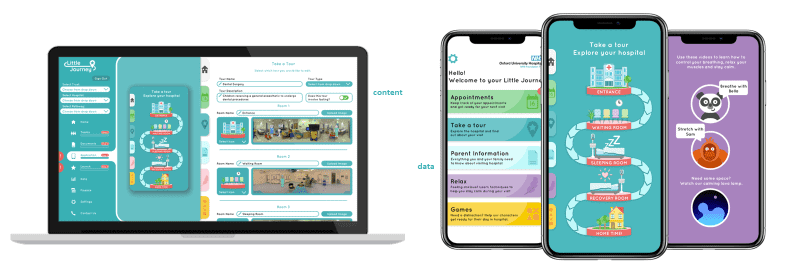
Rationale
Little Journey is an end-to-end digital psychological preparation and support tool for children and their families undergoing a healthcare procedure. Consisting of a patient-facing mobile application (app) and hospital-facing web application (portal) that enables organisations to control the app in real time, Little Journey provides engaging, interactive and age-tailored content to families from the safety of their own home.
Little Journey was founded by Dr Chris Evans – a peri-operative anxiety management expert and NHS England clinical entrepreneur – with the aim of democratising health information. Working closely with key stakeholders, the platform has grown and evolved based on his research and understanding of key stakeholder needs.
Little Journey has been configured to over 50 NHS organisations. A health economic analysis performed at five NHS organisations identified that 71% of patients verbally offered the app went on to use it, with 98% satisfaction. In addition, premedication rates, on-the-day cancellations, recovery times and fasting times were reduced providing cost-benefit to the hospital (£3.50 per pound invested) and society (£6.00 per pound invested).
Little Journey has since expanded to support families undergoing Endoscopy, phlebotomy and COVID swabs. It was accepted onto the NHS Innovation Accelerator program to increase adoption across the NHS.
Planning
The first version of Little Journey was developed and launched in 2018 following an extensive double diamond co-development and design process through informal discussions, focus groups (both parent and Young Person advisory group (YPAGS)), as well as key stakeholder meetings. This version provided an age-tailored virtual reality tour of the rooms’ children would visit on the day of an operation. The storylines, characters and technology itself were assessed through two separate YPAGs.
Following its successful launch, we performed a single-centre usability and acceptability study which identified that parents act as gate keepers of healthcare information. It also identified that parents were using the app independently of their child to enable discussions about what would happen. This led to a second version of the application being co-developed which delivered drip-fed information articles to parents before and after the procedure. After the second versions launch, we held focus with early adopters identifying their desire to:
- create additional information pathways for common procedures such as MRI, Phlebotomy, etc
- collect and report patient reported outcomes for service improvement
- update information in real time
This has led to the significant expansion of our mobile- and web-facing applications to further benefit organisations and families. We have worked closely with organisations before and after launch to achieve ongoing customer success.
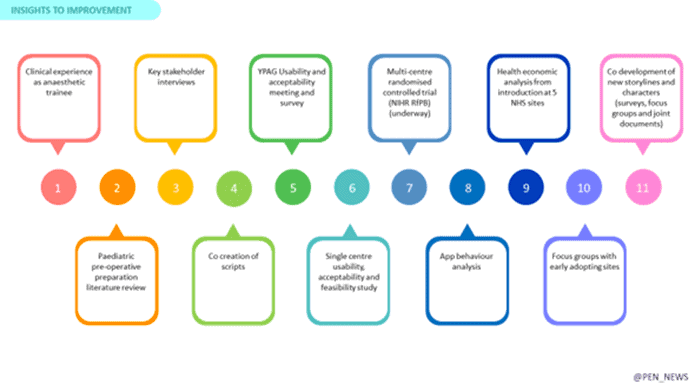
Impact
- Little Journey has been used over 35,000 times with over 350 app store reviews (4.7 rating). 97% of users rate the information provided as good or very good with an average use of 49 minutes and seven sessions.
- Our usability and acceptability study (IRAS number: 223644) surveyed parents of children undergoing ambulatory surgery to assess the usability and acceptability of the application and gain feedback, identifying that 100% of parents either agreed or strongly agreed it helped them talk to their child about the operation, that it helped prepare them for their child’s operation and that they would recommend to a friend before an operation. A follow-on multi-centre randomised controlled trial is currently underway in 10 NHS hospitals (IRAS number: 251219, REC:19/LO/0255).
- An independent health economic analysis assessing the cost-benefit of Little Journey’s introduction at five NHS Hospitals was performed. It identified a cost benefit to hospitals through lowering anxiety (reduction in premedication rates) and improving flow through the hospital (reduction in fasting times by one hour for liquids and two hours for solids, 30% reduction in the time spent in the recovery room and 42% reduction in on-the-day cancellations). Societal benefits were identified through an improvement in family’s quality of life and reduction in missed days of work.
- Belfast children’s hospital reported a 30% reduction in parent perceived anxiety levels in children with Autism and ADHD undergoing daycase dental surgery.
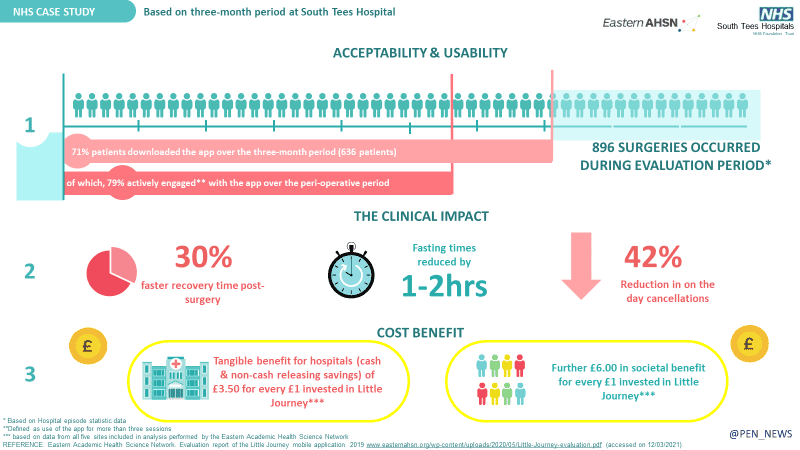
Standing Out
Several patient-facing applications have been created with the aim of preparing children to come to hospital. Typically, they attempt to support children of a single age group over a wide range of procedures using generic, inflexible content with insufficient depth. Little Journey changes this.
Through provision of a solution designed for both children and their parents, Little Journey promotes discussion and learning across the child’s social network, while provision of content over the whole peri-procedure period makes the information digestible and understandable. For children, the delivery of multi-faceted immersive, engaging and age-tailored content from virtual reality tours, therapeutic games and relaxation exercises promotes ongoing engagement and makes the preparation enjoyable.
A core component of Little Journey is the flexible, modular, hospital portal that puts hospitals directly in control. By enabling organisations to configure the mobile application to their local patient pathways, we create a personalised solution to increase engagement. The ability to update content in real time prevents incorrect and out of date information dissemination.
A key element contributing to the success of Little Journey has been its co-design with key stakeholders including children, families and healthcare professionals. Similarly, creating continual learning loops through formal research and real-world evidence has ensured the solution stays relevant and evidence driven. Finally, the pandemic has heightened the need for a digital solution that can be continually updated to support families from the comfort and safety of their own home.
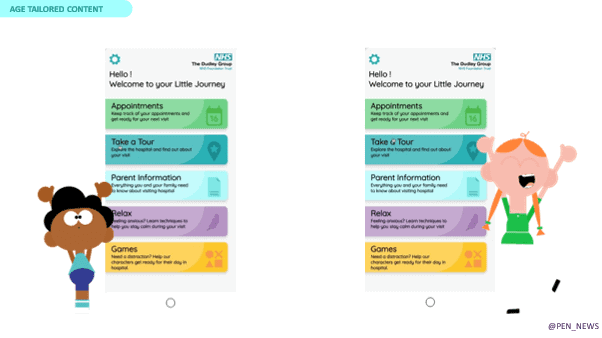
Key Learning Points
- There is no one-size fits all solution and human behaviour requires variation to engage and satisfy everyone. This is particularly relevant when it comes to health behaviours and information preferences to better understand how people will respond to health information.
- Keep co-design at the core and listen
- Combine subject matter experts, healthcare professionals, children and families voices together to create the ideal solution but also identify how this solution should be implemented.
- Focus is often placed solely on the efficacy of the intervention rather than its ability – or the desire – for it to be implemented into routine care, resulting in a research-to-practice gap. Close this gap through implementation science focusing not only on the effectiveness of an intervention but the cost-effectiveness, security, implementation strategy and interoperability.
- Balance the need for accuracy and speed by generating data from both standard clinical trial methodologies and real-world evidence.
- Actively seek the unheard voice to address health inequalities. Young person advisory groups naturally self-select their participants with those with chronic illness, interests in healthcare or healthcare professional relatives. The voice of the person who needs the intervention most is often never heard.
- Continue to seek feedback and learn. Create continual learning loops to iterate and improve the solution. It is never finished.
-
Insight & Partnership Improving Experience for Staff and Patients
Midlands & Lancashire Commissioning Support Unit

Organisation
Midlands and Lancashire Commissioning Support Unit (MLCSU) has 1300 members of staff and provides services to 45 CCGs which include communications and engagement, finance, quality, business intelligence, HR and governance. The total population covered by the CSU is 8.42 million and the commissioning budget is 9.8 billion. Stoke on Trent CCG (SOTCCG) covers a population of 290,000 people and has 52 GP practices and North Staffordshire CCG (NSCCG) has a population of 213,000 with 33 GP practices. Both CCGs are supported by Midlands and Lancashire CSU for their patient experience, insight and involvement support.
General Summary
This initiative is part of a broader initiative that won the commissioning Penna award. 2014 details can be found here: http://www.nhsiq.nhs.uk/news-events/events/pen-awards-webinar-series/pen-award-winners-webinar-6th-october-2015.aspx. The initiative is supported by MLCSU and implemented by SOTCCG and NSCCGS in partnership with local providers, GP surgeries and patients. It takes disparate sources of data across patient experience, clinical effectiveness and safety data and aggregates under standard data sets so that themes and trends can be identified. All data is then reviewed under a subgroup of the quality committee and actions agreed with providers. The success of this initiative has been the engagement from all members of staff across the various organisations embracing the feedback from patients and repointing to it in a spirit of partnership and learning. Its innovative approach is groundbreaking, the clinical leadership across organisations has been inspirational, the outcomes are patient focused and have been aggregated over time, it is sustainable via its process and procedures and the buy-in from staff and patients, and it is eminently transferable as the dissemination from the Stoke on Trent pilot shows. It started in one CCG with 54 practices and transferred to 113 CCGs and over 600 practices as well as other organisations.
Rationale
To provide an opportunity for GPs and practice staff to provide feedback from a clinical and safety perspective on services delivered by local providers and to triangulate this data with patient experience information to create themes and trends to be used or improvement activities and learning. This initiative originally came from the initial enquiry from a commissioning perspective from David Colin Thome into the failures at Mid Staffs in 2009. The Insight database provided by MLCSU had been set up for 12 months, and the CCGs wanted to extend the data from just patient experience to include the other two tenets of quality, clinical effectiveness and safety. In April 2013, the 54 GP practices in Stoke on Trent took part in a pilot that allowed them to feed information directly into a database which would give them access to real-time data triangulated against patient experience so that any themes and trends could be identified. This pilot was then extended to the 33 GP practices covered by North Staffordshire CCG and through this work the local providers of acute, mental health and community care were then engaged in a healthy economy basis to share in the identified themes to action improvement activities.
Planning
The implementation with the GP surgeries and the first CCG involved a face to face meeting that explained the quality strategy and approach and then took the practices through the physical entry into the system. This was then followed up by a face to face on-site session and backed up by phone helpline support. The data was reviewed and calibrated for accuracy, and then the first review meeting took place. Work then began on the implementation at the second CCG and via the practices. From here work commenced with the local providers in engaging them in the learning and improvement ethic and this included acute care – University Hospitals of North Midland, mental health – Combined Healthcare Trust community and social Care – Staffordshire and Stoke on Trent Partnership Trust and parallel work was undertaken with the patient congress to recruit patients to review the data so that there was a full managerial patient and clinical perspective. The appointment of a sustaining sponsor to work with the GP practices was key to the implementation process.
Impact
The initiative has resulted in many changes to practices and has been measured both in terms of numbers of data entered, changes effected as well as changes to culture from the partnership working. Data North Staffs CCG:
- Events, clinical effectiveness and safety – total number of records 813 from 06/08/12 to 02/12/15
- Outcome recorded 353 (44%)
- Action recorded 532 (65.4%)
- Feedback- patient experience total number of records 1988 from 13/3/12 to 2/12/15
- Outcome recorded 1951 (98.1%)
Stoke CCG:
- Events – Clinical effectiveness and safety – total 1563 records from 28/02/2013 to 01/12/2015
- Action recorded = 1207 (77.2%)
- Outcome recorded =966 (61.8%)
- Feedback total �patient experience – 2425 records from 02/04/2012 to 30/11/2015
- All 2425 records have an outcome
Year on year increases in reporting numbers and actions
Areas identified for improvement activities include:
- Radiology
- Obstetrics and gynaecology
- District nursing
- Ears syringing in the community
- Implementation of gold faxes
- Changes to policies on missed appointment
- Referral issues
- Notification of patient deaths
- Changes to blood testing procedures
Consistently the areas of reporting are emergency admission and discharges, and the sub-themes are medications, safe, high quality care. Culture – The establishment of a subcommittee of the quality committee to review the data, agree actions and feedback to the individual practices ensures ongoing staff engagement. The actions are then reported directly to the board by the PI lay members. All providers have their own login to the system and can update directly on RCAs, action plans improvements and all of the information is auditable via the system. Each month the CCG quality lead and the governance manager from the acute hospital review the themes and trends and any outstanding actions. The community providers review every incident and patient experience feedback that is reported, and they feedback within 24 hours and the mental health provider reviews all incidents at the time for reporting, although the relative numbers for mental health are low. The change from assurance to learning has also meant that the providers have now started to report back issues from a primary care perspective. Consistently 60% of the 85 practices report on a monthly basis, and the average reporting is 300 per month.
Standing Out
- It is a holistic approach to collating, aggregating and triangulation of the three tenets of quality to identify opportunities to improve and make services better for patients
- It has a reach across 85 GP practices, condition support groups and three main providers
- It is partnership between MLCSU, SOTCCG, and NSCCG working in partnership across the health economy with the providers of all main services including NHSE
- It is led by staff from each of the partner organisations who all bring a slightly different perspective to the review process
- Patients are integral to the review process
- It implements many of the approaches recommended within the Francis report
- It listens and responds to the concerns of staff and patients
- It involves working in partnership with patients to identify what they require from involvement and how the existing structures could be incorporated to ensure the maximum effect
- It involves working closely with commissioning managers and clinical leads to ensure that the involvement meets the requirements and is embedded from practice to board level and throughout the commissioning cycle
- The potential for creating a cross health economy approach to insight and involvement which overcomes the perceived barrier between patient involvement with commissioner and provider
- The divide between commissioner and provider is a myth, we all interact and need the feedback of the same patients in order to take a patient centred approach
- Communication is key at each stage of the implementation in relation to changes in practice, process and procedure
Key Learning Points
- Good clinical leadership � engage with the practices and work with them to find benefits for them
- Appoint an initiating sponsor at the start of the work programme who can authorise and endorse the process
- Back up your initiating sponsor with a sustaining sponsor who acts as a champion, engaging the people who embrace the process and helps unblock any issues, real or perceived
- Make sure that your database and your technical team are customer focussed and will work with the customer to co-produce solutions
- Engage with your providers and ensure that they are able to learn from the feedback and work with a quality improvement approach
- Providers and commissioners can work in partnership with patients to make changes and implement learning
- Reviewing the data with GPs, nurses, safeguarding leads, managers and patients to give everyone the opportunity to have an input and shape the outcomes.
- Providing systemic feedback to providers in a systematic way ensures changes for patients.
- Commitment and tenacity
- Clear outcomes and realistic timescales
- Obtaining the input of the staff that will use the data to codesign the system
- Making use of systems that are already in place and amending them to suit the needs of the project
- Exploring the places where soft intelligence is available and providing an intuitive system to allow multiple inputs in a simple way
- Tackle a big project one step at a time, communicating along the way.
Case Study Resources
Download the Presentation Here! -
Me First : Children and Young People Centred Communication
Common Room in Partnership with Great Ormond Street Hospital for Children

Organisation
Common Room is a consultancy led by people with lived experience. We promote collaborative practice and turn children and young people’s lived experience into person-centred service, policy and practice improvements across disability, health and mental health. Common Room has a small team of three, including the Director, as well as a team of 8 paid young advisors who have lived experience of disability, long term health conditions or mental health issues who work in partnership with us to co-develop and co-deliver our projects and work streams.
Our work aims to:
-Find the best ways of involving children and young people in decisions about their lives, treatment, support and services
-Find the best ways of responding to and supporting children and young people with the issues they experience.
-Support young people to be partners in research, policy, and service improvement programmes
-Research and understand the views and lived experience of young people, families, and practitioners about the issues that affect them.
Common Room works in partnership with or is commissioned by a number of leading organisations including the Anna Freud Centre, National Children’s Bureau, Great Ormond Street Hospital, NHS England, Council for Disabled Children, Child Outcomes Research Consortium, amongst others.
General Summary
Me first is the first healthcare communication model designed specifically for and with children and young people; it has the potential to make a significant difference to children and young people’s experience and health outcomes. Children and young people’s involvement in designing, developing, and delivering all aspects of Me first has been the single most important driver for the success of the project.
Me first is an innovative education package to improve communication between children, young people (CYP) and healthcare professionals. Me first aims to improve health outcomes for CYP by enhancing the knowledge, skills and confidence of healthcare professionals (HCP) in communicating with CYP. Crucially, all of the resources have been co-developed with CYP and have a strong evidence base in research. The centrepiece of the project is the Me first CYP centred communication model – the first designed specifically for and with CYP. The Me first masterclasses and mefirst.org.uk help HCPs to build on their existing expertise and apply the Me first communication model to their clinical practice. Co-delivered with young people, the masterclasses use quality improvement techniques to ensure the learning makes a lasting impact on practice. The emerging findings from our independent evaluation are showing a lasting impact on the communication skills of participants. A core aim of Me first is to ensure that the model, resources and learning apply to and can be adopted by all healthcare areas and services. We are determined to transcend organisational boundaries and develop education resources that make a difference to professional practice and to the experience of children and young people across the UK.
Rationale
‘I should be the one involved in decisions because it’s my body’
‘When they talk to my parents, it feels like they’re the one with the condition, not me.’
Improving communication and decision making in healthcare is an issue consistently highlighted by CYP as a priority. 43% 12-15 years olds said they were not involved in decisions about their care, with CYP with long term conditions more likely to have poor experiences of communication, including not feeling listened too. The HEE mandate is clear that improved training in communicating and involving children and young people in decisions about their care has a significant part to play in improving their health. Me first seeks to improve health outcomes for children and young people through the delivery of an education programme and resources designed to enhance the knowledge, skills and confidence of healthcare professionals in relation to communicating with children and young people. The primary audience for Me first is healthcare professionals and healthcare support workers working in predominantly adult settings, who will come into contact with children and young people in the course of their work. However, we have learnt from the pilot phase that members of the children’s healthcare workforce have also found the resources useful in their own practice, in addition to supporting the development of good communication practice with trainee healthcare professionals or non-paediatric colleagues.
Planning
Partnership working has been the foundation of Me first. Funded by Health Education North Central and East London (HENCEL), Me first has been developed by Common Room and Great Ormond Street Hospital with the support of Birmingham Children�s Hospital Young Peoples Advisory Group (YPAG), East & North Hertfordshire NHS Trust, Dr Cathy Street & Associates, Evidence Based Practice Unit (UCL and the Anna Freud Centre), and Nutshell Communications. Following a review of the research, we held a national stakeholder event and also undertook extensive interviews with professionals experienced at working with CYP from a range of backgrounds, and with CYP with experience of healthcare, in order to gather evidence and top tips for use in practice and to ensure the project was informed by and worked across disciplines.
We worked with a team of young advisors to synthesize this and co-develop the full range of resources, including:
-The Me first communication model, which provides a practical framework to support children and young people-centred conversations in healthcare. We believe this is the first healthcare communication model of its kind, designed for and with children and young people.
-The Me first website (mefirst.org.uk) contains an interactive communication model to enable healthcare professionals to build their own conversations and apply the model to their practice; a resource hub, which enables users to share tools, projects, and ideas from throughout the UK; and practical advice and tips from children, young people, and healthcare professionals about how to put the model into practice.
-The Me first masterclasses, which are co-delivered with young people and support healthcare professionals to apply the Me first communication model to their practice. The training builds on attendees existing skills and expertise, and utilises quality improvement techniques to enable healthcare staff to embed learning in their clinical practice. The resources were developed and piloted, before being rolled out nationally in 2015.
Impact
The Me first project has been hugely successful. In 10 months we have trained over 200 healthcare professionals, with 100% of participants rating the training and resources as good or excellent. The Me first masterclasses have been independently evaluated by the Evidence Based Practice Unit (Anna Freud Centre and UCL), with emerging findings showing improvements in professionals exploratory listening, consensus-oriented listening and receptive listening after the masterclass. All of the professionals interviewed are now using what they learnt in their practice to make care more collaborative and young person centred.
Attendees of the masterclass have said:
‘The training has inspired me to make changes to my own practice and the department I work in.’
‘Excellent course. Very useful having all different professionals present to get a variety of perspectives and ideas.’
‘The day was engaging and creative, with a mix of different activities and time for reflection. We not only learnt the principles of CYP centred communication but how to apply them within our own specialities and practices. A rare and much needed course, I would highly recommend this to any professional working with CYP.’
Comments on our twitter #CYPMefirst include:
‘It really is excellent, I am genuinely very excited and feel this is part of the solution to so many common themes raised by our young people. Top work! It is up to us to now get using it locally.’ Karen Higgins, Young Health Champions Project Manager, Shropshire CCG
‘Just wanted to say I love everything about Me First it’s exactly what we need!. Go team Me first!’ Young Person
Relevance to Others
Improving communication and decision-making with children and young people has significant benefits across healthcare, including reducing fear, anxiety, and resistance, increasing adherence to treatment, and improving health outcomes. Thus, from the outset, the aim has been to develop a model and resources that can support CYP-centred communication across the full range of healthcare roles, professions, and services.
To achieve this we have:
-Developed the communication model, training, and resources based on extensive interviews with practitioners across a wide range of healthcare professions and services to ensure applicability and acceptability.
-Resource section and website are free and promoted nationally to ensure they are widely accessible to healthcare professionals across England. Submitting funding bids for two impact studies in partnership with other organisations to explore and evidence the impact of Me first.
-Seeking endorsement from Royal Colleges to increase the perceived relevance of Me first for specific professional groups.
Case Study Resources
Download the Me First Presentation Here! -
DISCOVER! Engagement Programme
The Partnership Commissioning Unit
Organisation
The Partnership Commissioning Unit (PCU) is a NHS shared service arrangement across the four North Yorkshire CCGs (Hambleton, Richmondshire & Whitby CCG, Harrogate & Rural District CCG, Scarborough & Ryedale CCG and Vale of York CCG) covering a total of 3,341 square miles.
The PCU incorporates Case Management (Continuing Healthcare, Funded Nursing Care and Mental Health & Vulnerable Adults), Adult Safeguarding, commissioning teams for Mental Health & Vulnerable Adults and Children, Young People & Maternity Services and a Contracting & Finance team. Our offices are in York and 91 members of staff work in the unit covering clinical, administrative and managerial roles. We commission services to the value of circa £100 million and work in close partnership with North Yorkshire County Council and the City of York Council.
General Summary
DISCOVER! is an engagement tool designed by the PCU to support the commissioning of mental health services in North Yorkshire and York. DISCOVER! asks a critical question of anyone who has an interest in the provision of mental health services (service users/carers, NHS/local government organisations, voluntary partners, and local communities) ‘What is your best experience of mental health services and how can we do more of that?’
DISCOVER! was developed in response to two important aspects of our commissioning responsibility; to find out what really matters to service users/carers about their mental health support, and to build the practice (ways of thinking/being/doing) of commissioning teams across our four North Yorkshire and York CCGs to engage with service users and communities in a meaningful way.
DISCOVER! is based on the principles of Appreciative Inquiry (AI)[1] a highly engaging, sense-making tool which inquires into what works well in any given situation and uses that as evidence to build strategies for change. DISCOVER! is based on the first stage of AI, which uses stories from people’s personal experience to draw out good practice that can be used for future planning.
Rationale
Vale of York CCG was re-tendering its mental health contract and all four CCGs were keen to find new ways of engaging with service user/partners. The PCU made a decision to connect with service users who do not usually have a voice by adopting an inclusive approach which purposefully started from their perspective. The view from many service users is that they are often asked to consider an answer rather than being asked an open question about what matters to them. Staff similarly had developed ways of working which started from organisational perspectives. We wanted to create new ways of relating and to develop thinking about co-design and shared-ownership of commissioning services. Our aspiration is a sustainable environment for engagement based on appreciative and collaborative relationships, rather than asking specific questions about individual consultations. This initiative is lead by the PCU’s Director and senior managers with support from senior staff in the CCGs.
An outcome involved the Vale of York CCG’s re-tendering of its mental health contract; this provided a great opportunity to build comments/feedback from service users into the specification.
Planning
The key elements of the DISCOVER! process are:
- A launch event and development day to introduce DISCOVER! to anyone who has an interest in the commissioning of mental health services including service users/carers. The aim is to make clear ‘the offer and the ask’ of DISCOVER! and to generate energy/commitment across a shared group of stakeholders. The ‘offer’ is an AI training day to develop understanding of the tool, whilst the ‘ask’ is for participants to use the AI approach to host conversations about the DISCOVER! question in their own sphere of influence – e.g. GP surgery, family home, community group, local shops.
- DISCOVER! Conversations – participants from the launch took the process into their communities/organisations and asked the DISCOVER! question to everyone they met; sometimes through AI events. The intelligence from the question was fed back to the PCU.
- World Cafe Conversations[2] – these PCU-facilitated events were held in a range of settings and focused on different aspects of mental health commissioning, e.g. adult mental health, dementia, learning disabilities, children’s and adolescent mental health services. The World Cafe conversations attempted to create an informal cafe environment, rather than a formal meeting and encouraged the kind of conversation where friends might gather to have coffee to talk about whatever mattered to them about mental health. The intelligence from the cafes was fed into the knowledge capture process.
- Knowledge Capture – a range of vehicles were utilised for feeding back and distilling peoples’ experience of mental health services, including the @PCUDiscover Twitter account and a dedicated email address. A particular innovation which exemplified the participatory and purposeful nature of programme was the DISCOVER! postcard designed by Laurie, a mental health service user, as his response to the AI ‘ask’. Laurie’s contribution was to design a communication tool which would allow anyone to write their response to the DISCOVER! question to be included in the feedback.
- Open Space and Feedback – the information was analysed, gathered into themes and then fed back to all stakeholders at an Open Space event[3]. The aim was to refine themes/principles which would be used to underpin the commissioning of services. This allows for an iterative on-going process of engagement.
Impact
Impact on commissioning of mental health services – in the Vale of York CCG the DISCOVER! themes/principles had a direct relationship to the development of new service specifications for the re-procurement of the main mental health contract. In the three North Yorkshire CCGs this will be used to inform ongoing conversations with providers about the kind of services required. A repeated theme was the role of service users/families in decision-making, which has led to a request from the CCG/PCU for HealthWatch to recruit two service users to be part of the interview/decision-making panel for the mental health provider for the Vale of York. Similarly, a powerful message from service users was that mental health services are the smallest part of what works well about living with mental health, and that families/communities/community-based organisations are the most important enablers of living well with mental illness. There is now a clear steer in the commissioning specification about how providers will work with families/community-based organisations to support people with mental illness.
A significant impact of DISCOVER! was the development of the thinking and practice of staff about how to work with service users/communities. The process consciously set out to challenge assumptions about engagement as a consultation tick-box exercise in which staff have no views and simply listen to service users without disclosing the givens and realities of the issue being discussed (and then often ignore what is said!). Instead, DISCOVER! encouraged staff to share their views about what was important in a more collaborative dialogue with service users. This enabled the dilemmas of how to provide high quality services against the backdrop of financial constraints to become a shared challenge for dialogue between commissioners/providers/service users. This approach contrasts with many NHS consultations in which the challenges or knowledge about what is possible are not openly discussed. DISCOVER! encouraged and set the conditions for an open conversation about these issues and enabled a genuinely collaborative approach to emerge based on mutual interests and a shared vision for what ‘good’ might realistically look like.
This was underpinned by a development process to embed a more collaborative, sense making mindset amongst staff, which will continue beyond the current dialogue about mental health services, and has been incorporated into our ongoing engagement strategy. The AI training and review of experience was particularly useful in supporting behaviour change. Staff were encouraged to base their relationships with service users on the principle of asking questions which seek to understand what is important from the perspective of the other and to keep reviewing their learning. This approach marks a significant culture change for NHS staff and builds on the current post-Francis policy directives (reinforced in Simon Stephens’ 5 year Plan for the NHS Chapter 2) to develop a new kind of relationship with service users/communities which puts their needs, rather than organisational needs, at the heart of decision-making.
Standing Out
- – Shared ownership between commissioners/stakeholders of the principles for future commissioning of mental health in North Yorkshire.
- – An appreciative and inclusive engagement approach starting from the perspective/needs of service users.
- – Recognition of the need to enable staff to develop new ways of working and thinking rather than assuming building a new kind of relationship is easy.
- – Dedicated capacity to lead the programme.
- – Feedback given to everyone who attended the events and we were clear about what we would do with the data gathered e.g. procurement process for Vale of York CCG.
- – Learning about what works well explicitly shaped commissioning decisions
- – Opportunity for intelligence to form part of JNSA in City of York Council.
- – Service users have been part of the delivery team (co-production model), providers/commissioners/service users have all learnt from each other.
- – Participants were equipped with AI skills to facilitate conversations within their local
Key Learning Points
DISCOVER! is an evolving process. We have learnt from the highlights and challenges we have encountered:
- The flexibility of the process and clarity of our critical question enables people to join the process at different stages, in ways that suit them. Its design is inclusive.
- The focus on mental health services was appreciated by everyone involved and asking our critical question from an AI perspective generated positive and genuine conversations/debates across and between local communities.
- Initially we struggled to reach beyond organisational agendas as AI proved to be a challenge in terms of organisational cultures. However, DISCOVER! focuses on the positive experiences of a diverse range of service users. Therefore it is a valuable mechanism in creating a vision for mental health services.
- Being part of the DISCOVER! process can be personally challenging for service users/their families/carers. This can raise immediate and live issues that need to be addressed.
- The DISCOVER! postcard was a fantastic symbol of what we wanted to achieve.
- We have been asked to share this model across the other NHS/local government organisations. The approach has been included in the National Systems Leadership Forum’s forthcoming Total Place 2 guide on how to lead system change. This will enable our experience to be disseminated across communities, and NHS and local government partnerships in the UK.
[1] The Appreciative Inquiry Handbook, 2008 by David Cooperrider, Diana Whitney, Jaqueline Stavros
[2] The World cafe � drawn from the world caf� tool kit – Juanita Brown
[3] Open Space Technology � Harrison Owen
Case Study Resources
Download the DISCOVER presentation Here! -
Staff Engagement the WWL Way
Wrightington, Wigan and Leigh NHS Foundation Trust
Organisation
Wrightington, Wigan and Leigh NHS Foundation Trust is a major acute trust serving the people of Wigan and Leigh. Innovative and forward thinking, the trust is dedicated to providing the best possible healthcare for the local population in the Wigan Borough and surrounding areas.
The Trust aims to continuously provide safe and good quality care to all patients. Over 220 million is spent each year on a diverse range of reputable general and specialist acute services.
The Trust has three hospital sites, a state-of-the-art outpatient’s centre, a dedicated Ophthalmology centre and offices located at Buckingham Row in Wigan town centre. The Trust employs approximately 5000 staff.
General Summary
The ‘WWL Way; is a vision for understanding, implementing and embedding sustainable staff engagement in Wrightington, Wigan and Leigh NHS Foundation Trust (WWL). It has grown out of a long history of successful staff engagement initiatives that have delivered positive outcomes to staff and patient care, and has developed into an evidence-based measurable pathway model and robust strategy for staff engagement.
Our long term objective is to embed a sustainable positive organisational culture, through strong leadership and by giving staff at all levels the information, tools and encouragement they need to self-sufficiently enhance engagement throughout WWL. Our forward-thinking approach to staff engagement has already received national attention because of our ‘gold standard example of a systemic and sustainable programme to improve staff engagement and satisfaction’ (HPMA). We believe our approach has the transferability to make a huge impact on the wider NHS.
The WWL Way has created a framework to continuously measure and improve engagement, identifying specifically the factors that are enabling engagement at Trust level or at a team level. Not only that, it directs staff and the Trust towards the right tools to address specific staff engagement needs, creating a bespoke solution as opposed to ‘one size fits all’. In addition, strong leadership and staff side sponsorship and consistent communication has ensured the WWL Way has become ‘the way we do things’ and an authentic approach as opposed to a tick box exercise. The difference the WWL Way has made to patient care, quality and experience has been extremely encouraging.
Rationale
Our staff engagement journey evolved over 15 years and included the following three distinct initiatives:
- Staff Involvement Delivers (SID) – a partnership between Human Resources and Staff Side. Conversations with Directors events allowed staff to raise issues important to them and walkabouts gave Directors the opportunity to integrate with staff at the front line.
- Listening into Action (LiA) – In 2011 we undertook the NHS national staff survey, resulting in scores below average on 55.3% staff engagement measures and only above average on 21% of measures. LiA further energised staff engagement, giving a greater focus on making quick-win and bigger system changes, aligned to the needs of staff. LiA encouraged staff to run their own listening events and local level changes.
- Our partnership with Unipart – Lean ways of working through team communication cells, visual management tools and a strong emphasis on metrics and devolved problem-solving.
Practical application of these tools can be observed at the following link: http://www.youtube.com/watch?v=lTNZCdfMKV4
We needed a joined up approach where all initiatives were accessible as tools to all staff, and used in the appropriate places. We also needed to understand how these tools were influencing the cultural conditions at WWL e.g. what was the cause and effect? By knowing this we could understand and regularly measure their impact, to create a continuous improvement approach to staff engagement.
Planning

In mid-2013 we combined the three initiatives to create our own unique brand of staff engagement ‘the WWL Way’. We created a new Staff Engagement Pathway model underpinned by research/theory – a framework for understanding staff engagement more deeply, by gauging levels of staff engagement, and identifying several factors that help us better understand what enables improved staff engagement. The framework focuses on nine staff engagement enablers as well as staff engagement feelings and behaviours.
Practical Application

Our validated ‘WWL Way’ quarterly diagnostic survey and extensive engagement toolkit are now used together both at Trust and Team level, to measure, track and continuously improve the enablers of staff engagement and ultimately our organisation’s performance.
Our Staff Engagement Pioneer Teams 26 week Programme allows teams to use the survey to identify their specific engagement needs. Our new ‘WWL Way toolkit integrates our initial trio of initiatives into eight staff engagement tools. It offers a choice of solutions to apply locally, avoiding a ‘one size fits all’ approach. The Programme helps teams feel empowered to engage in, and offer up, service improvements through their own initiative.
Who Made it Happen?
- Chief Executive and Directors – Acted as Engagement Sponsors, there to build excitement, be authentic, harness the WWL community and emphasise the significance of staff engagement.
- Staff Side – worked in partnership to bring honesty and openness to staff engagement and also encourage and mobilise staff engagement activity at all levels.
- Staff Engagement Team – Develop and Deliver the WWL pathway framework, diagnostics, staff engagement toolkit and Trust Wide Engagement Activities.
- Staff Engagement Champions – Advocates and sponsors of staff engagement activities, guiding and supporting staff engagement teams at every step.
The following video explains more: http://www.youtube.com/watch?v=Zrq0m2nY1Q4&feature=youtu.be
Impact

In 2012 we saw major improvements in our national staff survey results. Above average scores increased by 64% from 2011, and increased again by another 15% in 2013. During this period we saw significant reductions in sickness absence (down from 4.62% in April 2012 to 4.17% in Dec 2013) and expenditure of temporary staffing (down from 15 million in 2011/2012 to 12 million in 2012/2013).
In 2014 we have seen continued improvement in our Trust-wide engagement scores as a result of a range of organisational activities aimed at addressing development needs identified through our quarterly staff engagement survey. We have seen significant improvement in two particular engagement enablers: Trust (staff feeling trusted and empowered) and Working Relationships (staff feeling supported). These improvements have been supported by proactive work to develop our leadership skills, extending the use of communication cells and listening to staff. As a result we have seen significant improvements in staff advocacy (staff recommending the Trust as a place to work and a place to be treated) which has risen by 14% since January 14. We have also ranked 22nd out of 241 Trusts in the 2014 Staff Friends and Family test results (released November 14), compared to 54th place in 2013.
We have seen a 7% overall improvement in engagement collectively amongst teams, one of which improved by 25% over six months. This was all measured and achieved through our staff engagement pathway framework, and the hard work of our own staff to take ownership and action.
Staff engagement has also enabled us to achieve Quality and Safety Improvement between 2007/08 and 2013/14:
- Reducing mortality rates (HSRM) 126 to 87
- (annual actual deaths in hospital falling by 30% in the same period)
- C-DIFF incidences 373 to 26
- MRSA reduction 39 to 1
Staff engagement has also influenced our patient experience:
- Top 25% in the annual patient survey.
- Friends and Family Test: Consistently the highest scoring A&E Department in Greater Manchester, Second in Greater Manchester for our inpatient quality.
- WWL received recent national notoriety when our bereavement staff went the extra mile to enable a dying patient to see her horse for the last time. This was an example of engaged staff going above and beyond to enhance patient experience and deliver compassionate care.
Key Learning Points
- Buy-in. We ensured strong visibility and promotion of our staff engagement the WWL Way and its initiatives, gaining senior leaders commitment and sponsorship, and acting at scale.
- We established a partnership approach between staff side and management, working together towards mutual staff engagement goals.
- We acted and communicated quickly following listening events, providing regular feedback through a You Said, We Did approach.
- We acknowledged that staff engagement can be enabled in many ways, from how we recognise and value staff, to the way we involve staff in decisions, to the way we build motivation and morale.
- Every Day Enactment. We always ask the question have we asked our staff? We are seeing a cultural shift from our leadership, in that they are beginning to make more informed and collaborative decisions with greater staff involvement.


